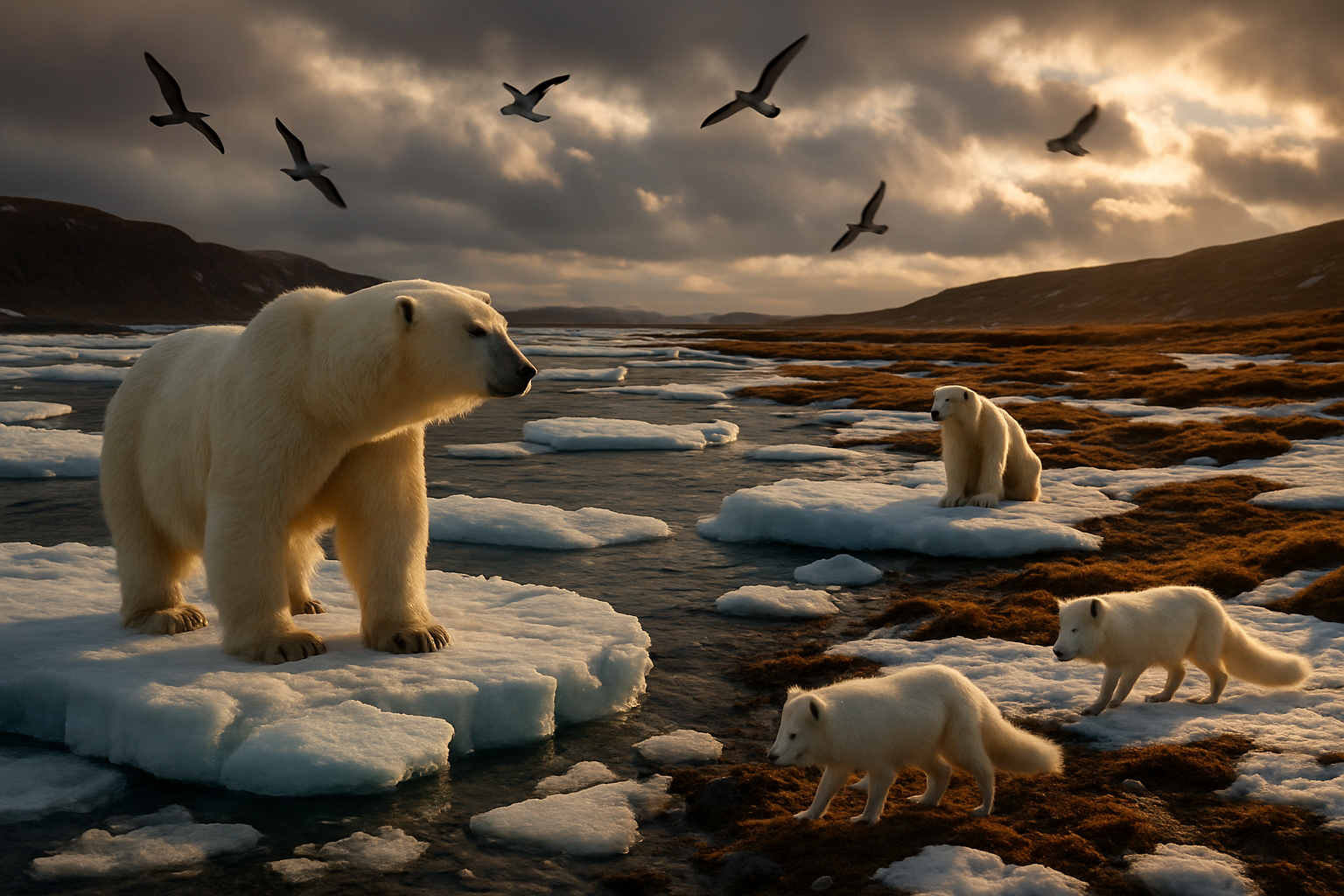
Arctic wildlife conservation efforts have reached a critical juncture as environmental protection initiatives race against accelerating climate change, with the planet experiencing an unprecedented 23rd consecutive month of temperatures exceeding 1.5°C above pre-industrial levels—the longest sustained warming streak in recorded history.
The Arctic region, warming at twice the global average, has become ground zero for one of the most urgent conservation challenges of our time. Arctic wildlife populations have plummeted 60% over the past decade as traditional habitats disappear beneath their feet—literally and figuratively. Traditional spawning grounds in the North Atlantic are shifting hundreds of kilometers northward as ocean temperatures rise, leaving coastal communities facing both ecological and economic devastation.
Emperor Penguins: Canaries in the Coal Mine
The International Union for Conservation of Nature (IUCN) officially declared emperor penguins endangered as Antarctic sea ice becomes increasingly fragile, literally breaking under the weight of colonies during traditional nesting seasons. French Antarctic research has documented unprecedented challenges as breeding grounds become unreliable, with ice platforms essential for the birds' five-month development period before entering the Southern Ocean proving unstable.
Dr. Christophe Barbraud of the French Antarctic Research Program confirms "a complete breakdown of a system that has functioned for millennia." The Antarctic Peninsula is experiencing the fastest warming on Earth, threatening not just penguins but the entire polar ecosystem that has evolved over thousands of years.
"We're witnessing the collapse of ice-dependent breeding systems that emperor penguins have relied upon for generations. The birds require stable ice for nearly half a year, but that stability no longer exists."
— Dr. Christophe Barbraud, French Antarctic Research Program
Arctic Fox and Marine Ecosystems Under Pressure
In Norway, the critically endangered Arctic fox (Vulpes lagopus) faces mounting pressure as climate change enables red fox range expansion northward into traditional Arctic territory. With populations at critically low levels throughout Europe, every individual Arctic fox represents a precious genetic resource. Norwegian authorities have issued hunter advisories emphasizing extreme caution, as the species enjoys complete legal protection while facing an existential threat from warming temperatures.
The crisis extends beyond terrestrial species to marine ecosystems. Norwegian Arctic marine populations have declined dramatically as ocean warming reaches record levels, disrupting traditional food webs and migration patterns that have sustained Arctic life for millennia.
Technology Meets Traditional Knowledge
Modern Arctic conservation represents a sophisticated evolution combining cutting-edge technology with traditional ecological knowledge. Advanced environmental DNA sampling, satellite monitoring, and AI-powered threat detection now work alongside generations of indigenous wisdom about Arctic ecosystem rhythms and animal behavior patterns.
This integration has become fundamental to conservation methodology, moving beyond purely technological or traditional approaches toward comprehensive frameworks that combine scientific rigor with cultural sensitivity and community ownership of conservation initiatives.

Conservation Renaissance Emerges
Despite the mounting challenges, 2026 has witnessed what conservationists are calling a "global conservation renaissance"—unprecedented coordinated international wildlife protection efforts during Earth's most challenging environmental period. Recent successes demonstrate that well-designed programs can achieve remarkable results even under extreme environmental stress.
The evolution represents a fundamental shift from reactive crisis management to proactive ecosystem service management, emphasizing community participation, technological integration, and economic viability as essential components of sustainable conservation.
Economic Dimensions of Arctic Protection
Environmental protection increasingly functions as an economic development strategy rather than a regulatory burden. Arctic conservation supports eco-tourism industries worth hundreds of millions annually, attracts international research partnerships, and positions nations as leaders in environmental stewardship—credentials that enhance competitiveness for sustainable investment.
Economic analyses consistently show that environmental degradation costs—including healthcare impacts from pollution, infrastructure damage from extreme weather, and tourism losses from ecosystem destruction—far exceed the investments required for proactive conservation protection.
International Cooperation: A Necessity, Not an Option
Arctic wildlife conservation transcends political boundaries through ocean currents, atmospheric systems, and species migrations that connect ecosystems globally. Success requires unprecedented coordination, as unilateral efforts prove insufficient against challenges that span continents and ocean basins.
The diversity of conservation approaches provides resilience against single-solution dependencies, offering multiple adaptation pathways for addressing complex, interconnected environmental challenges. Knowledge sharing creates global networks that strengthen local capacity while contributing to planetary sustainability goals.
Critical Implementation Challenges
Funding sustainability remains critical for developing nations where immediate economic pressures often override long-term environmental considerations. Technical capacity building requires sustained investment in education, training, and institutional development. Climate change continues to disrupt project timelines, demanding adaptive management approaches that can respond to rapidly changing conditions.
- Community ownership and engagement in conservation decisions
- Transparent governance frameworks that ensure accountability
- Economic incentives that make protection financially viable
- Integration of traditional ecological knowledge with modern conservation science
The Narrowing Window for Action
April 2026 represents a critical juncture in global environmental protection—a choice between reactive crisis management and proactive ecosystem service management that will determine whether conservation efforts can keep pace with accelerating environmental change during this decisive climate action decade.
Environmental scientists warn that the action window is narrowing rapidly as ecological systems approach critical thresholds that could trigger potentially irreversible changes affecting global food security, climate stability, and human settlements. The tools, knowledge, and cooperation frameworks exist for comprehensive protection, but success depends on sustained international cooperation, enhanced coordination, and financial commitments that recognize environmental protection as essential infrastructure for human prosperity and planetary sustainability.
"We're at a crossroads where the choices we make in 2026 will determine the fate of Arctic ecosystems for generations. The window for effective action is closing, but we still have the opportunity to prevent irreversible collapse."
— International Conservation Coordination Committee
Hope Through Innovation and Coordination
The convergence of technological innovation, international cooperation, and political commitment offers hope for maintaining Arctic biodiversity during this unprecedented environmental challenge period. Conservation initiatives across multiple continents demonstrate humanity's growing capacity to protect essential natural systems under extreme environmental stress.
Success in Arctic wildlife conservation during 2026 could prove decisive for conservation approaches in the decades ahead, influencing global biodiversity protection, climate adaptation strategies, and sustainable development policies for generations to come. The integration of cutting-edge technology with traditional ecological wisdom creates adaptable frameworks that respect cultural diversity while leveraging global capabilities for maximum conservation impact.
The fate of Arctic wildlife—from emperor penguins to Arctic foxes, from polar bears to marine mammals—hangs in the balance. Their survival depends on humanity's ability to organize and implement solutions rapidly enough to match the pace of environmental change, protecting the natural systems upon which all life depends during Earth's most challenging environmental period in recorded history.