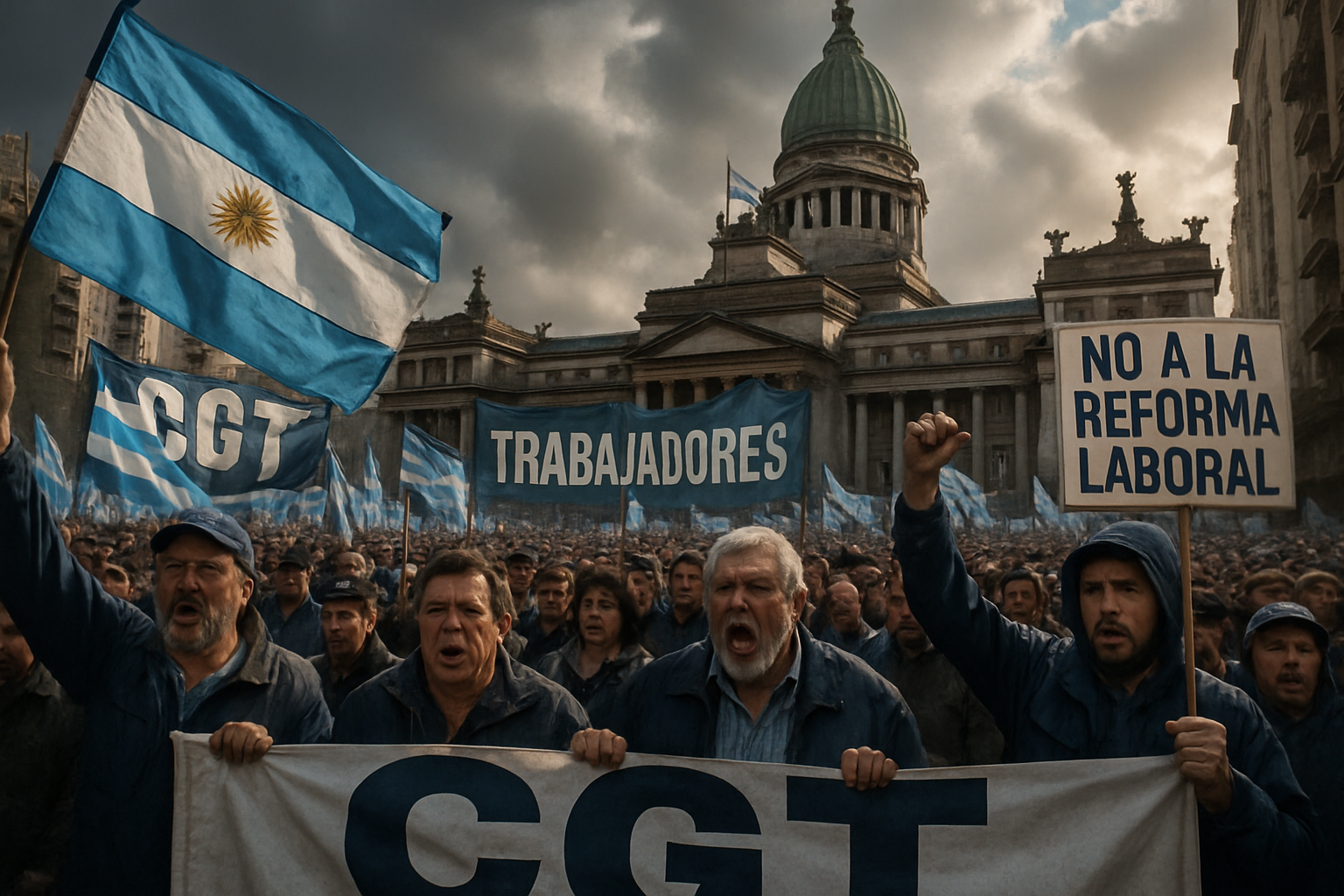
Argentina's General Confederation of Labor (CGT) led massive protests across Buenos Aires on February 11, 2026, as the Senate prepared to debate President Javier Milei's controversial labor reform legislation, with federal security forces implementing unprecedented anti-protest protocols.
The CGT, Argentina's largest labor confederation, convened demonstrations starting at 2:00 PM in the vicinity of the National Congress, where senators were scheduled to begin deliberations on the government's comprehensive labor reform package at 11:00 AM. The mobilization drew support from multiple labor organizations, political groups, and social movements opposing what they characterize as an assault on workers' rights.
Coalition of Opposition Forces
Beyond the CGT's core membership, the protests united diverse opposition forces including both branches of the Workers' Central of Argentina (CTA), various social movements, and the Left Front coalition. The Kirchnerist group La Cámpora organized its militants to march from Montevideo and Rivadavia, while Governor Axel Kicillof's Derecho al Futuro Movement called for mobilization "in defense of workers' rights" from the Mothers of Plaza de Mayo house.
Notably absent from the protest organization was a traditional speakers' platform or formal oratory program, signaling the CGT's emphasis on mass participation over political rhetoric. This strategic decision reflected the union confederation's focus on demonstrating numerical strength rather than engaging in partisan political discourse.
Government Security Response
The Milei administration implemented what sources described as "a strong security operation" with federal forces deployed to maintain circulation throughout Buenos Aires. The government's approach reflected lessons learned from previous labor confrontations and concerns about potential disruptions during the critical Senate session.
The timing of the protests coincided precisely with the Senate's scheduled 11:00 AM debate on the labor reform bill, creating a dramatic backdrop of street demonstrations outside the legislative chamber where lawmakers would determine the fate of Argentina's employment framework.
Anti-Protest Protocol Implementation
The demonstrations unfolded under the shadow of the government's controversial "anti-protest protocol," which has drawn criticism from civil liberties advocates and opposition political leaders. Federal authorities confirmed their intention to ensure traffic flow and maintain public order, though specific enforcement details remained closely guarded ahead of the mobilization.
This represents the first major test of the Milei administration's crowd control policies since taking office, as labor leaders promised one of the largest worker demonstrations in recent Argentine history.
Legislative Context and Reform Details
The labor reform legislation reaching the Senate represents a significantly modified version of the government's original proposals, with Interior Minister Patricia Bullrich having altered over 30 articles to secure support from the Radical Civic Union (UCR). These negotiations demonstrate the Milei administration's recognition that its initial reform package faced substantial resistance even from traditional center-right allies.
Key elements of the reform include implementation of a "bank of hours" system fundamentally changing overtime calculations, reduced worker indemnification scope while maintaining basic severance protections, modified financing structures for severance payments, and changes to tax obligations and union contributions. The government argues these measures will increase labor market flexibility while preserving core worker protections.
"The CGT will not accept the trading away of rights and surrendering of our future."
— CGT Leadership Statement
The reform package forms part of President Milei's broader economic restructuring agenda, designed to complement the historic US-Argentina trade agreement that eliminated over 1,600 tariffs. Government officials position labor flexibility as essential for capitalizing on new international opportunities and attracting foreign investment.
Economic and Political Pressures
The labor reform protests occur against a backdrop of significant economic challenges, with January 2026 inflation reaching 2.9% monthly and economists projecting 22.4% annual inflation for 2026—more than double the government's 10.1% forecast. Despite these pressures, currency markets have remained relatively stable with the official dollar at 1,442 pesos and the blue dollar at two-month lows.
The government's strategy of pursuing multiple structural reforms simultaneously—including labor legislation, trade agreements, and institutional changes—reflects what policy analysts describe as an effort to create "irreversible economic changes" that would be difficult for future administrations to reverse.
Historical Context and Union Resistance
Argentina's labor movement has a long history of resistance to structural reforms, with the CGT serving as a powerful political force capable of mobilizing hundreds of thousands of workers. The confederation's decision to coordinate with provincial governors, including Buenos Aires Governor Axel Kicillof, signals the depth of opposition to the Milei administration's reform agenda.
The current mobilization builds on months of growing union resistance to the government's economic policies, with the CGT having previously threatened general strikes and coordinated opposition activities. Six provincial governors have expressed support for the labor movement's position, creating a significant political challenge for the federal government.
Implementation Challenges Ahead
Even if the labor reform legislation passes both chambers of Congress, implementation will require extensive regulatory development and employer training programs. Legal challenges from unions are anticipated, potentially creating years of litigation that could delay or modify the reforms' practical application.
The government must balance domestic reform priorities with international labor standards through International Labour Organization (ILO) commitments, adding another layer of complexity to the implementation process.
Regional and International Implications
Argentina's labor reform effort is being closely watched across Latin America as an indicator of the region's willingness to embrace structural economic changes. Success could enable additional reforms in tax and regulatory frameworks, while failure might signal broader challenges to comprehensive economic modernization strategies.
International investors are monitoring the situation as an indicator of Argentina's commitment to structural change under the Milei administration. The country's elevated risk indicators—above 500 points according to JP Morgan—reflect ongoing uncertainty about the government's ability to implement its reform agenda.
The coming weeks will prove crucial for determining the legislative success of the labor reform and the broader momentum of President Milei's economic restructuring program. The massive CGT mobilization represents the most significant organized opposition the government has faced since taking office, testing both the administration's political resolve and Argentina's democratic institutions' capacity to manage intense social and economic tensions.