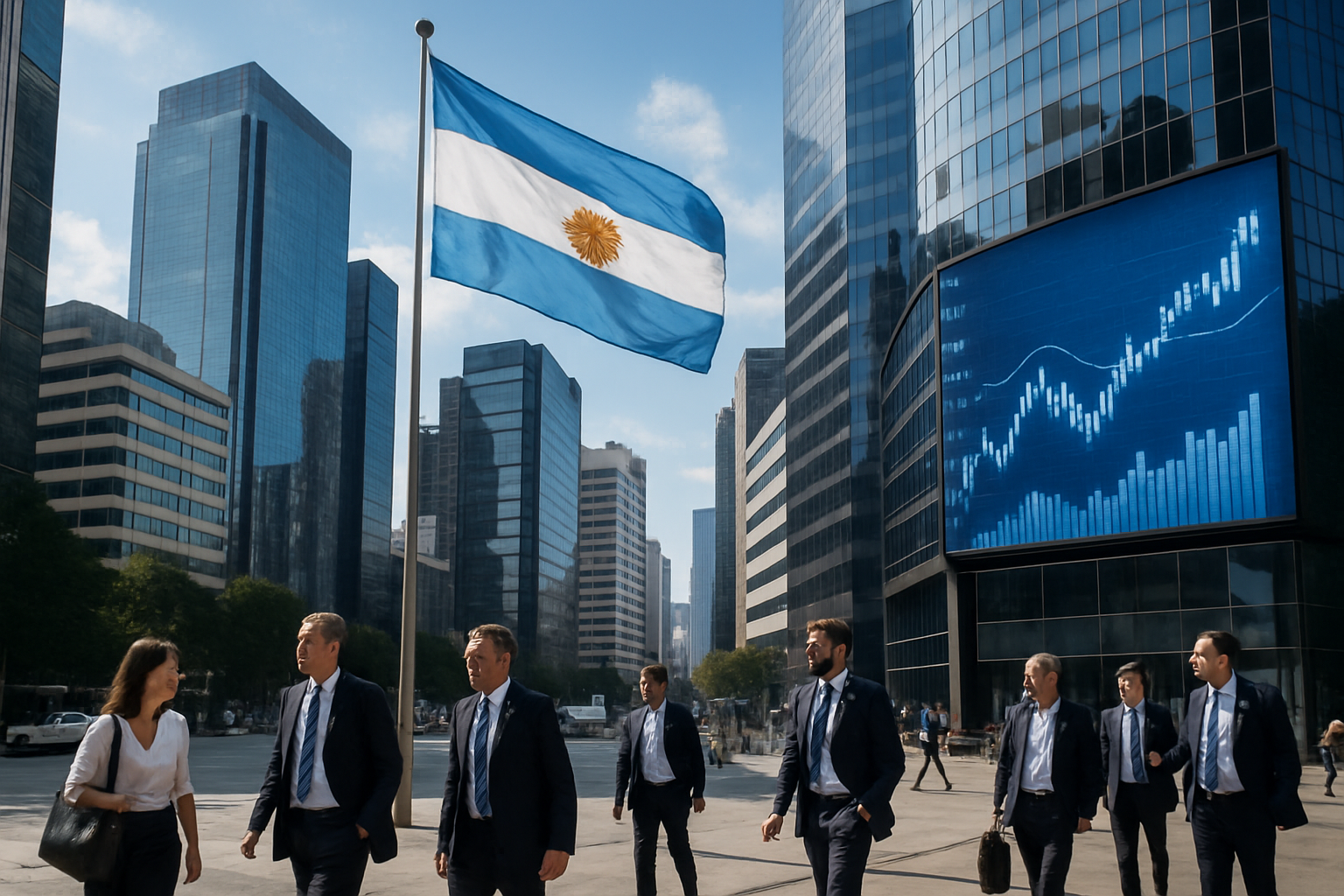
Argentina stands at a critical economic crossroads in 2026, as President Javier Milei's administration navigates a complex landscape of promising growth indicators, persistent inflation challenges, and unprecedented global market volatility that threatens to reshape the country's economic trajectory.
The South American nation's economy finished 2025 with a growth rate that nearly doubled the regional average, marking a significant rebound from the recession-heavy 2024. However, beneath this statistical success lies a more nuanced reality: while year-over-year comparisons appear favorable due to the low base effect from 2024's economic corrections, the economy remained virtually stagnant throughout 2025, displaying stark heterogeneity between sectors.
The Growth Paradox
Economic analyst Fernando Eguren, who brings extensive experience from the Bank of England and the Federal Reserve of New York, warns that "this year, the balance between lowering inflation and the cost on activity is going to be more evident." His assessment reflects growing concerns about the sustainability of Argentina's current economic trajectory amid global headwinds.
The statistical illusion of growth becomes apparent when examining the quarterly progression throughout 2025. While some sectors achieved historical peaks, others continued operating well below optimal capacity. This disparity has created an economy of two speeds, where export-oriented industries thrive while domestic consumption-dependent sectors struggle with persistent challenges.
Inflation Expectations vs. Reality
A stark disconnect has emerged between government projections and market expectations regarding inflation control. The Central Bank's latest Market Expectations Survey of 45 economists projects 22.4% annual inflation for 2026, more than doubling the government's budget forecast of 10.1%. This divergence highlights the credibility challenges facing Milei's economic team as they attempt to consolidate their desinflation strategy.
"The market is expressing skepticism about the government's inflation targets, despite currency stability in dollar markets."
— Market Analyst, Central Bank Survey
Monthly inflation rates are not expected to fall below 2% until May 2026, according to economist consensus. This timeline suggests that the path to price stability remains longer and more challenging than initially anticipated by policymakers.
Global Market Turbulence Impact
Argentina's economic outlook has been significantly complicated by global market developments, particularly the nomination of Kevin Warsh as Federal Reserve chairman. His more hawkish profile has triggered a recalibration of global expectations, resulting in a stronger dollar and less accommodative monetary policy worldwide.
The impact on Argentina has been immediate and severe. Local markets experienced acute volatility, with the Merval index measured in dollars plummeting 9.1% during the week following Warsh's nomination. This "red week" demonstrated Argentina's continued vulnerability to external financial conditions, despite ongoing economic reforms.
The dollar strength poses particular challenges for Argentina's competitiveness, especially as the appreciation of currencies from major trading partners Brazil, China, and the European Union had previously favored a more significant depreciation of Argentina's real exchange rate since April 2025.
Artificial Intelligence and Economic Management
An intriguing dimension of Argentina's economic debate involves the potential role of artificial intelligence in public administration. The concept of "gestión artificial" (artificial management) has gained traction among policy analysts who envision AI systems constraining government spending to strictly necessary expenditures while eliminating waste and perverse incentives.
This vision represents a stark departure from Argentina's historical experience with industrial policy, where political intervention has often contaminated economic efficiency. The country's past attempts at sector-specific policies across industries from steel to software have yielded mixed results, leading some economists to advocate for technology-driven governance as a potential solution.
Strategic Trade Partnerships
Argentina's economic prospects have been bolstered by the historic trade agreement with the United States, eliminating over 1,600 US tariffs on Argentine goods while Argentina removes 220+ levies on US products. The agreement, which includes unprecedented agricultural market access and lithium cooperation provisions, positions Argentina as a key partner in the Trump administration's South American strategy.
The deal's significance extends beyond trade volumes, representing a strategic realignment that could help Argentina access critical markets while reducing dependence on traditional partners. The agreement includes provisions for Port of Rosario expansion and intellectual property protections across multiple sectors, from automobiles and technology to critical minerals and agricultural products.
Currency Stability Amid Volatility
Despite global turbulence, Argentina's currency markets have shown unexpected resilience. The official dollar rate declined modestly by 0.4% to 1,442 pesos, while the blue dollar reached a two-month low. This stability contrasts sharply with the volatility experienced by other emerging market currencies and suggests that Milei's monetary policies may be gaining credibility among market participants.
However, economists caution that this stability could be temporary, particularly if global risk sentiment continues deteriorating or if domestic inflation expectations become unanchored from current projections.
Institutional Changes and Statistical Integrity
The appointment of Pablo Lines as the new head of INDEC (National Institute of Statistics) following Marco Lavagna's resignation has raised questions about statistical methodology during a critical economic transition. The government's decision to postpone implementing new inflation measurement methodology until desinflation consolidates reflects pragmatic concerns about statistical consistency versus modernization pressures.
Lines, promoted internally after serving as Lavagna's deputy, brings institutional continuity to an organization responsible for producing crucial economic indicators. The timing of this transition, occurring as Argentina attempts to restore international credibility to its economic statistics, underscores the delicate balance between technical improvements and political objectives.
Sector-Specific Challenges
The heterogeneous nature of Argentina's economic recovery becomes evident when examining individual sectors. While mineral extraction and agricultural exports have reached unprecedented levels, manufacturing and construction face significant headwinds from rising costs and reduced domestic demand.
The construction sector exemplifies these challenges, with material costs rising substantially throughout 2025, creating negative profit margins for developers. This situation has contributed to a slowdown in residential and commercial construction, despite growing demand for housing and infrastructure investment.
Property markets reflect this mixed reality, with rental prices surging 2.7% in January 2026 after a stable 2025. Small apartments show the highest year-over-year increases, making them attractive investments even as new construction faces cost pressures.
International Investment Climate
Foreign investors are closely monitoring Argentina's policy consistency and institutional stability as key factors in their decision-making processes. The country's risk indicator, while volatile, has remained around 516-520 points according to JP Morgan measurements, suggesting cautious optimism tempered by awareness of potential policy reversals.
The success of recent bond issuances and the positive response to trade agreements indicate growing international confidence in Argentina's reform trajectory. However, sustaining this momentum requires continued policy coherence and the ability to navigate external shocks effectively.
Labor Market Dynamics
Argentina's labor market faces significant transformations as the government advances controversial reform legislation. The CGT union confederation's threatened general strike, supported by six provincial governors, represents the most serious domestic challenge to Milei's economic agenda.
Unemployment projections are rising according to analyst consensus, reflecting the tension between short-term adjustment costs and long-term competitiveness improvements. The balance between labor market flexibility and social protection remains a critical political and economic challenge.
Looking Forward: Critical Challenges
As Argentina progresses through 2026, several key factors will determine economic success. The government's ability to maintain currency stability while reducing inflation expectations represents the most immediate challenge. Global market conditions, particularly US monetary policy under Kevin Warsh's potential leadership, will significantly influence capital flows and risk sentiment toward emerging markets.
The implementation of structural reforms, including labor market modifications and trade agreement provisions, will test the administration's political capital and institutional capacity. Success in these areas could position Argentina for sustained growth, while failures could trigger renewed economic instability.
Regional and global economic developments will continue shaping Argentina's options. The strengthening of strategic partnerships, particularly with the United States, provides new opportunities for export diversification and technology transfer. However, these relationships require careful management to avoid excessive dependence on any single market or partner.
The role of artificial intelligence and technology in economic governance represents an intriguing long-term possibility that could help Argentina overcome historical challenges with policy implementation and institutional efficiency. While still conceptual, the integration of AI-driven decision-making systems could provide the technical precision and political insulation necessary for sustained economic modernization.
Argentina's economic renaissance in 2026 will ultimately depend on balancing immediate stabilization needs with long-term structural transformation requirements. The country's success in navigating this complex transition will have significant implications not only for its own development but also for broader regional economic dynamics and the viability of market-oriented reforms in Latin America.