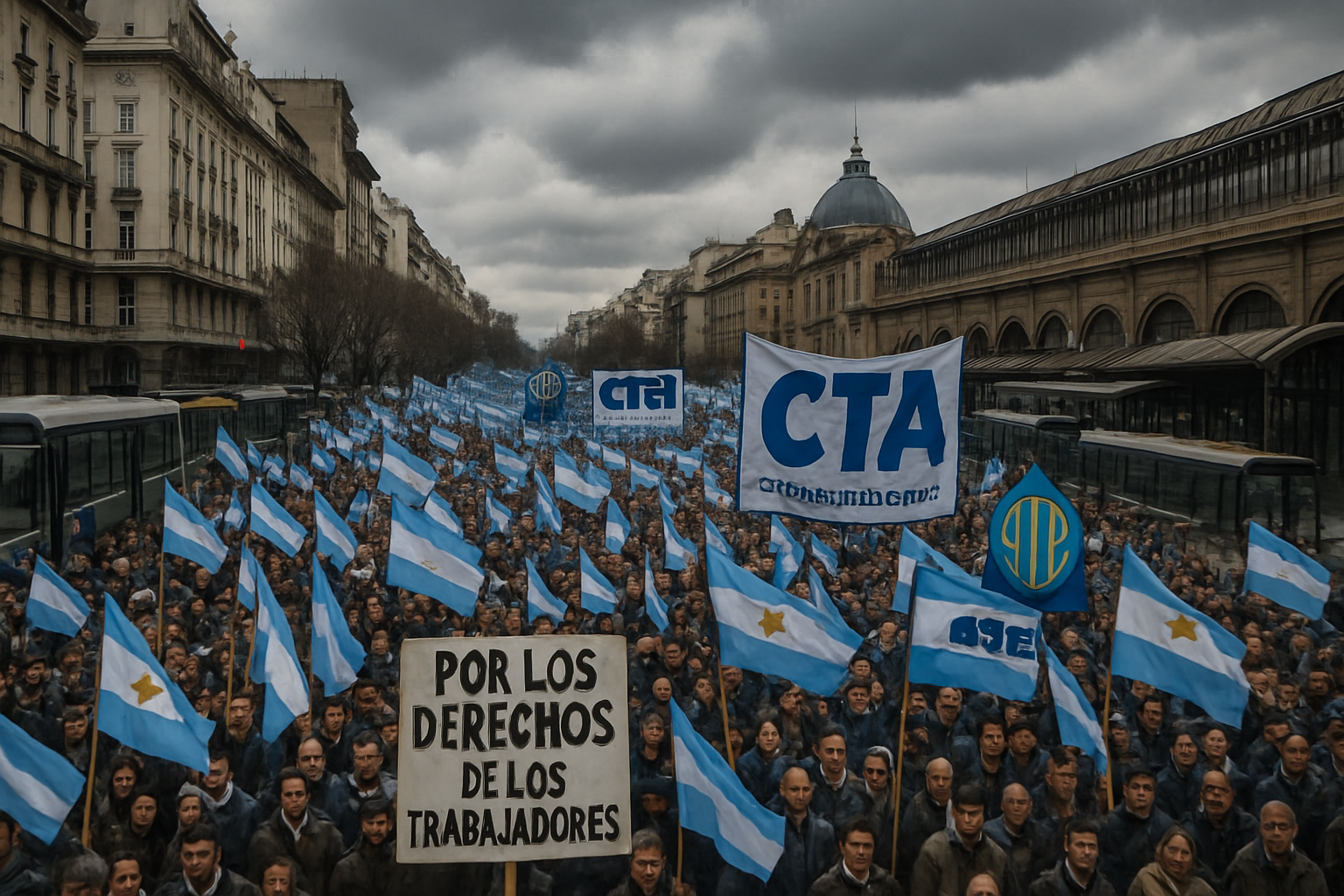
Argentina came to a virtual standstill on February 19, 2026, as the General Confederation of Labor (CGT) successfully executed the fourth general strike against President Javier Milei's administration, paralyzing transportation networks and forcing widespread flight cancellations that extended beyond the country's borders.
The 24-hour strike, strategically timed to coincide with the Chamber of Deputies debate on controversial labor reform legislation, achieved unprecedented participation across multiple sectors, demonstrating the sustained organizational capacity of Argentina's trade union movement in its confrontation with the libertarian government.
Complete Transportation Shutdown
The strike's impact was immediate and comprehensive. The Unión Tranviarios Automotor (UTA) confirmed total participation affecting bus services "short, medium and long distance throughout the country." In Tucumán province, the UTA declared it was "not in agreement with labor reform," suspending all provincial bus services completely.
Buenos Aires metropolitan area faced complete public transport paralysis with Metrodelegados shutting down the entire subway system. La Fraternidad railway workers joined the action, bringing train services to a halt across the capital region. The coordinated transport shutdown effectively trapped millions of commuters, maximizing political pressure during the crucial legislative session.
Aviation workers from APLA and AOITA unions caused widespread flight cancellations, with airlines including Flybondi issuing passenger advisories about service disruptions. The impact extended internationally, affecting over 1,000 passengers in Paraguay as JetSmart, Aerolíneas Argentinas, and other carriers suspended operations between Argentina and neighboring countries.
Banking and Essential Services Affected
The Association of Bank Employees achieved full participation, closing banking services nationwide and demonstrating the strike's reach beyond traditional manufacturing and transport sectors. Gas stations faced disruptions, while essential services experienced varying degrees of impact across different provinces.
Despite the comprehensive nature of the strike, some services maintained operations. DOTA continued running over 60 bus lines, Yerba Buena Munibus maintained service in Tucumán, and PAMI medical services along with gas stations remained operational, providing limited relief to citizens.
Economic Cost and Political Stakes
Economic research institute INECO-UADE calculated the strike's cost at $489 million, representing 0.8% of February GDP and 17.3% of single-day economic output. The massive economic disruption occurred as Argentina grapples with economists projecting 22.4% annual inflation versus the government's optimistic 10.1% forecast.
CIARA-CEC, representing agricultural exporters, criticized the union's "resistance to change," arguing it affects employment, foreign currency earnings, and regional economies. The criticism highlighted the tension between export-oriented sectors benefiting from Milei's reforms and domestic industries facing increased competition.
Labor Reform at Critical Juncture
The strike coincided precisely with the Chamber of Deputies' 2 PM session debating the "Labor Modernization" bill, which had already secured Senate approval by a 42-30 margin in February following violent protests that saw Molotov cocktails thrown at Congress and over 50 arrests.
The reform introduces a "bank of hours" overtime system enabling employer scheduling flexibility, modified severance payment structures while maintaining basic worker protections, and changes to union contribution requirements. Interior Minister Patricia Bullrich had modified over 30 articles to gain support from the Radical Civic Union (UCR) and dialoguing opposition blocs.
The legislation complements the historic US-Argentina trade agreement eliminating more than 1,600 tariffs, positioning Argentina as a key partner in the Trump administration's South American strategy. However, the reform faces fierce resistance from workers who view it as an attack on decades of labor protections.
Opposition Coalition Mobilizes
The CGT coordinated the broadest opposition coalition against the Milei administration, including both CTA branches, the Left Front, La Cámpora, and various Peronist groups. Six provincial governors supported the union position, including Buenos Aires Governor Axel Kicillof, who is positioning himself for a 2027 presidential campaign.
The strike was designated "without mobilization," representing a tactical evolution from the violent February Senate protests to pure economic pressure. This strategic shift avoided negative publicity while maximizing political impact during the decisive legislative session.
Regional and International Impact
The strike's effects extended beyond Argentina's borders, with Chilean airlines LATAM, Sky, and JetSmart canceling all flights between Chile and Argentina. Paraguay faced significant disruption with over 1,000 affected passengers, while Bolivia had to reschedule football matches due to stadium worker participation in solidarity strikes.
International observers monitored the events closely as a test case for Latin American structural reforms, examining whether democratic institutions can manage comprehensive economic transformation while preserving social stability.
Government Response and Coalition Building
The Milei administration dismissed the strike as "senseless" and part of a "CGT agenda that holds back progress." Officials argued that union leaders "had to resort to transport sector adhesion" to create an image of paralysis, suggesting the strike lacked broader worker support.
Despite the disruption, the government demonstrated successful coalition building through the La Libertad Avanza-PRO-UCR-dialogist alliance, effectively isolating traditional Peronist parties. This political alignment enabled the Senate approval despite unprecedented street violence and now positions the reform for final Chamber approval.
Economic Crisis Context
The strike occurred amid severe economic challenges, with Argentina losing 21,938 companies under the Milei administration, affecting 290,602 workers according to Superintendency of Labor Risks data. The recent closure of FATE tire plant, eliminating 920 jobs due to Chinese competition, symbolized the broader industrial challenges facing the country.
Construction sectors report negative margins from material cost increases, while currency stability has been maintained with the official dollar rate showing convergence with parallel market rates, indicating some monetary policy success despite broader economic pressures.
Historical Significance and Implementation Challenges
The February 19 strike represents the most sustained union opposition to an Argentine government since the return to democracy, demonstrating the CGT's tactical evolution from violent confrontations to sophisticated economic disruption strategies.
Looking ahead, the government faces massive implementation challenges even if the Chamber approves the reform. Union leaders have signaled legal challenges that could create years of litigation, while extensive regulatory development and federal-provincial coordination will be required for effective implementation.
The success or failure of Argentina's labor reform will serve as a crucial template for other Latin American countries attempting to balance economic modernization with democratic governance and social stability. As the region watches, the outcome will influence approaches to structural change management across emerging democracies facing similar pressures to adapt to global economic realities while maintaining social cohesion.
The coming weeks will prove decisive not only for the specific legislation but for the broader trajectory of President Milei's comprehensive economic restructuring agenda and Argentina's position as a reliable partner in the evolving global economy.