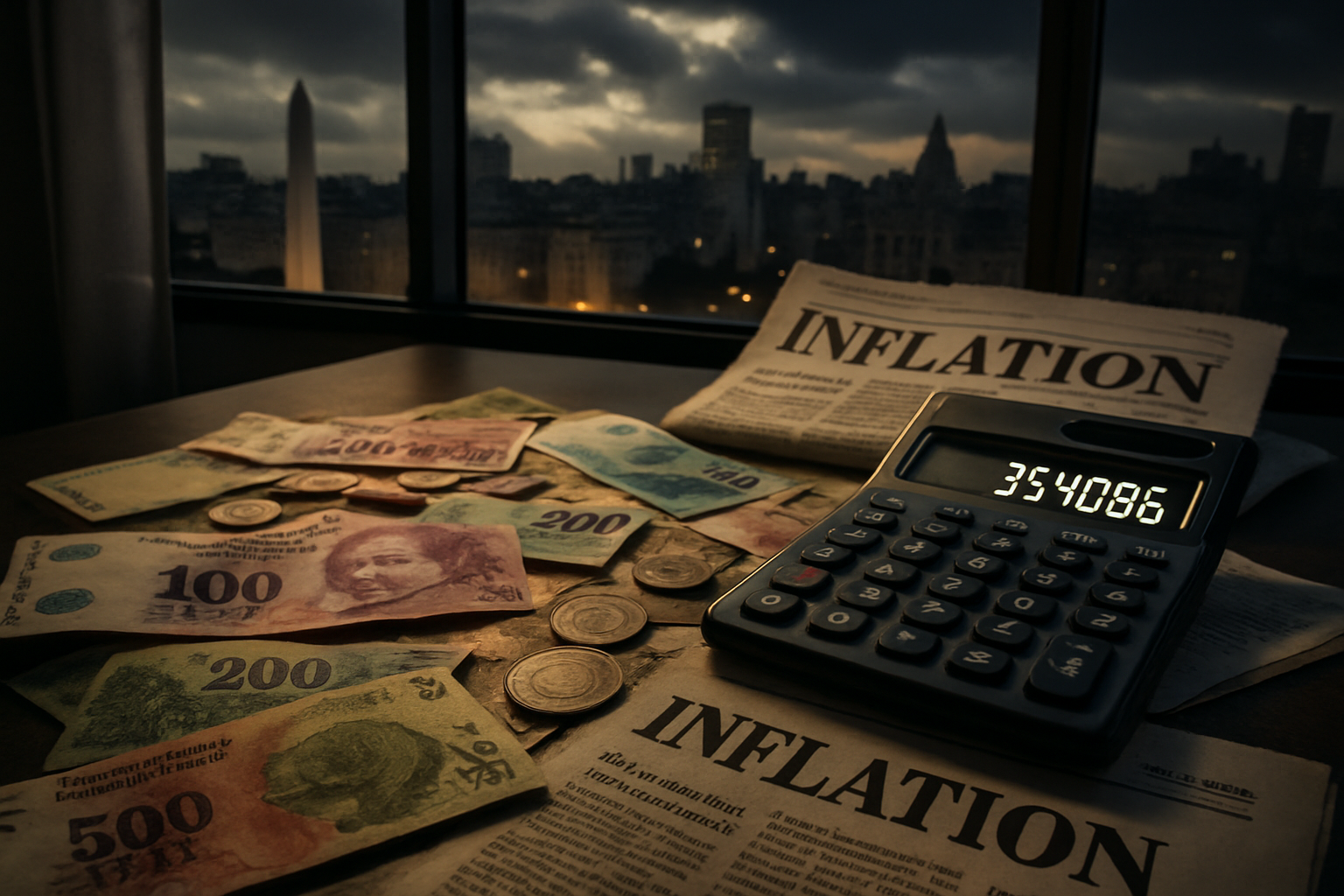
Argentina's inflation crisis has deepened significantly as consumer prices rose 2.9% in January 2026 compared to December, extending a troubling upward trend for the fifth consecutive month and pushing annual inflation to a staggering 32.4%, according to data released by the National Institute of Statistics and Census (INDEC).
The latest figures represent a marked acceleration in price pressures that threatens to undermine President Javier Milei's ambitious economic reform agenda, even as his administration celebrates historic trade agreements with the United States and maintains relative currency stability. The inflation data was released amid significant institutional turbulence at INDEC, following the resignation of its former director Marco Lavagna and controversial delays in implementing updated measurement methodologies.
INDEC Leadership Crisis Compounds Economic Uncertainty
The January inflation figures were released under the direction of Pablo Lines, who was appointed as INDEC's new head following Marco Lavagna's February 2026 resignation. The leadership change occurred during a critical period when the statistics agency faced pressure to modernize its Consumer Price Index methodology, which has relied on consumption patterns dating back more than 20 years.
Economy Minister Luis Caputo's decision to delay the implementation of updated measurement techniques until the "desinflation process consolidates" has raised questions about the government's commitment to statistical transparency during a sensitive period of economic transition. The controversy highlights the delicate balance between maintaining data consistency and ensuring accurate representation of current economic conditions.
"The timing of these methodological discussions during elevated inflation creates short-term data discrepancies that we want to avoid,"
— Luis Caputo, Economy Minister
Economists Sound Alarm Over Inflation Trajectory
The Central Bank's Market Expectations Survey, conducted among 45 economists between January 28-30, 2026, reveals a stark disconnect between government projections and expert assessments. Economists project annual inflation of 22.4% for 2026, more than doubling the government's official forecast of 10.1%. Perhaps more concerning, monthly inflation is not expected to fall below 2% until May 2026, suggesting the current crisis may persist for several more months.
These projections were formulated before the government's reversal on statistical methodology updates, indicating that expert skepticism about inflation control predates the recent institutional controversy. The survey's timing makes its findings particularly significant as they reflect independent analysis of the underlying economic fundamentals rather than political considerations.
Fernando Eguren, an economist with experience at the Bank of England and Federal Reserve Bank of New York, has warned that the 2026 inflation-growth balance will become "more evident" as the year progresses. This assessment suggests that the government's optimistic projections may face increasing scrutiny as real economic conditions become more apparent.
Currency Stability Masks Deeper Economic Tensions
Despite the concerning inflation trends, Argentina has achieved notable currency stability that provides some offset to the price pressures. The official dollar exchange rate declined to $1,442 pesos, while the parallel "blue dollar" market reached a two-month low, indicating convergence between official and informal exchange rates—a traditionally positive sign for monetary stability.
This currency performance reflects several factors including increased agricultural export liquidations, renewed investor interest in peso-denominated assets, favorable emerging market conditions, and successful corporate debt issuances that provide dollar inflows. The stability has been maintained despite broader global market turbulence and represents one of the few bright spots in Argentina's current economic landscape.
However, the disconnect between currency stability and inflation acceleration highlights the complex nature of Argentina's economic challenges. While exchange rate pressures have eased, domestic price dynamics continue to reflect underlying structural issues that cannot be resolved through monetary policy alone.
Regional Context and International Implications
Argentina's inflation crisis occurs within a broader Latin American context where economic policies vary significantly across countries. The 2.9% monthly rate positions Argentina among the region's higher inflation experiences, contrasting sharply with countries like Brazil, where São Paulo's consumer price index rose only 0.15% in early February, with food prices remaining completely flat.
The timing of Argentina's inflation challenges coincides with President Milei's efforts to position the country as a key strategic partner for the Trump administration. The recently signed bilateral trade agreement eliminates over 1,600 US tariffs on Argentine goods and 220 Argentine levies on US products, representing unprecedented market access that could provide economic benefits if inflation can be brought under control.
Foreign Minister Pablo Quirno has described the trade agreement as providing "unprecedented" agricultural access, potentially generating an estimated $800 million in additional external sales. However, these opportunities may be undermined if persistent inflation erodes competitiveness and complicates business planning for both domestic and international partners.
Sectoral Impact and Consumer Burden
The 2.9% monthly inflation rate affects different sectors of the economy unevenly, with particularly sharp impacts on essential goods and services. Rental prices, which remained relatively stable throughout 2025, surged 2.7% in January 2026 alone, indicating that housing costs are beginning to reflect broader inflationary pressures.
Consumer spending patterns show households struggling to adapt to persistent price increases. The Buenos Aires metropolitan area, home to nearly 40% of Argentina's population, faces particular challenges as urban consumers have fewer alternatives to rising costs compared to rural areas where some goods and services may be more readily substitutable.
Small businesses report increasing difficulties in pricing decisions, as rapid price changes make inventory management and cash flow planning extremely challenging. The situation is compounded by construction sector difficulties, where material costs have risen substantially, creating negative profit margins for developers and further limiting economic growth prospects.
Government Response and Policy Challenges
President Milei's administration faces the complex challenge of maintaining economic reform momentum while addressing immediate inflation pressures. The government's approach has emphasized currency stabilization and fiscal discipline, but the January figures suggest these measures have not yet translated into price stability.
The administration's broader reform agenda includes controversial labor market changes that face opposition from the CGT union confederation, which has threatened general strikes. Interior Minister Patricia Bullrich has reportedly secured "solid consensus" for labor reform legislation by modifying 30 articles to gain support from the Radical Civic Union (UCR), but implementation remains uncertain amid social tensions.
The government argues that structural reforms, including the US trade agreement and improvements in the business environment, will eventually create conditions for sustained price stability. However, the timeline for these benefits to materialize remains unclear, while inflation's immediate impact on living standards continues to mount.
Market Reactions and Investment Climate
Financial markets have shown mixed reactions to Argentina's economic developments. While country risk indicators remain elevated at over 500 points according to JP Morgan measures, bond and equity markets have demonstrated resilience, particularly following the announcement of the US trade agreement.
International investor sentiment reflects cautious optimism about Argentina's long-term prospects tempered by concerns about near-term inflation dynamics. The combination of structural reforms and persistent price pressures creates a complex investment environment where potential returns must be weighed against ongoing economic volatility.
The government's challenge lies in maintaining international confidence while addressing domestic economic pressures that could undermine reform implementation. Success in controlling inflation could unlock significant economic opportunities, while failure might jeopardize the broader transformation agenda.
Looking Ahead: Critical Months for Economic Policy
The coming months will prove crucial for determining whether Argentina's inflation crisis represents a temporary adjustment during economic transition or a more fundamental challenge to the Milei administration's reform strategy. With economists projecting that monthly inflation will remain above 2% until May, the government faces sustained pressure to demonstrate progress.
The institutional stability at INDEC under Pablo Lines's leadership will be essential for maintaining credible economic data during this critical period. Any perception that statistical reporting lacks independence or accuracy could further undermine confidence in government economic policies and complicate international relationships.
Argentina's experience serves as a case study in the challenges of implementing rapid economic reforms while managing immediate macroeconomic stability. The outcome will have implications not only for Argentina's 45 million citizens but also for broader discussions about economic policy approaches in emerging markets facing similar challenges.
As the government works to balance reform ambitions with inflation control, the January 2.9% figure stands as a stark reminder that economic transformation rarely proceeds in straight lines, and success ultimately depends on the ability to navigate complex political, social, and economic pressures simultaneously.