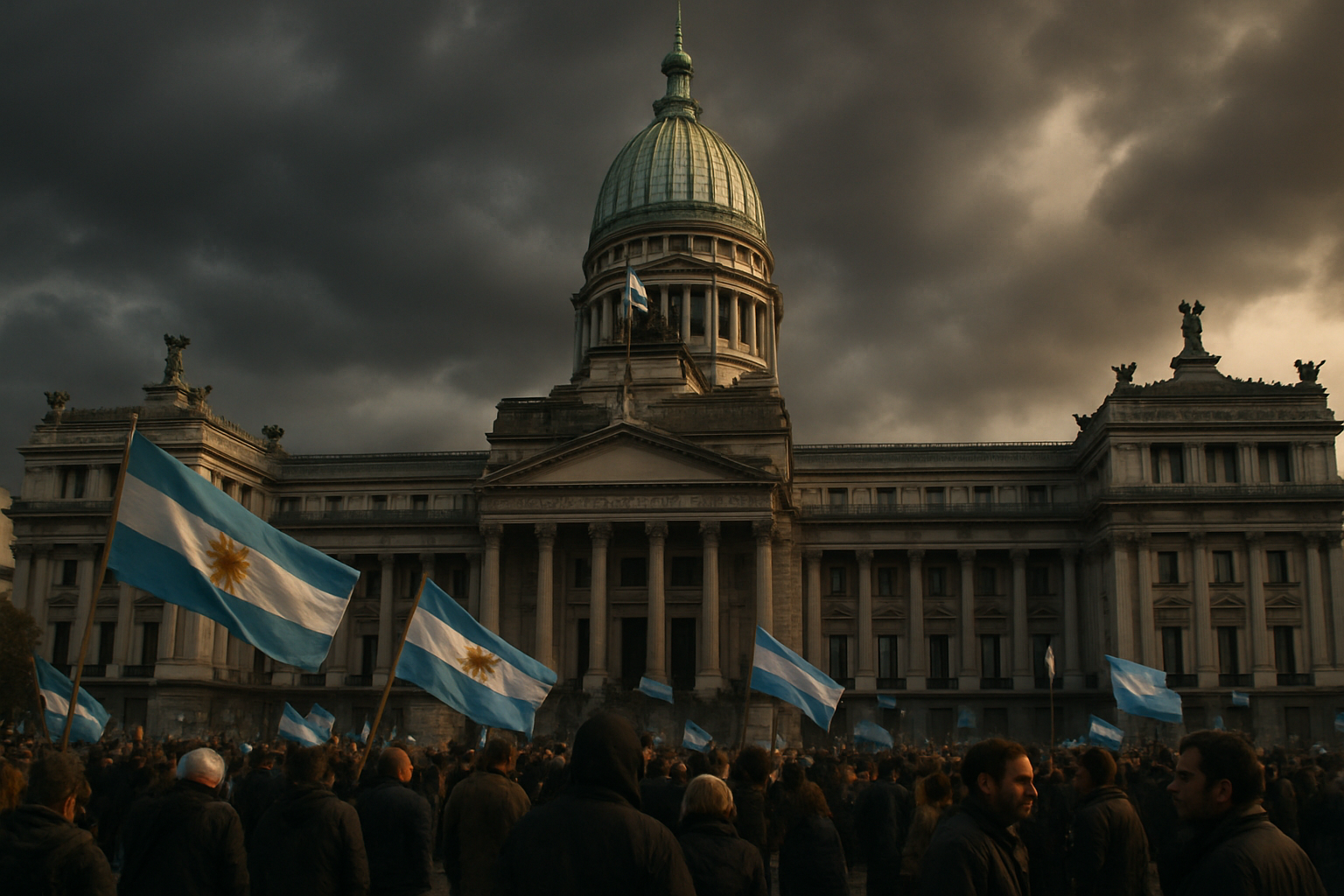
Argentina's Chamber of Deputies approved President Javier Milei's controversial labor reform legislation by a narrow margin of 135-115 votes early Friday morning, marking a significant victory for the libertarian administration despite facing the fourth nationwide general strike organized by the powerful CGT labor confederation.
The approval came after an intense overnight session that coincided perfectly with a comprehensive general strike that paralyzed transportation, banking, and essential services across the country. The strike, designated "without mobilization" to avoid street violence, demonstrated the sophisticated tactical evolution of Argentina's labor movement from the violent February Senate protests that featured Molotov cocktails and resulted in over 50 arrests.
Legislative Victory Amid Economic Disruption
Interior Minister Patricia Bullrich's strategic modifications of more than 30 articles proved crucial in securing support from the Radical Civic Union (UCR) and dialoguing opposition blocs, effectively isolating the traditional Peronist parties. The legislation now returns to the Senate for final approval due to the elimination of Article 44 concerning medical leave provisions—a concession to mounting political pressure.
The economic impact of the strike was massive, with research institute INECO-UADE calculating the cost at $489 million, equivalent to 0.8% of February's GDP. The comprehensive work stoppage affected virtually all sectors of the economy, from bus services suspended nationwide by the UTA union to the complete closure of banking services through the Association of Bank Employees' full participation.
"These are structural and long-term changes," Economy Minister Luis Caputo celebrated on social media, predicting an "incredible future" for the country.
— Luis Caputo, Economy Minister
Union Opposition Demonstrates Organizational Strength
The CGT's tactical sophistication was evident in their coordination of what they termed a "without mobilization" strike—avoiding the street confrontations that had characterized previous protests while maximizing economic pressure during the crucial legislative session. The transport sector's complete shutdown included:
- UTA bus services suspended nationwide across all distances
- Metrodelegados achieving complete Buenos Aires subway halt
- Aviation unions causing widespread flight cancellations affecting over 31,000 passengers
- Railway workers through La Fraternidad participating fully
Buenos Aires Governor Axel Kicillof, who leads the opposition and is positioning himself for a 2027 presidential campaign, coordinated the broadest resistance coalition including both CTA branches, the Left Front, La Cámpora, and six provincial governors.
Reform Content and Economic Context
The approved legislation introduces a "bank of hours" overtime system that enables greater employer scheduling flexibility while maintaining basic worker protections. The reform also includes modified severance structures and adjusted union contribution requirements, designed to complement the historic US-Argentina trade agreement that eliminates over 1,600 tariffs.
The legislative victory occurs against a backdrop of severe economic challenges. Economists project 22.4% annual inflation for 2026, more than double the government's forecast of 10.1%. Argentina has lost 21,938 companies under the Milei administration, affecting 290,602 workers according to the Superintendency of Labor Risks data.
The symbolic closure of the iconic Fate tire manufacturing plant, which eliminated 920 jobs just days before the vote, highlighted the industrial devastation from Chinese import competition under rapid trade liberalization policies.
Political Realignment and Coalition Building
The vote demonstrated Milei's growing capacity to build coalitions beyond his libertarian base through the La Libertad Avanza-PRO-UCR alliance. The government's tactical flexibility in modifying contentious provisions while preserving core objectives proved essential for securing the necessary votes.
Deputy Florencia Carignano criticized what she saw as betrayal by governors who had supported the reform, while ATE union leader Rodolfo Aguiar characterized the legislation as a "criminal law" that would fundamentally change the country's social model.
"If you're not well positioned, Kirchnerism will sweep you away," libertarian Deputy Pelli defended the project, describing a "tense and shameful" session.
— Deputy Pelli, La Libertad Avanza
Historical Violence and Tactical Evolution
The current strike's disciplined approach marked a significant departure from the unprecedented violence that accompanied the Senate approval in February. During those protests, demonstrators threw Molotov cocktails at federal police, resulting in over 50 arrests and 270 million pesos in property damage—representing the most serious CGT-organized violence in recent Argentine history.
The shift to economic pressure without street mobilization demonstrated the unions' learning from that experience while maintaining their capacity to disrupt the country's economic functioning during critical legislative moments.
International Implications and Implementation Challenges
The reform positions Argentina as a key Trump administration partner in South America, complementing the bilateral trade agreement that eliminates tariffs on agricultural products and includes strategic lithium cooperation. However, implementation faces significant obstacles, with union legal challenges anticipated to create years of litigation.
International observers are monitoring Argentina as a test case for Latin American structural reforms, examining whether democratic institutions can manage comprehensive economic transformation while preserving social stability.
The success or failure of Argentina's approach will influence similar modernization efforts throughout the region, as governments grapple with balancing economic competitiveness with historical worker protection commitments.
Looking Forward
With the legislation returning to the Senate for final approval—likely scheduled for February 27—the government faces continued challenges from organized labor resistance. The CGT's sustained organizational capacity suggests ongoing workplace confrontations regardless of the legislative outcome.
The broader implications extend beyond labor policy, representing a fundamental test of President Milei's capacity to implement his comprehensive economic restructuring vision while managing intense social pressures. The coming weeks will prove decisive for both the specific reform and the administration's broader transformation agenda.
As Argentina navigates this critical juncture, the outcome will determine not only the country's labor relations but also its political-economic trajectory and its role as a model for democratic governance during periods of comprehensive structural change.