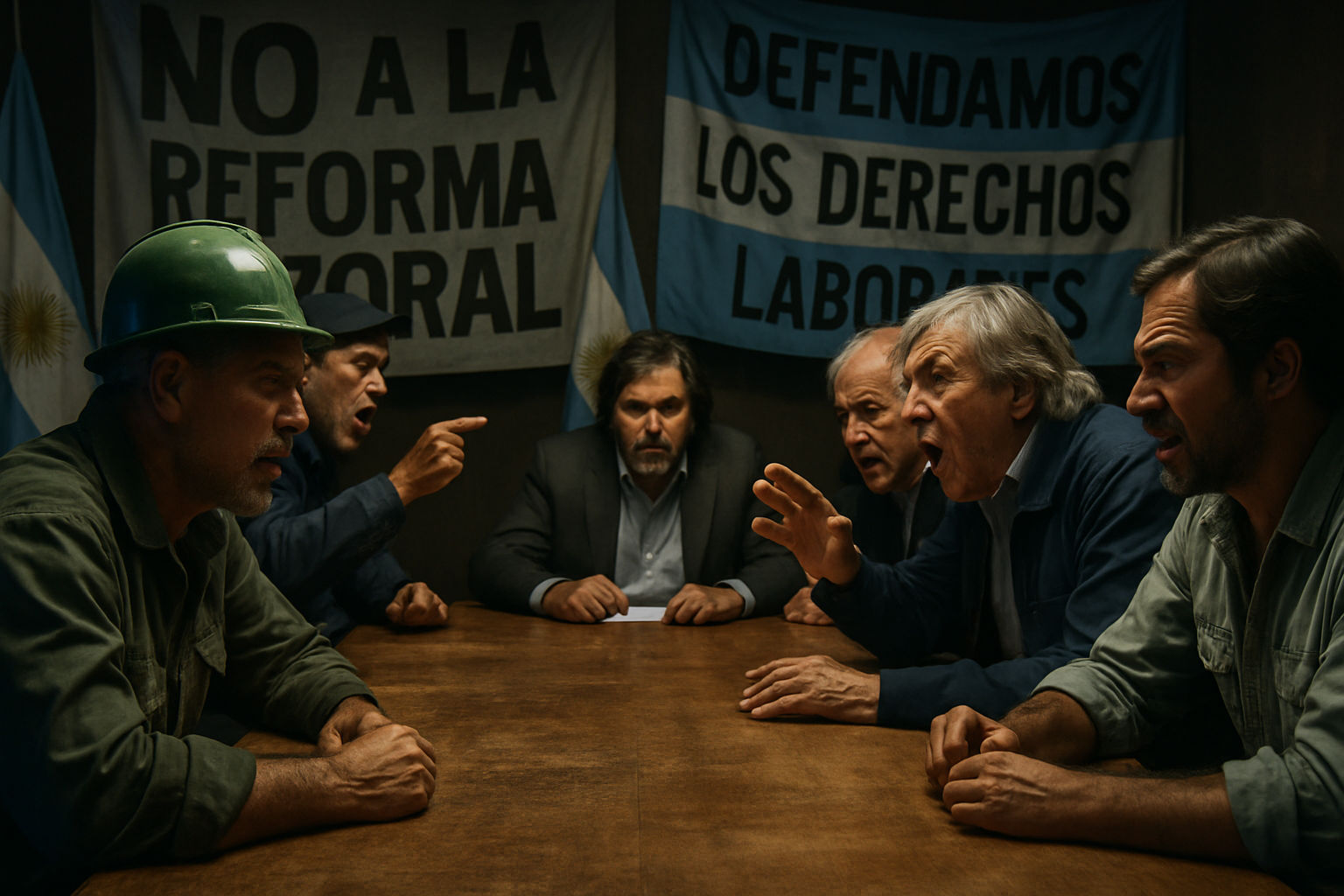
Argentina's government faces a significant reversal on its flagship labor reform legislation as mounting political pressure forces consideration of eliminating the controversial Article 44, which addresses medical leave provisions, threatening the initiative's passage through the Chamber of Deputies.
The development represents a major political setback for President Javier Milei's administration, which had successfully secured Senate approval for the comprehensive "Labor Modernization" bill after intense negotiations and violent street protests. The reform package, designed to introduce workplace flexibility through a "bank of hours" overtime system and modified severance structures, now faces renewed uncertainty in the lower chamber.
Industrial Support Despite Medical Leave Controversy
Despite the brewing controversy, Martín Rappallini, president of the Industrial Union of Argentina (UIA), expressed support for the reform direction while acknowledging the elimination of Article 44. "The sector was not surprised" by the modification, he stated, celebrating the Senate's preliminary approval as a positive step toward labor market modernization.
The UIA's backing reflects broader business community support for reforms aimed at increasing Argentina's competitiveness in global markets, particularly as the country seeks to capitalize on the recent US-Argentina trade agreement eliminating over 1,600 tariffs. However, the medical leave provisions had drawn criticism from both opposition lawmakers and moderate coalition partners.
Congressional Opposition Mounts Pressure
The political pressure intensified following statements by Tucumán deputy Carlos Cisneros, who characterized the reform as "not modernization, but a regression against workers." Cisneros, representing opposition sentiment in the Chamber of Deputies, confirmed that La Bancaria union would mobilize when the legislation reaches the floor for final consideration.
"This is not about updating labor laws for the modern economy," Cisneros argued during recent congressional hearings. "This represents a fundamental attack on workers' rights that have been built over decades of struggle."
The opposition's stance reflects broader union resistance led by the General Confederation of Labor (CGT), which has organized multiple strikes and demonstrations against the reform package. The CGT's co-secretary Cristian Jerónimo has maintained that unions will continue fighting what they characterize as an attempt to "cover government failures" through weakening worker protections.
Government's Strategic Recalculation
Interior Minister Patricia Bullrich, who has served as the administration's chief negotiator on labor reform, reportedly held emergency meetings to discuss modifying the contentious Article 44. Government sources suggest the administration recognizes that maintaining the medical leave provisions could jeopardize passage in the Chamber of Deputies, where coalition margins are narrower than in the Senate.
The potential elimination would require the legislation to return to the Senate for additional consideration, creating further delays in a process the government had hoped to complete during the current extraordinary session period. This represents a significant tactical setback for an administration that has prided itself on legislative efficiency and coalition-building.
Economic Context and Reform Necessity
The labor reform controversy unfolds against Argentina's challenging economic backdrop, with economists projecting 22.4% annual inflation for 2026—more than double the government's 10.1% forecast. The reform package forms part of President Milei's broader structural transformation agenda, designed to attract foreign investment and modernize Argentina's regulatory framework.
The legislation includes provisions for enhanced workplace scheduling flexibility, modified overtime calculations, and streamlined registration systems. Supporters argue these changes are essential for Argentina to compete internationally and create employment opportunities, particularly as the country positions itself as a key partner for the Trump administration in South America.
Union Movement's Strategic Response
Labor organizations have demonstrated remarkable organizational capacity throughout the reform process, coordinating strikes and protests that have included both major confederations and smaller sectoral unions. The announcement of renewed mobilization by La Bancaria represents the expansion of resistance beyond traditional manufacturing and public sector unions into the financial services sector.
Union leaders argue that the reforms would undermine collective bargaining power and reduce worker security during an already difficult economic period. They have pointed to the 21,938 fewer companies operating under the Milei administration as evidence that labor flexibility alone cannot address Argentina's economic challenges.
International Implications and Investment Climate
The labor reform's fate carries significance beyond domestic policy, as international investors closely monitor Argentina's capacity for structural change. The country's recent trade agreement with the United States positions Argentina as a potential manufacturing and agricultural hub, but implementation depends partly on labor market flexibility that foreign companies view as essential.
Country risk indicators, while elevated above 500 points according to JP Morgan, have shown some improvement on reform momentum. However, the setback on Article 44 could signal to international markets that Argentina's reform agenda faces more substantial political obstacles than initially anticipated.
Parliamentary Mathematics and Coalition Dynamics
The government's challenge in the Chamber of Deputies reflects the complex coalition mathematics required for major legislative initiatives. While President Milei's La Libertad Avanza party, allied with PRO and moderate Radical Civic Union (UCR) lawmakers, managed Senate passage, the lower chamber presents different political dynamics.
Opposition Peronist parties, despite internal divisions, have found common ground in opposing labor reforms they characterize as favoring business interests over worker welfare. The addition of provincial deputies with specific regional concerns creates additional complexity for government whips attempting to secure passage.
Implementation Challenges Ahead
Even if the modified legislation passes both chambers, implementation presents significant challenges. Union organizations have signaled their intention to pursue legal challenges through Argentina's court system, potentially creating years of litigation over specific provisions.
The reforms also require extensive regulatory development at the federal and provincial levels, employer training programs, and coordination between different government agencies responsible for labor oversight. Success depends not only on legislative passage but on effective implementation amid continued union opposition.
Historical Context and Regional Significance
Argentina's labor reform debate occurs within a broader Latin American context where several countries are reconsidering worker protection frameworks amid global economic pressures. The outcome serves as a test case for democratic governments attempting to balance economic modernization with social stability.
The controversy also reflects Argentina's historical tension between business flexibility demands and strong labor movement traditions dating to the Peronist era. This cultural and political legacy continues to influence contemporary policy debates, making comprehensive labor reform particularly challenging compared to other economic policy areas.
Looking Forward: Critical Weeks Ahead
The coming weeks will prove decisive for both the specific reform legislation and the broader Milei reform agenda. Government officials express confidence about eventual passage, citing public support for economic modernization and continued coalition unity despite the Article 44 setback.
However, the need to return to the Senate for additional consideration creates new opportunities for opponents to mobilize resistance and potentially force additional modifications. The administration faces the delicate task of maintaining coalition support while addressing legitimate concerns about worker protections during Argentina's economic transition.
As Argentina navigates this critical juncture, the labor reform debate represents more than specific policy provisions—it embodies the fundamental challenge of implementing necessary but politically difficult changes within democratic institutions while maintaining social cohesion and economic stability.