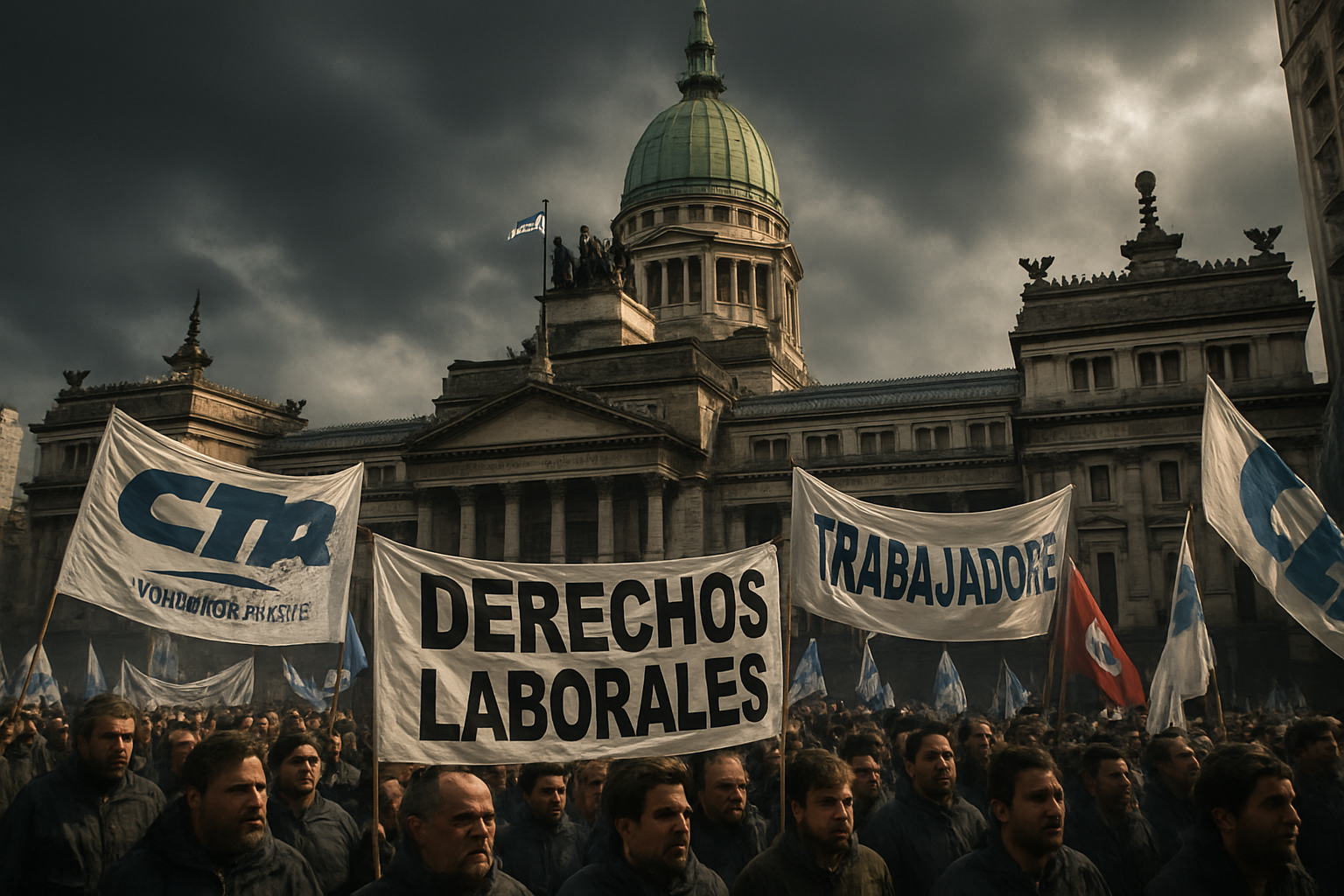
Argentina's contentious labor reform legislation enters its final phase as President Javier Milei's government pushes for Chamber of Deputies approval amid mounting opposition from unions, economic pressures from persistent inflation, and critical political calculations ahead of the 2027 electoral cycle.
The Labor Legislation and Budget committees of the Chamber of Deputies are scheduled to analyze the labor modernization project starting Wednesday at 2 PM, marking a crucial moment for the Milei administration's ambitious reform agenda. The legislation has already secured Senate approval with a 42-30 vote in February, but faces uncertain prospects in the lower house where coalition mathematics prove more complex.
Coalition Building Under Pressure
Interior Minister Patricia Bullrich has emerged as the architect of the government's legislative strategy, successfully modifying over 30 articles to secure support from the Radical Civic Union (UCR) and dialoguing opposition blocs. This tactical flexibility demonstrated the administration's willingness to compromise on contentious provisions while preserving core modernization objectives.
The reform package introduces a "bank of hours" overtime system that would fundamentally alter how employers manage worker schedules, alongside modified severance payment structures and adjusted union contribution requirements. While maintaining basic worker protections, the legislation aims to increase labor market flexibility to complement Argentina's historic trade agreement with the United States, which eliminates over 1,600 tariffs.
"This is a historic moment for Argentina's economic modernization, but we must balance competitiveness with worker protections."
— Patricia Bullrich, Interior Minister
Union Opposition Intensifies
The General Confederation of Labor (CGT) maintains fierce opposition to the reform, with former Labor Minister Kelly Olmos delivering sharp criticism of the project, characterizing it as "anticonstitutional" and "regressive." Olmos warned that the reform represents "a regression to the 19th century" in terms of worker rights.
Union resistance extends beyond rhetoric to concrete action. Rodolfo Aguiar, secretary general of the State Workers Association (ATE), has intensified criticism of the Milei government, declaring it "the most corrupt in history" while insisting that "if the president succeeds with his ideas, we all fail."
The CGT has already orchestrated four general strikes against the Milei administration, with the most recent featuring unprecedented violence outside Congress. Protesters threw Molotov cocktails and stones at federal police, resulting in over 50 arrests and property damage assessed at 270 million pesos. This tactical escalation marks the most serious labor confrontation in recent Argentine history.
Economic Context and International Implications
The labor reform debate unfolds against a challenging economic backdrop. Economists project 22.4% annual inflation for 2026, more than double the government's optimistic 10.1% forecast. This disconnect between official projections and expert assessments highlights the economic uncertainty surrounding the reform implementation.
Argentina has lost 21,938 companies under the Milei administration, affecting 290,602 workers according to data from the Superintendency of Labor Risks. The construction sector faces particular challenges, with negative profit margins due to material cost increases.
Despite these challenges, currency stability has been maintained, with the official dollar rate steady at 1,442 pesos and the blue dollar showing convergence trends. Country risk has improved to 504 points, reflecting cautious investor optimism about the reform momentum.
Political Stakes and 2027 Calculations
The labor reform battle extends beyond immediate policy concerns to encompass broader political positioning for the 2027 presidential election. Buenos Aires Governor Axel Kicillof has emerged as a leading opposition figure, personally joining protests while consolidating control over the Buenos Aires Peronist party structure.
Kicillof's strategic positioning represents a significant challenge to Milei's reform agenda, as Buenos Aires Province contains Argentina's largest electoral constituency. His criticism that the project "puts workers' rights at risk" resonates with traditional Peronist voters while appealing to broader concerns about economic inequality.
The timing of the legislative debate coincides with President Milei's scheduled trip to Washington for a Peace Summit convened by former President Trump, demonstrating the international dimensions of Argentina's domestic policy choices.
Implementation Challenges Ahead
Even if the Chamber of Deputies approves the legislation, significant implementation challenges remain. Union leaders have signaled plans for legal challenges that could create years of litigation, while the reform requires extensive regulatory development and employer training programs.
The success of the labor modernization depends on effective federal-provincial coordination, sustained political commitment, and ongoing workplace negotiations to maintain operational stability amid continued organized labor opposition.
International observers are monitoring the Argentine case as a test for democratic governance capacity during comprehensive economic transformation. The balance between modernization and social stability has broader implications for similar reform efforts throughout Latin America.
Regional and International Context
Argentina's labor reform occurs within a broader context of regional economic transformation and shifting international relationships. The legislation complements the historic US-Argentina trade agreement that promises $800 million in additional agricultural export opportunities, positioning the country as a key Trump administration partner in South America.
The reform serves as a template for Latin American structural modernization, testing whether democratic institutions can manage comprehensive change while preserving social cohesion. Success could encourage similar regional efforts, while failure might signal fundamental obstacles to market-oriented reforms in countries with strong union traditions.
Critical Weeks Ahead
The coming weeks will prove decisive for both the specific legislation and broader Milei reform agenda momentum. The Chamber of Deputies debate represents more than technical policy adjustment—it embodies fundamental questions about Argentina's economic direction, democratic governance capacity, and social contract evolution.
Government officials express confidence about passage, citing coalition unity and public support for modernization. However, the complex parliamentary arithmetic and sustained union pressure create genuine uncertainty about the final outcome.
The labor reform debate ultimately reflects deeper tensions between Argentina's economic modernization imperatives and its historical commitment to worker protections—a balance that will define the country's trajectory for years to come.