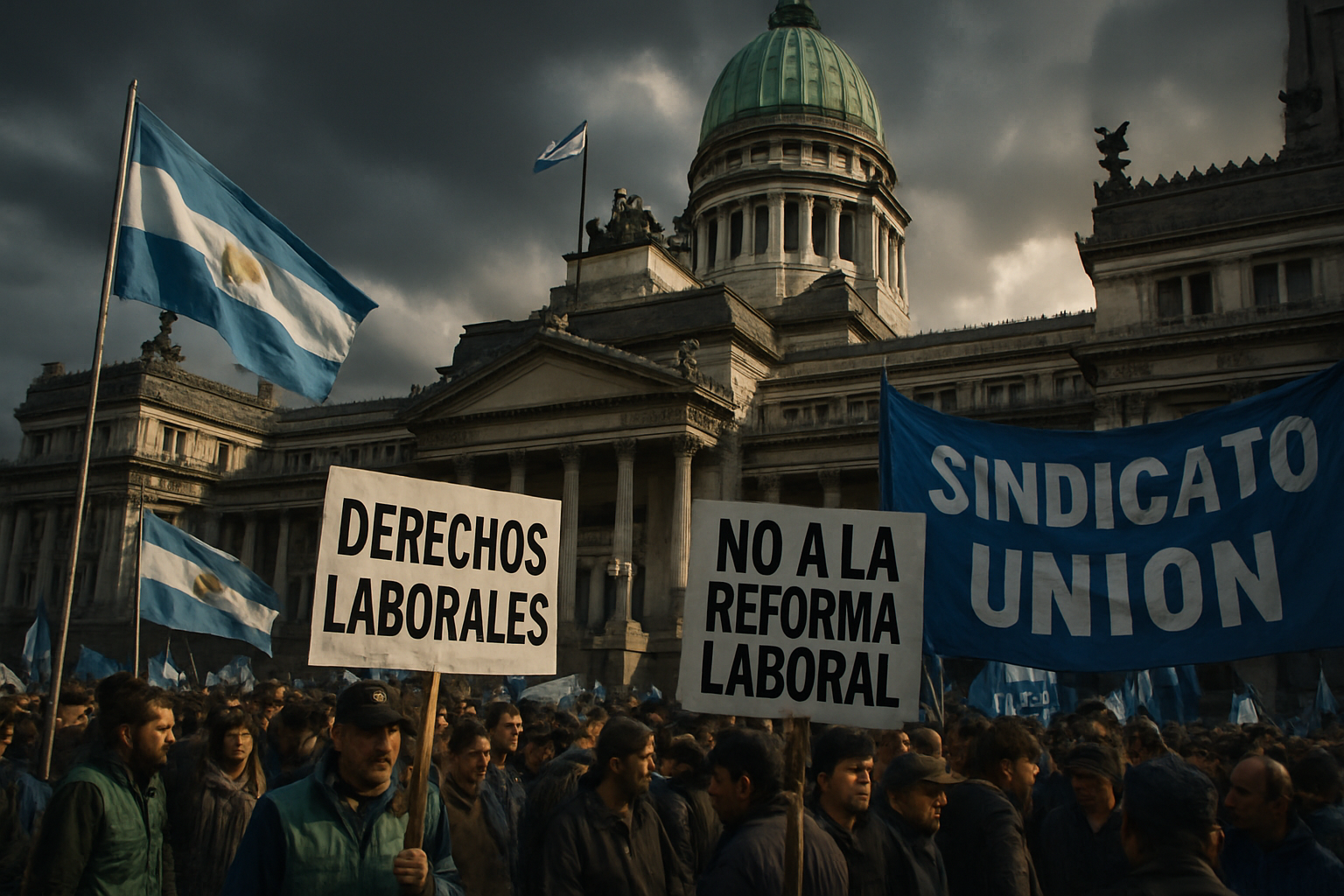
Argentina's contentious labor reform legislation faces a critical juncture as government officials claim to have secured enough votes for passage while major unions mobilize for a general strike, setting up a dramatic confrontation that could determine the future of President Javier Milei's economic transformation agenda.
Interior Minister Patricia Bullrich announced on Tuesday that the government has reached a "solid" consensus for the labor reform bill, securing crucial support from the Radical Civic Union (UCR) through strategic modifications to 30 key articles. Speaking after intensive congressional negotiations, Bullrich expressed confidence that the revised legislation has garnered sufficient votes for approval in Wednesday's Senate session.
Government Secures Key Political Support
The breakthrough comes after marathon negotiations between the ruling party and opposition legislators, particularly focusing on addressing UCR concerns about worker protections and implementation timelines. Government sources indicate that the modifications include enhanced safeguards for existing labor contracts and phased implementation of new flexibility measures.
"The consensus is solid," Bullrich stated, emphasizing that the government had successfully addressed major opposition concerns while maintaining the reform's core objectives. The Interior Minister's announcement represents a significant political victory for the Milei administration, which has faced fierce resistance to its economic reform agenda since taking office.
The Senate session, scheduled for 11 AM Wednesday, will serve as the critical test for the government's legislative strategy. If successful, the labor reform would advance to the lower house for final approval, potentially completing a key component of Milei's "irreversible economic changes" platform.
Transport Unions Join General Strike
Despite the government's optimism, Argentina's powerful labor confederation CGT (General Confederation of Labor) is proceeding with plans for a general strike Wednesday, now reinforced by the critical transport workers' union. The addition of transport workers significantly amplifies the potential impact of the protest, as it could paralyze Buenos Aires and other major cities during the crucial legislative session.
The CGT has positioned the strike as defending fundamental worker rights against what union leaders characterize as an assault on decades of labor protections. The confederation enjoys support from six provincial governors, including powerful Buenos Aires Governor Axel Kicillof, creating a formidable opposition coalition that spans both union and political leadership.
Transport union participation adds particular weight to the protest, given the sector's strategic importance to Argentina's economy and the symbolic power of shutting down movement in major urban centers. The timing - coinciding with the Senate vote - appears deliberately calculated to demonstrate union strength and potentially influence wavering legislators.
Economic Context Drives Reform Urgency
The labor reform initiative forms part of Milei's comprehensive economic restructuring program, designed to attract foreign investment and capitalize on new international opportunities, including the historic US-Argentina trade agreement that eliminated over 1,600 US tariffs on Argentine goods.
Government economists argue that labor market flexibility is essential for Argentina to compete globally and reverse decades of economic stagnation. The reforms aim to reduce hiring costs, streamline dismissal procedures, and introduce more flexible working arrangements that supporters claim will ultimately create more employment opportunities.
However, critics point to Argentina's complex economic situation, with inflation projected at 22.4% annually by independent economists (versus the government's 10.1% forecast) and ongoing currency volatility. Union leaders argue that weakening worker protections during an inflationary crisis would devastate middle and working-class families.
Controversial Proposals Under Debate
Among the most contentious elements of the reform package is the proposed Fund for Labor Assistance (FAL), which has drawn criticism from prominent economist Roberto Cachanosky. In a detailed analysis, Cachanosky outlined three primary objections to the FAL's inclusion in the labor reform framework.
Economic analysts warn that the FAL mechanism could create unintended distortions in the labor market while failing to provide meaningful support for displaced workers. These concerns have contributed to ongoing modifications in the legislative text, as government negotiators attempt to balance reform objectives with opposition concerns.
The modifications secured by Bullrich reportedly address some of these technical concerns while maintaining the reform's core flexibility objectives. However, union leaders remain skeptical that any adjustments can adequately protect worker interests in the face of what they view as fundamental attacks on labor rights.
International Stakes and Regional Implications
The outcome of Argentina's labor reform carries implications beyond national borders, as international investors and trading partners closely monitor Milei's ability to implement his promised economic transformation. The recent US-Argentina trade agreement specifically anticipates labor market modernization to maximize new export opportunities.
Regional observers note that Argentina's experience could influence similar reform debates across Latin America, where governments face pressures to modernize labor frameworks while managing powerful union movements. The balance between economic competitiveness and worker protection remains a central challenge for developing economies seeking to attract international investment.
Financial markets have responded positively to reform prospects, with Argentina's country risk indicator showing improvement in recent weeks. However, sustained economic confidence depends partly on the government's ability to implement changes without triggering prolonged social conflict.
Congressional Battle Lines Drawn
Wednesday's Senate session represents the culmination of months of political maneuvering, with both sides claiming momentum heading into the crucial vote. Government whip counts suggest a narrow but sufficient majority, while opposition leaders warn that rushed implementation could face constitutional challenges.
The modified legislation must now survive detailed scrutiny from senators who have faced intense pressure from both business groups supporting reform and union constituencies opposing changes. Provincial dynamics add complexity, as governors balance national political considerations with local economic interests.
UCR support proves particularly crucial given the party's traditional role as a swing vote in Argentine politics. The modifications negotiated by Bullrich appear designed to provide UCR legislators with political cover for supporting reforms that their traditional working-class base might oppose.
Looking Ahead: Implementation Challenges
Even if the labor reform passes Congress, implementation challenges loom large. Union resistance is expected to continue through legal challenges, workplace actions, and political pressure for future modifications. The CGT has demonstrated sustained organizational capacity throughout the Milei presidency, suggesting ongoing confrontation rather than acceptance of legislative defeat.
Government officials acknowledge that successful reform implementation requires more than legislative victory. Building consensus around new labor market rules will demand continued negotiation with business groups, unions, and provincial governments responsible for enforcement.
The international context also presents opportunities and constraints. While new trade agreements provide incentives for reform, Argentina's economic recovery depends on maintaining social stability and investor confidence simultaneously - a delicate balance that Wednesday's events may significantly influence.
As Argentina prepares for this decisive moment, the confrontation between Milei's reform agenda and organized labor represents a fundamental test of the country's democratic institutions and economic transformation capacity. The outcome will likely shape not only Argentina's labor landscape but also the broader trajectory of the Milei presidency and its ambitious economic revolution.