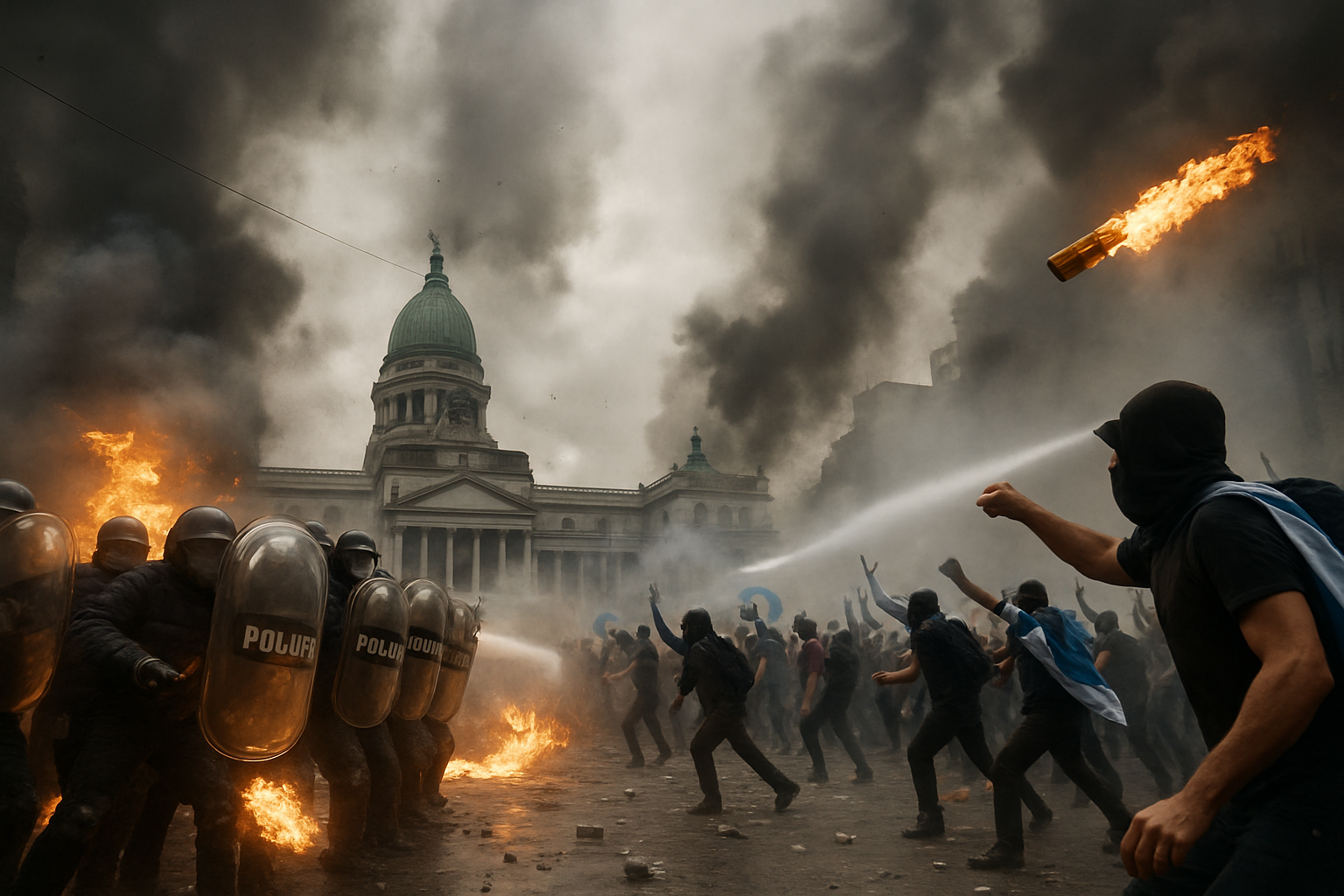
Violent confrontations erupted in Buenos Aires on Wednesday as thousands of protesters clashed with police outside the Argentine National Congress during demonstrations against President Javier Milei's controversial labor reform legislation, marking one of the most serious challenges to his administration since taking office.
The protests, organized by Argentina's powerful General Confederation of Labor (CGT), coincided with a crucial Senate debate over Milei's "Labor Modernization" bill, which seeks to fundamentally restructure the country's employment laws. What began as a planned demonstration quickly escalated into violent confrontations that left at least four police officers injured and resulted in multiple arrests.
Molotov Cocktails and Tear Gas Mark Violent Escalation
The most dramatic scenes unfolded around 3:30 PM on Rivadavia Avenue, when a group of masked protesters began hurling molotov cocktails, stones, and other projectiles at police lines. Television footage captured protesters preparing and launching firebombs in broad daylight, while federal forces responded with tear gas and water cannons to disperse the crowds.
Security Minister Alejandra Monteoliva condemned the violence, stating: "We will not allow the usual violent groups to sow chaos and disorder. The violent individuals who attacked our forces will be identified and prosecuted to the full extent of the law."
The confrontations represented a stark escalation from previous CGT demonstrations, which had typically remained peaceful despite strong opposition to Milei's economic policies. Images of firebombs being thrown at the iconic Congress building shocked many Argentines and drew widespread condemnation from government officials.
Political Opposition Rallies Against Reform
Buenos Aires Governor Axel Kicillof, a leading figure in the Peronist opposition, joined the protest and delivered sharp criticism of the government's labor proposals. "We will not validate a project that puts workers' rights at risk," Kicillof declared, positioning himself as a key opponent of Milei's reform agenda ahead of potential 2027 presidential ambitions.
The protest brought together an unusual coalition of labor unions, left-wing political parties, and Peronist groups, including both branches of the Central Workers' Union (CTA), the Left Front, and the La Cámpora organization. This broad alliance demonstrated the significant opposition Milei faces in implementing his structural reform agenda.
What's in Milei's Labor Reform Package
The legislation under debate represents one of the most significant overhauls of Argentina's labor laws in decades. Key provisions include:
- Implementation of a "bank of hours" system that fundamentally changes overtime calculations
- Reduced worker indemnification scope while maintaining basic severance protections
- Modified financing structures for severance payments
- Changes to tax obligations and union contributions
- Enhanced labor market flexibility measures to attract foreign investment
Interior Minister Patricia Bullrich had previously modified over 30 articles of the original proposal to secure support from the centrist Radical Civic Union (UCR), demonstrating the government's tactical flexibility in advancing the legislation. Despite these concessions, union opposition remained fierce.
Economic Context Drives Reform Push
The labor reform forms a crucial component of Milei's broader economic restructuring strategy, designed to capitalize on Argentina's recent historic trade agreement with the United States. The bilateral deal eliminates over 1,600 US tariffs on Argentine goods and positions the country as a key Trump administration partner in South America.
Argentina continues to grapple with significant economic challenges, including projected annual inflation of 22.4% according to central bank economists - more than double the government's optimistic 10.1% forecast. January 2026 monthly inflation reached 2.9%, extending an upward trend that has persisted for five consecutive months.
Despite these pressures, currency markets have remained relatively stable, with the official dollar rate at 1,442 pesos and the parallel "blue dollar" rate at two-month lows. The country's risk indicator has shown improvement following news of the US trade deal and reform momentum.
Senate Debate Continues Amid Chaos
As violence raged outside, the Senate continued its lengthy debate session, which was expected to extend well past midnight. With almost 40 senators registered to speak, the government appeared confident it had secured sufficient votes for passage despite the narrow margins in the upper chamber.
The timing of the protest was deliberately calculated to coincide with the legislative session, creating maximum pressure on senators as they deliberated. Television broadcasts alternated between scenes of Senate floor debates and dramatic footage of street confrontations, underlining the stakes involved in the reform process.
International Attention and Broader Implications
The violent protests drew extensive international media coverage, with regional neighbors closely monitoring developments in South America's second-largest economy. Peru's El Comercio reported that at least four security force members were injured and two protesters detained during the confrontations.
The events occurred against the backdrop of Milei's broader "shock therapy" economic program, which has included massive public spending cuts, currency devaluation, and the elimination of numerous government subsidies. While these measures have won praise from international financial institutions, they have also generated significant domestic resistance.
CGT Strategy and Labor Movement Response
The CGT's decision to organize the protest without a traditional speakers' platform emphasized mass participation over political rhetoric, reflecting the confederation's strategy to demonstrate broad-based opposition to the reforms. The union leadership had previously struggled to build consensus for a fourth general strike against Milei's government, making the protest an important test of their mobilization capacity.
Labor leaders argued that the reforms would strip away decades of worker protections and reduce Argentina's employment standards to benefit multinational corporations. They particularly criticized provisions that would make it easier for companies to dismiss workers and reduce severance payments.
Government Doubles Down on Reform Agenda
Despite the violent confrontations, government officials showed no signs of backing down from their reform agenda. Milei's administration has consistently argued that labor market flexibility is essential for attracting foreign investment and creating jobs in a more competitive global economy.
The government's ability to maintain Senate support despite street pressure will be seen as a crucial test of Milei's political durability. Success in passing the labor reform could provide momentum for additional structural changes, including tax reform and further deregulation measures.
Looking Ahead: Challenges and Opportunities
The violent protests highlight the significant challenges Milei faces in implementing his ambitious reform agenda while maintaining social stability. The images of molotov cocktails being thrown at the Congress building will likely resonate in Argentine political discourse for months to come.
If the Senate approves the labor reform, it would advance to the lower house for final passage, where the government enjoys somewhat stronger support. However, the street violence demonstrates that implementation challenges may persist even after legislative victory.
The protests also underscore the broader question of whether Argentina can successfully navigate the transition from its traditional state-centered economic model to the market-oriented approach championed by Milei. With inflation remaining stubbornly high and significant sectors of society opposed to his policies, the president faces a delicate balancing act between reform momentum and social stability.
As Argentina continues to grapple with these fundamental questions about its economic future, the violent scenes outside Congress serve as a stark reminder of the stakes involved in the ongoing transformation of South America's second-largest economy.