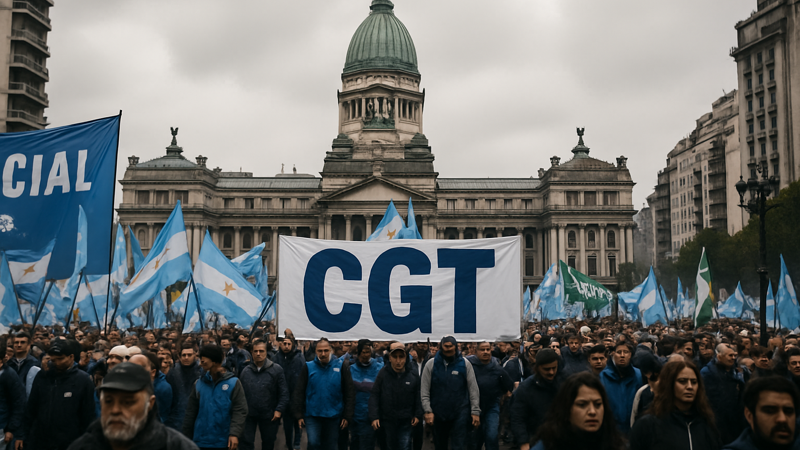
Argentina's General Confederation of Labor (CGT) has announced a comprehensive 24-hour national strike to coincide with the Chamber of Deputies' final debate on President Javier Milei's controversial labor reform legislation, representing the most significant organized resistance to the libertarian administration's sweeping economic restructuring agenda.
The timing of the strike is strategically calculated to maximize political pressure during the crucial legislative session where the Chamber of Deputies will consider final approval of reforms that have already passed the Senate with a narrow 42-30 majority in February following unprecedented violent protests outside the National Congress.
Strike Scope and Transportation Impact
The nationwide work stoppage will significantly impact Argentina's transportation networks, with collective buses, trains, and flights facing substantial disruptions. The CGT has coordinated with major transport unions to ensure maximum participation, though the confederation has notably announced there will be no mass mobilization march, departing from traditional protest tactics in favor of work-based action.
The strike coincides with the exact day that the Chamber of Deputies is scheduled to debate the labor reform package, creating a dramatic backdrop that alternates between legislative proceedings and nationwide labor action. This strategic synchronization demonstrates the CGT's sophisticated political calculation to apply maximum pressure at the decisive legislative moment.
Labor Reform Content and Controversy
The legislation at the center of the conflict introduces sweeping changes to Argentina's labor framework, most notably the "bank of hours" overtime system that would enable employer scheduling flexibility while modifying traditional overtime calculations. The reform package also includes reduced worker indemnification scope while maintaining basic severance protections, adjusted union contribution requirements, and digital registration systems.
Interior Minister Patricia Bullrich successfully modified over 30 articles of the original proposal to secure support from the Radical Civic Union (UCR) and dialoguist opposition blocs, demonstrating the government's tactical flexibility in building legislative coalitions beyond its libertarian base.
"This reform represents a fundamental attack on decades of worker protections," declared CGT co-secretary Cristian Jerónimo, who has positioned the strike as a defense of fundamental labor rights against what unions characterize as a rollback of social progress.
— Cristian Jerónimo, CGT Co-Secretary
The reform is designed to complement Argentina's historic trade agreement with the United States, which eliminates over 1,600 US tariffs on Argentine goods while positioning labor market flexibility as essential for capitalizing on new international opportunities and attracting foreign investment.
Political Coalition Building and Opposition
President Milei's government has achieved remarkable political success in building coalitions through strategic alliances between La Libertad Avanza, PRO, UCR, and dialoguist blocs while effectively isolating traditional Peronist parties. This coalition-building capacity represents a significant political achievement for an administration that began with a narrow congressional base.
Buenos Aires Governor Axel Kicillof has emerged as a leading opposition figure, personally joining earlier protests and positioning himself as a defender of worker rights in what appears to be strategic positioning for the 2027 presidential campaign. Six provincial governors have publicly supported the union position, demonstrating the political stakes involved in the reform debate.
The opposition coalition includes not only the CGT but also both CTA branches, the Left Front, La Cámpora, and various Peronist groups, representing the broadest organized resistance to the Milei administration since taking office.
Economic Context and International Implications
The labor reform occurs amid complex economic pressures, with economists projecting 22.4% annual inflation for 2026, more than double the government's forecast of 10.1%. Despite these inflationary pressures, currency stability has been maintained with the official dollar at 1,442 pesos and the blue dollar at two-month lows, reflecting some market confidence in the administration's reform agenda.
The country risk indicator has improved to 504 points, indicating investor optimism about structural changes, while the reform complements Argentina's positioning as a key Trump administration partner in South America through the comprehensive bilateral trade agreement.
Argentina's employment landscape shows significant strain, with 21,938 fewer companies operating under the Milei administration according to official data, heavily concentrated in the construction sector facing negative profit margins due to material cost increases.
Historical Context of CGT-Government Confrontations
This strike represents the most serious CGT confrontation with the government since the violent protests during Senate approval, when demonstrators threw Molotov cocktails and stones at federal police outside the National Congress, resulting in over 50 arrests and an estimated 270 million pesos in property damage.
The February Senate session marked unprecedented violence in recent Argentine labor history, with the imagery of firebombs at the Congress building creating lasting political symbolism. Despite the street violence, Senate proceedings continued past midnight, demonstrating the government's determination to advance its reform agenda.
Previous CGT actions have typically involved peaceful demonstrations, making the escalation to systematic property destruction and violent confrontations a significant tactical shift that reflects the intensity of opposition to structural economic changes.
Implementation Challenges and Legal Battles
Even if the Chamber of Deputies approves the legislation, implementation faces substantial challenges. Union leaders have signaled court challenges that could create years of litigation, while the reform requires extensive regulatory development and employer training for effective implementation.
Success depends on sustained political commitment, effective federal-provincial coordination, and ongoing workplace negotiations to maintain operational stability amid continued union opposition. The CGT has demonstrated remarkable organizational capacity and political coordination suggesting continued confrontation rather than acceptance of potential legislative defeat.
International monitoring organizations, including those focused on labor standards, are observing the implementation process as Argentina must balance domestic reform objectives with International Labour Organization commitments and international labor standards.
Regional and International Significance
Argentina serves as a critical test case for comprehensive structural reform implementation through democratic processes in Latin America. The success or failure of managing social tensions while maintaining democratic governance and institutional effectiveness will influence similar efforts throughout the region.
The reform package positions Argentina as a template for economic modernization that balances market flexibility with democratic accountability, though the violent opposition demonstrates the challenges of implementing necessary but unpopular reforms through democratic institutions.
European and regional media coverage has been extensive, monitoring how democratic societies can manage comprehensive economic transformation while preserving social stability and institutional legitimacy. The outcome affects investor confidence and regional debates about the capacity for structural change within democratic frameworks.
Government Response and Future Outlook
The Milei administration has remained confident about Chamber of Deputies approval, citing continued coalition unity and public support for modernization efforts. The government argues that labor flexibility is essential for global competitiveness and job creation while maintaining that basic worker protections remain intact.
Security Minister Patricia Bullrich has indicated that enhanced security protocols will be implemented during the legislative session, with federal forces prepared to maintain order and ensure congressional proceedings can continue regardless of street pressure.
The coming weeks will prove decisive for determining whether the administration can maintain reform momentum and translate legislative victories into effective implementation, or whether sustained organized labor resistance will create ongoing institutional challenges to the comprehensive economic restructuring agenda.
The 24-hour strike represents not just opposition to specific labor reforms, but a fundamental challenge to President Milei's broader vision of structural economic transformation, making its outcome crucial for Argentina's political and economic trajectory in the years ahead.