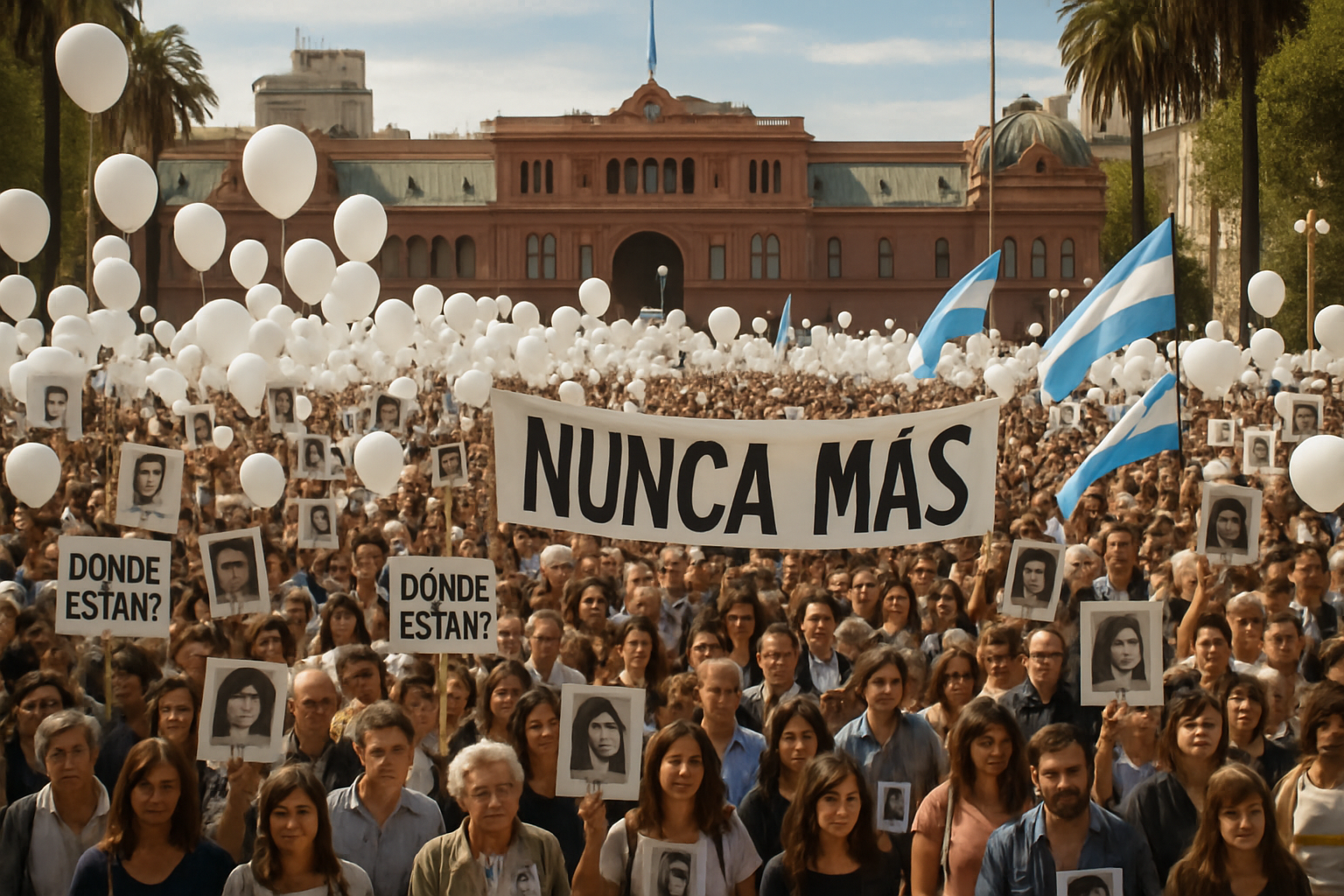
Tens of thousands of Argentines marched through Buenos Aires on Tuesday, marking exactly 50 years since the military coup that installed a brutal dictatorship, in what became one of the largest memorial demonstrations in recent history amid growing tensions with President Javier Milei's administration.
Under the historic battle cry "Nunca Más" (Never Again) that has defined generations of Argentines, the massive mobilization stretched across the kilometer separating Plaza de Mayo from 9 de Julio Avenue, with crowds spilling into adjacent streets in a sea of white balloons carrying photographs of the disappeared.
The march, led by the iconic Mothers and Grandmothers of Plaza de Mayo, took on special significance as participants directly challenged President Milei's recent attempts to revise the historical narrative surrounding the dictatorship. Signs reading "No nos han vencido" (They have not defeated us) and chants demanding "¡Que digan dónde están!" (Tell us where they are!) echoed through the capital's streets.
Historic Confrontation with Current Government
The commemoration occurred against a backdrop of unprecedented political tension, as the Mothers and Grandmothers of Plaza de Mayo have publicly responded to President Milei's controversial statements questioning the official count of 30,000 disappeared persons during the 1976-1983 dictatorship.
In a festive yet defiant atmosphere, protesters carried banners declaring "Aún te estamos buscando" (We are still looking for you) while white balloons with photos of the disappeared rose into the Buenos Aires sky, creating a powerful visual reminder of the unresolved trauma that continues to define Argentine society.
"The disappeared are 30,000, and we will never stop searching for them,"
— Mothers and Grandmothers of Plaza de Mayo statement
The demonstration represents the latest chapter in Argentina's ongoing struggle over historical memory, particularly relevant as the country grapples with President Milei's libertarian administration, which has shown sympathy for revisionist interpretations of the military period.
50 Years of Remembrance and Resistance
March 24, 1976, marks the date when a military junta overthrew the constitutional government of Isabel Perón, initiating what would become one of Latin America's most brutal dictatorships. The regime, known for its systematic use of enforced disappearances, torture, and murder, left an estimated 30,000 people dead or disappeared.
The Mothers of Plaza de Mayo, who began their weekly vigils in 1977 searching for their missing children, have become global symbols of peaceful resistance and human rights advocacy. Their Thursday afternoon marches around the Plaza de Mayo's central pyramid continue to this day, making them one of the world's longest-running human rights movements.
The military government's reign of terror particularly targeted students, workers, intellectuals, and anyone suspected of opposing the regime. Clandestine detention centers operated throughout the country, where victims were subjected to torture before many were killed and their bodies disposed of in mass graves or thrown from aircraft into the Río de la Plata.
Contemporary Political Tensions
Tuesday's massive turnout reflects growing concern among human rights organizations about the current political climate under President Milei, whose administration has shown concerning tendencies toward historical revisionism. The president's questioning of the 30,000 figure has been interpreted by many as an attempt to minimize the dictatorship's crimes.
The march also comes amid broader social tensions as Milei's government implements sweeping economic reforms that have sparked widespread protests from labor unions and social movements. The country has experienced multiple general strikes since Milei took office, with critics arguing his policies threaten Argentina's social fabric.
International observers have noted parallels between current political polarization and the conditions that preceded the 1976 coup, though Argentina's democratic institutions have proven far more resilient than in the past.
Legacy of Memory and Justice
Argentina has become a global model for transitional justice following its return to democracy in 1983. Unlike many Latin American countries that granted amnesty to military leaders, Argentina eventually prosecuted hundreds of former officials for crimes against humanity.
The country's commitment to memory is institutionalized through the National Memory Day, observed annually on March 24, and numerous memorial sites including the former ESMA detention center, now converted into a Space for Memory and Human Rights.
However, the memory debate continues to evolve with new generations. While older Argentines lived through the dictatorship or its immediate aftermath, younger citizens know the period primarily through education, commemorations, and family stories, making preservation of accurate historical memory increasingly crucial.
International Recognition and Ongoing Challenges
The Mothers and Grandmothers of Plaza de Mayo have received international recognition for their decades-long struggle, influencing human rights movements worldwide. Their work has been particularly important in developing legal frameworks for prosecuting crimes against humanity and disappearances.
The Grandmothers have successfully identified 130 grandchildren stolen during the dictatorship and raised by military families or others connected to the regime. Their scientific approach to identification, working with geneticists and international databases, has become a model for similar efforts globally.
Despite these achievements, significant challenges remain. Many perpetrators died before being prosecuted, thousands of cases remain unresolved, and political polarization continues to threaten consensus around human rights issues.
Looking Forward
As Argentina marks this solemn anniversary, the massive turnout for Tuesday's march demonstrates that historical memory remains a vital force in the country's political life. The participation spans generations, from elderly survivors to young people born decades after the dictatorship ended.
The challenge for Argentina moving forward will be maintaining this commitment to memory and human rights while addressing contemporary economic and social challenges. The intersection of historical memory with current politics ensures that the legacy of March 24, 1976, continues to shape the nation's democratic discourse.
Tuesday's march served as both a remembrance of past suffering and a statement about present values, with participants making clear that Argentina's commitment to "Nunca Más" extends beyond historical commemoration to encompass vigilance about contemporary threats to human rights and democratic institutions.