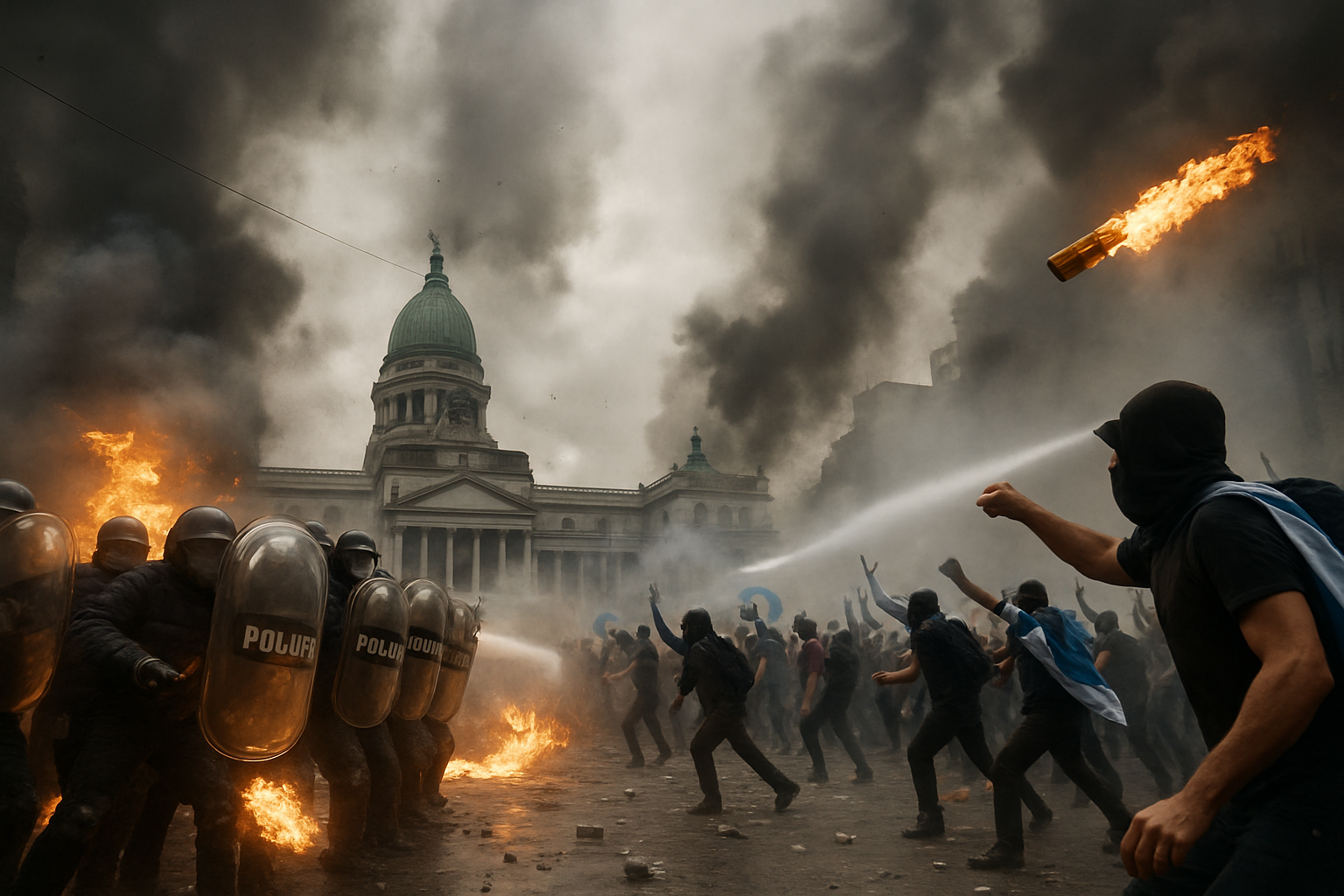
Violent confrontations erupted in Buenos Aires as thousands of protesters opposed to President Javier Milei's labor reform legislation clashed with federal police outside the National Congress, with demonstrators throwing Molotov cocktails, stones, and bombs against uniformed officers during a crucial Senate debate.
The protests, organized by Argentina's powerful General Confederation of Labor (CGT), escalated dramatically on February 11, 2026, as lawmakers inside the Congress debated the government's controversial "Labor Modernization" bill. More than 50 people were arrested during the disturbances that continued for hours, while the Senate session proceeded past midnight despite the violence outside.
Unprecedented Violence Rocks Congressional District
The confrontations began around 3:30 PM on Rivadavia Avenue, where masked protesters were seen in broad daylight preparing firebombs and hurling them at federal police officers. Video footage captured demonstrators systematically breaking sidewalks with hammers and using the debris as projectiles against law enforcement.
According to multiple news sources, the violence far exceeded typical CGT demonstrations, with protesters employing tactics rarely seen in Argentine labor protests. Federal forces responded with tear gas and water cannons as the situation deteriorated throughout the afternoon and evening.
"The manifestants threw stones and Molotov cocktails against the uniformed officers. The disturbances continue despite the passage of hours,"
— Perfil News Report
Security Minister Alejandra Monteoliva confirmed that four police officers were injured during the clashes, with two protesters also requiring medical attention. The government implemented enhanced security protocols around the Congress building, deploying federal forces under anti-protest measures designed to ensure legislative proceedings could continue.
Broad Opposition Coalition Mobilizes
The protests represented one of the most significant organized resistance efforts against the Milei administration since taking office. The coalition included not only the CGT but also both branches of the Central de Trabajadores de la Argentina (CTA), the Left Front, La Cámpora, and various Peronist groups.
Buenos Aires Governor Axel Kicillof joined the demonstration, using the occasion to criticize what he called a "project that puts workers' rights at risk." Kicillof's participation signals his positioning for the 2027 presidential campaign while providing the opposition with a unified voice against Milei's reform agenda.
The protests were strategically timed to coincide with the Senate session, creating dramatic television imagery as broadcasters alternated between floor debates inside Congress and violent confrontations on the streets outside.
Government Damage Assessment
Buenos Aires city government officials revealed that the destruction caused during the march cost the city approximately 270 million pesos. The Ministry of Public Space and Urban Hygiene had preemptively removed 140 containers across more than 60 blocks of the downtown microcentro to prevent damage and obstruction of public thoroughfares.
Despite these preventive measures, protesters managed to cause significant damage to public infrastructure, breaking sidewalks and damaging street furniture. The cleanup operation required extensive municipal resources and continued through the night following the demonstrations.
Labor Reform at the Center of Controversy
The violent protests centered on opposition to Milei's proposed labor reform legislation, which includes several controversial provisions that unions argue will undermine worker protections. The bill introduces a "bank of hours" overtime system, reduces worker indemnification requirements, and modifies severance payment financing structures.
Interior Minister Patricia Bullrich had modified more than 30 articles of the original proposal to secure support from the Radical Civic Union (UCR), demonstrating the government's recognition that the legislation faced significant resistance even from traditional allies.
The reform package is designed to complement Argentina's recent trade agreement with the United States, which eliminated more than 1,600 tariffs. Government officials argue that labor market flexibility is essential for capitalizing on new international opportunities and attracting foreign investment.
International Context and Economic Pressure
The protests occurred against a backdrop of significant economic challenges, with economists projecting 22.4% annual inflation for 2026, more than double the government's forecast of 10.1%. Despite these pressures, currency markets have remained relatively stable, with the official dollar at 1,442 pesos and the blue dollar at two-month lows.
Argentina's country risk indicator has been elevated at more than 500 points according to JP Morgan, though markets have shown cautious optimism about the government's reform program. The labor legislation represents a critical test of Milei's ability to implement structural changes while managing social tensions.
Political and Security Response
President Milei was reportedly "enraged" by the violent protests, according to government sources. Security Minister Monteoliva declared that violent groups would be "identified and prosecuted," emphasizing the government's intention to implement strict anti-protest protocols.
The violence represented a shocking escalation from typically peaceful CGT demonstrations, with images of Molotov cocktails being thrown at the Congress building creating powerful political imagery that is expected to resonate in ongoing political discourse.
"Modernizing is not about removing rights. It's about providing predictability, generating incentives to hire, and opening new opportunities for new generations,"
— US Chamber of Commerce in Argentina
Senate Proceedings Continue Despite Violence
Despite the violent confrontations outside, the Senate session continued through the night, with the vote on the labor reform expected around midnight. The government expressed confidence in securing passage, claiming to have more than 40 votes in the 72-member upper chamber.
The persistence of the legislative session while violence raged outside demonstrated the government's determination to advance its reform agenda regardless of street pressure. Television coverage alternated between the formal parliamentary debate and dramatic scenes of protesters clashing with police, creating a stark contrast that highlighted Argentina's political tensions.
Historical Significance and Future Implications
The February 11 protests represent the most serious violent confrontation during CGT-organized demonstrations in recent Argentine history. The use of Molotov cocktails and systematic property destruction marks a significant escalation in tactics that could reshape how labor disputes are conducted in Argentina.
The violence also tests Argentina's democratic institutions' capacity to manage intense social tensions while pursuing comprehensive economic reforms. Success or failure in implementing the labor legislation could determine the government's ability to advance additional structural changes in tax policy and deregulation.
International observers are closely monitoring developments as Argentina represents a test case for structural reform implementation in Latin America. The outcome could influence similar reform efforts across the region and demonstrate whether democratic governments can successfully navigate the complex balance between economic modernization and social stability.
As cleanup efforts continue and investigations into the violence proceed, Argentina faces the challenge of maintaining reform momentum while addressing the underlying social tensions that erupted so dramatically outside the National Congress. The coming weeks will prove crucial for determining whether the government can achieve its legislative objectives while preserving democratic norms and public order.