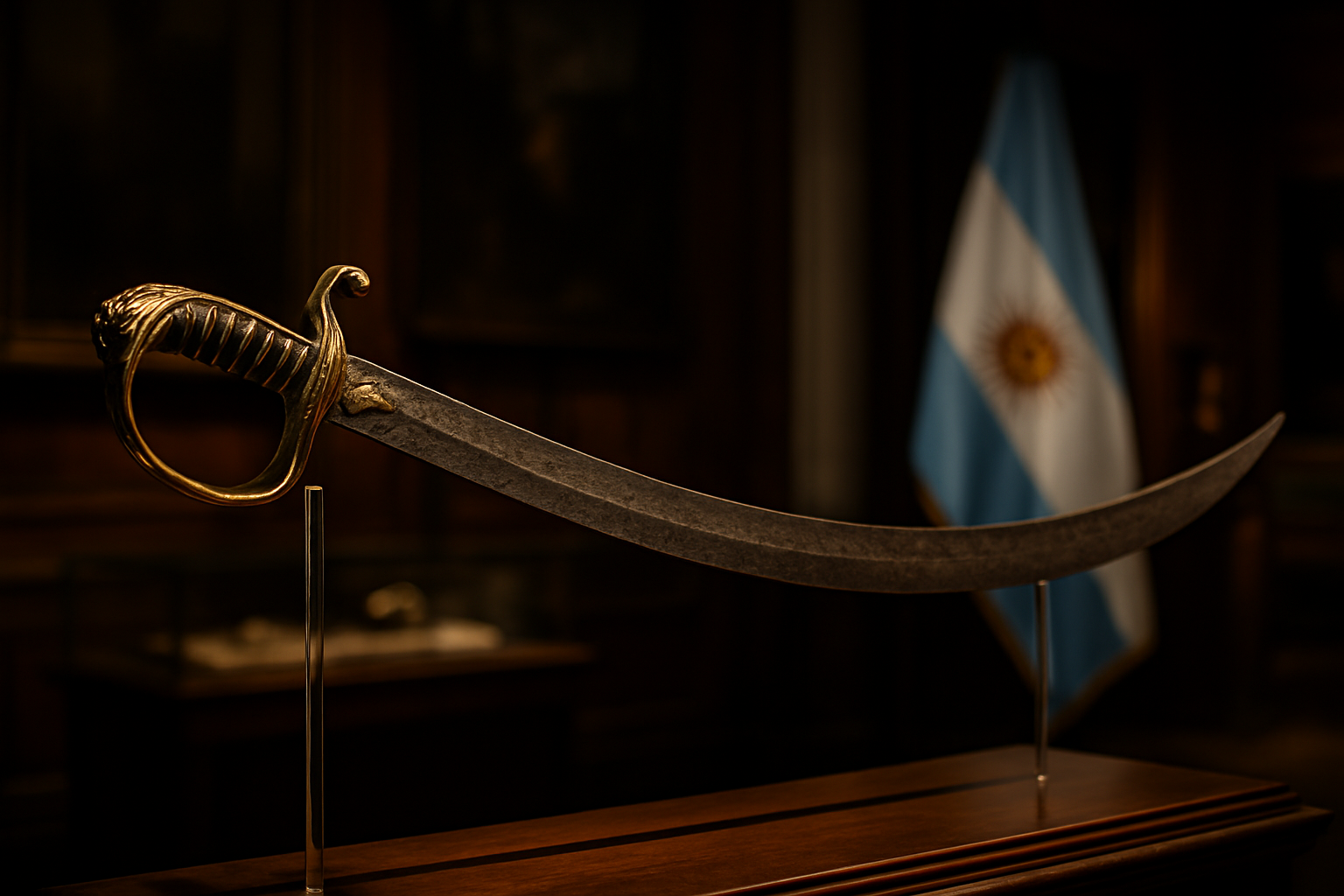
Argentina's government has officially transferred the iconic curved saber of independence hero General José de San Martín from the National Historical Museum to the headquarters of the Grenadiers Regiment, marking a significant shift in the custody of one of the nation's most revered historical artifacts.
The controversial decision was formalized through Decree 81/2026, published in the Official Bulletin on February 3, 2026, and signed by President Javier Milei and Army Chief Carlos Alberto Presti. The measure reverses previous legislation from 2015 that mandated the weapon's permanent exhibition at the National Historical Museum, transferring custody to the Grenadiers Regiment barracks located in the Palermo neighborhood of Buenos Aires.
Historical Significance of the Saber
The curved saber, known as the "Sable Corvo," holds extraordinary historical importance as one of Argentina's most significant national symbols. San Martín acquired the weapon in a small London shop before embarking for Buenos Aires to offer his services to the cause of American independence. The blade is crafted from damascened steel, a material prized for its resistance and cutting capability, making it ideal for light cavalry operations.
The weapon's elegant ebony wood handle and bronze-and-leather scabbard reflect both functionality and aesthetic refinement. After accompanying San Martín through his military campaigns that liberated Argentina, Chile, and Peru, the saber was donated to the Argentine state in 1897, officially becoming part of the national historical patrimony.
"The saber constitutes one of the most representative symbols of national sovereignty and has been part of the State's historical patrimony since its donation in 1897."
— Decree 81/2026, Official Text
Government Justification and Military Custody
According to the official decree, the transfer aims to enhance the weapon's "preservation and security" by placing it under the direct guard and custody of the military corps founded by San Martín himself. The Grenadiers Regiment, established by the Liberator, is considered the most appropriate custodian given its historical connection to the independence hero.
The government argues that the relocation responds to "criteria of safeguarding" and represents a return to the weapon's natural institutional home. Military officials emphasize that the Regiment of Grenadiers has maintained an unbroken tradition of ceremonial duties and historical preservation since San Martín's era.
Opposition and Cultural Heritage Concerns
The decision has generated significant controversy among historians, museum professionals, and cultural heritage advocates. Critics argue that the transfer removes the saber from public accessibility and academic study opportunities that the National Historical Museum provided.
Editorial commentary from La Nación newspaper questioned the rationale behind the move, stating that "no valid reason exists to modify the custody location of the relic." The editorial emphasized concerns about democratic oversight of cultural patrimony decisions, arguing that "no government should decide unilaterally about symbols that constitute the founding anchor of our Nation."
Museum experts note that the National Historical Museum offered specialized conservation conditions, climate control, and public educational programs that may not be replicated in a military setting. The transfer also raises questions about research access and scholarly examination of the artifact.
Broader Context of Milei Administration Policies
The sword transfer occurs within a broader pattern of policy changes under President Milei's administration, which has pursued significant reforms across multiple government sectors. Recent memory from our archives indicates that the administration has already implemented changes to Argentina's statistical agency INDEC, appointing Pablo Lines as the new head following Marco Lavagna's resignation.
The government has also delayed implementing new inflation measurement methodologies, prioritizing statistical consistency over modernization during the current economic transition. These decisions reflect the administration's approach of maintaining institutional continuity while pursuing broader economic reforms.
Argentina's country risk indicator recently fell to 491 points according to JP Morgan, suggesting some market confidence in the government's economic direction, though the administration faces ongoing challenges with inflation control and debt management.
Symbolic Politics and National Identity
Cultural heritage experts view the sword transfer as potentially carrying symbolic political messaging beyond practical preservation concerns. The move from a civilian museum to military custody may signal the administration's emphasis on traditional military values and institutional hierarchy.
The timing of the decree, coming amid various economic and social policy reforms, suggests the government may be seeking to demonstrate its connection to foundational national symbols while implementing contemporary changes. San Martín remains Argentina's most universally respected historical figure, transcending political divisions.
International Precedents and Cultural Policy
The controversy reflects broader global debates about cultural heritage management, public access to historical artifacts, and the balance between preservation and accessibility. International museum standards generally favor public institutions for cultural patrimony, emphasizing educational mission and scholarly access.
Similar debates have occurred in other nations regarding the custody of founding artifacts, often involving questions about military versus civilian stewardship, security concerns, and public engagement with national heritage.
Future Implications
The transfer establishes a precedent for how the Milei administration approaches cultural heritage decisions, potentially influencing future policies regarding other significant historical artifacts and national symbols. Critics worry about the precedent of removing culturally important items from public museums without extensive consultation.
The decision may also affect Argentina's cultural diplomacy and international academic cooperation, as scholars and institutions worldwide have traditionally accessed significant artifacts through established museum networks rather than military installations.
As Argentina continues navigating economic challenges and social reforms under President Milei's leadership, the management of national symbols and cultural heritage will likely remain a sensitive indicator of the government's broader approach to balancing tradition with change. The sword of San Martín, having witnessed the birth of the nation, now finds itself at the center of contemporary debates about how modern Argentina should preserve and present its foundational history.