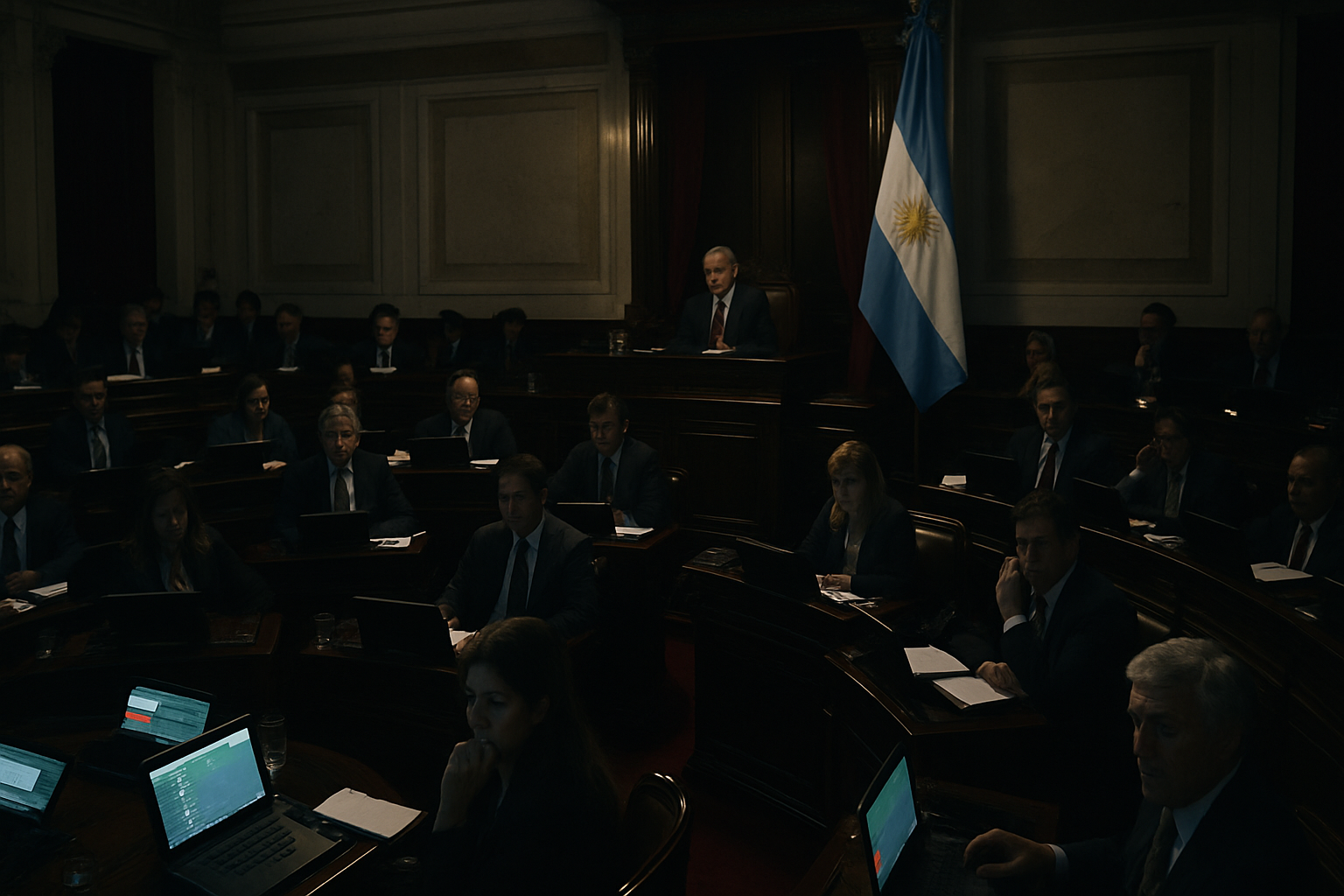
Argentina's Senate approved President Javier Milei's contentious labor reform legislation in the early hours of Thursday morning, passing the bill 42-30 after a marathon 12-hour debate that coincided with violent protests outside the National Congress building.
The legislation, which received media sanción (half-sanction) from the upper chamber, now advances to the Chamber of Deputies for final approval. The government secured the votes despite fierce opposition from Peronist parties and unprecedented street violence that saw protesters hurl Molotov cocktails at federal police forces.
Violence Erupts Outside Congress
The Senate session took place against the backdrop of the most serious violent confrontations during a CGT-organized demonstration in recent Argentine history. Beginning at 3:30 PM on Rivadavia Avenue, masked protesters prepared firebombs in broad daylight and systematically broke sidewalks with hammers to use debris as projectiles.
Security Minister Alejandra Monteoliva confirmed that federal police responded with tear gas and water cannons after being attacked with stones, bombs, and Molotov cocktails. At least four police officers were injured and two protesters were hospitalized during the hours-long clashes that continued past midnight.
"Violent groups will be identified and prosecuted,"
— Alejandra Monteoliva, Security Minister
The Buenos Aires city government assessed damage at 270 million pesos, despite preemptively removing 140 containers across 60+ blocks. More than 50 arrests were made during the disturbances, which marked a shocking escalation from typically peaceful CGT demonstrations.
Legislative Victory for Milei Administration
Despite the street violence, the Senate proceeded with the debate and voting process. The final tally of 42 votes in favor and 30 against represented a significant victory for President Milei's libertarian agenda, demonstrating his ability to build coalitions beyond his La Libertad Avanza party.
Interior Minister Patricia Bullrich played a crucial role in securing the victory, modifying more than 30 articles of the original proposal to gain support from the Radical Civic Union (UCR) and other opposition dialoguist blocs. The changes addressed concerns about worker protections while maintaining the reform's core flexibility objectives.
The legislation introduces fundamental changes to Argentina's labor relations, including a "bank of hours" overtime system that allows employers greater flexibility in scheduling, modifications to severance financing, and reductions in certain indemnification requirements while preserving basic worker protections.
Economic Context and Reform Objectives
The labor reform forms part of Milei's comprehensive economic restructuring aimed at attracting foreign investment and capitalizing on the recently signed US-Argentina trade agreement that eliminates over 1,600 US tariffs on Argentine goods. Government officials argue that labor flexibility is essential for global competitiveness and job creation.
The reform comes as Argentina grapples with persistent inflation challenges. Recent data shows monthly inflation reached 2.9% in January 2026, with economists projecting 22.4% annual inflation for 2026 - more than double the government's forecast of 10.1%.
The currency has remained stable with the official dollar at 1,442 pesos and the blue dollar at two-month lows, providing some economic stability amid the political turbulence. Country risk indicators have fluctuated around 500-520 points according to JP Morgan, reflecting cautious optimism about the reform agenda.
Opposition Coalition and Political Isolation
The legislative session demonstrated the isolation of Peronist forces, with various factions of the movement united in opposition but unable to prevent the reform's passage. Buenos Aires Governor Axel Kicillof personally joined the protests outside Congress, criticizing the "project that puts workers' rights at risk" while positioning himself for the 2027 presidential campaign.
The protest coalition included the CGT, both CTA branches, the Left Front, La Cámpora, and various Peronist groups, representing the most significant organized resistance to the Milei administration since he took office. However, their unified opposition proved insufficient against the government's legislative alliance.
"Historic"
— President Javier Milei, via social media
President Milei celebrated the victory by sharing an image of the voting board on social media with the simple caption "Histórico" (Historic). Government officials described the passage as "a first step toward a change historic," while the opposition insisted the reforms represented a century-long step backward for workers' rights.
Key Reform Provisions
The approved legislation maintains the core elements of Milei's original proposal while incorporating the modifications negotiated by Minister Bullrich. The "bank of hours" system allows employers to average overtime across longer periods, potentially reducing immediate overtime payments while maintaining annual limits.
Changes to indemnification include reduced scope for certain claims while preserving basic severance protections. The reform also modifies the financing structure for severance payments and introduces changes to tax obligations and union contributions, though specific details on union funding were among the areas most heavily amended during negotiations.
The legislation eliminates the proposed reduction of income tax (impuesto a las Ganancias) and significantly scaled back originally planned cuts to union funds, reflecting the compromises necessary to secure passage.
International and Economic Implications
The reform's passage positions Argentina to better capitalize on international trade opportunities, particularly the comprehensive agreement with the United States that includes agricultural access, lithium cooperation, and Port of Rosario expansion provisions. The Trump administration has positioned Argentina as a key South American partner in countering Chinese regional influence.
Financial markets are expected to respond positively to the policy certainty provided by the legislative victory, though implementation challenges remain. The reform must survive anticipated legal challenges from unions and requires extensive regulatory development and employer training programs.
The success also strengthens Milei's position for pursuing additional structural changes in tax and regulatory frameworks, though the violent protests demonstrate the social tensions that comprehensive economic modernization can generate.
Next Steps and Implementation
The legislation now moves to the Chamber of Deputies, where the government will seek to maintain its coalition and secure final approval before the close of the extraordinary session period. While the government expresses confidence about passage in the lower chamber, opposition parties are mobilizing to prevent or further modify the legislation.
Implementation will require careful coordination between federal and provincial authorities, extensive business training programs, and ongoing negotiation with union leaders to minimize workplace disruptions. The government must also balance domestic reform priorities with international labor standards through its ILO commitments.
The coming weeks will prove crucial for determining whether the legislative momentum can be sustained and whether Argentina's democratic institutions can effectively manage the intense social tensions generated by comprehensive economic reforms while maintaining social stability and international investor confidence.