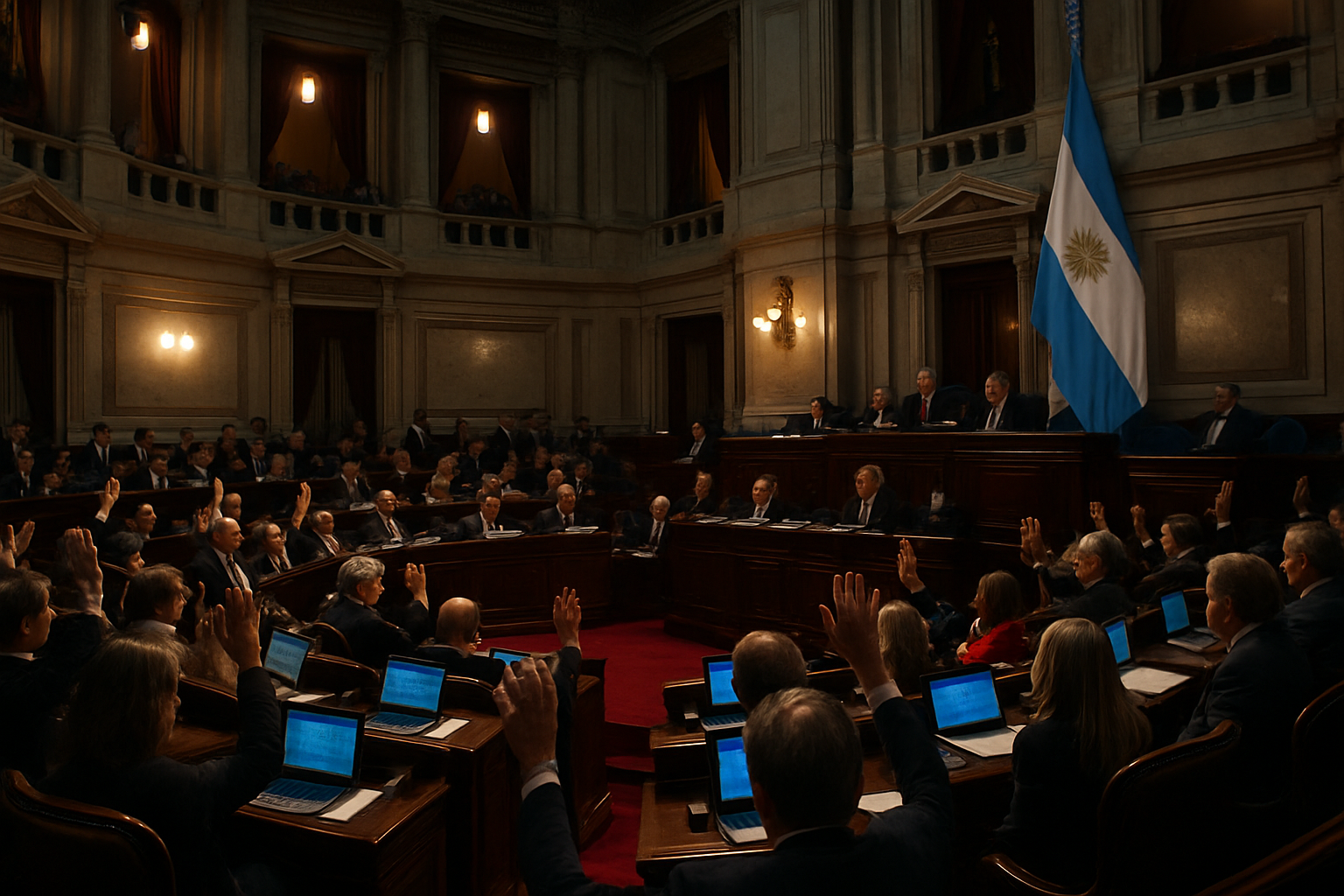
Argentina's Senate approved President Javier Milei's controversial labor reform legislation by a vote of 42-30 early Thursday morning, delivering the libertarian leader his most significant legislative victory yet after a 12-hour marathon session that continued past midnight.
The measure, officially termed the "Labor Modernization" bill, passed with zero abstentions following intense negotiations that saw Interior Minister Patricia Bullrich modify over 30 articles to secure crucial support from the Radical Civic Union (UCR) and dialoguist opposition blocs. The legislation now advances to the Chamber of Deputies for final approval before the extraordinary session period ends.
Key Provisions and Negotiations
The reform centers on introducing a "bank of hours" system that allows employers greater flexibility in scheduling overtime work. Under the new framework, employers can accumulate overtime hours that employees work during peak periods and compensate them with time off during slower periods, rather than immediate overtime pay.
The legislation also modifies Argentina's severance payment system, reducing the scope of worker indemnification while maintaining basic protections. Changes to union contribution structures and tax obligations for employers round out the core provisions aimed at increasing labor market flexibility.
Crucially, Bullrich's modifications addressed UCR concerns about worker protections by enhancing safeguards for existing contracts and establishing phased implementation timelines. The government eliminated proposed Ganancias tax reductions and scaled back union funding cuts through the negotiation process.
Violent Protests and Security Response
Outside the National Congress building, the most serious labor violence in recent Argentine history unfolded as CGT-organized protesters threw Molotov cocktails, stones, and improvised bombs at federal police forces. The confrontations, which began at 3:30 PM on Rivadavia Avenue, continued for hours past midnight.
Federal forces responded with tear gas and water cannons as masked protesters systematically broke apart sidewalks with hammers to use debris as projectiles. Security Minister Alejandra Monteoliva confirmed four police officers were injured and two protesters were hospitalized during the clashes.
"Violent groups will be identified and prosecuted to the full extent of the law. This government will not tolerate attacks on democratic institutions."
— Alejandra Monteoliva, Security Minister
The Buenos Aires city government assessed damage at 270 million pesos, requiring extensive overnight cleanup operations. Over 50 arrests were made during the disturbances, marking an unprecedented escalation from typically peaceful CGT demonstrations.
Political Coalition Building
The victory demonstrated Milei's growing ability to build coalitions beyond his libertarian base. The final vote breakdown saw La Libertad Avanza joining forces with the PRO party, UCR, and various dialoguist opposition blocs, while Peronist parties found themselves isolated in opposition.
Buenos Aires Governor Axel Kicillof joined the protests, criticizing the "project that puts workers' rights at risk" while positioning himself for a potential 2027 presidential campaign. Six provincial governors, including Kicillof, had previously announced their support for the CGT's opposition stance.
The legislative success occurs within the broader context of Milei's economic restructuring agenda, which includes a historic trade agreement with the United States that eliminated over 1,600 tariffs on Argentine goods.
Economic Context and Challenges
The reform passage comes amid persistent economic challenges, with economists projecting 22.4% annual inflation for 2026 despite the government's more optimistic 10.1% forecast. However, currency markets have remained stable, with the official dollar rate at 1,442 pesos and the blue dollar at two-month lows.
Argentina's country risk indicator fell to 504 basis points in early February, reflecting growing investor confidence in the government's reform agenda and its new strategic partnership with the United States.
The government argues that labor market flexibility is essential for capitalizing on new international opportunities, particularly the beef trade expansion that could generate an additional $800 million in external sales annually.
Implementation Challenges Ahead
Despite the legislative victory, significant implementation challenges remain. Labor unions have signaled their intention to pursue legal challenges that could result in years of litigation. The reform will require extensive regulatory development and employer training programs to ensure effective implementation.
Success will also depend on passage through the Chamber of Deputies, where the government faces a different political dynamic. The administration must also maintain effective federal-provincial coordination and continue negotiations with unions to ensure workplace stability.
"This historic achievement enables us to move forward with additional structural reforms that will modernize Argentina's economy and attract the foreign investment we need."
— President Javier Milei
International Implications
The reform's approval strengthens Argentina's position as a key Trump administration partner in South America, complementing the bilateral trade agreement that positions the country to benefit from shifting global supply chains away from Chinese dominance.
International observers are monitoring the implementation as a test case for comprehensive economic modernization that balances structural change with democratic governance. The ability to manage intense social tensions while maintaining investor confidence could serve as a template for other Latin American nations pursuing similar reforms.
Italian media reported extensively on the parliamentary victory and street violence, highlighting the international attention focused on Argentina's transformation under Milei's administration.
Looking Forward
With the Senate victory secured, the Milei administration is already advancing other elements of its legislative agenda. Thursday's Chamber of Deputies session will focus on the Juvenile Penal Reform and the Mercosur-European Union trade agreement, testing the government's ability to maintain legislative momentum.
The labor reform represents a critical test of Argentina's democratic institutions' capacity to manage comprehensive economic change while preserving social stability. Success could unlock additional reforms in tax policy and regulatory frameworks, while failure might signal broader challenges to the administration's ambitious modernization strategy.
As Argentina positions itself for a new era of international economic integration, the labor reform's ultimate success will depend not just on legislative approval, but on the government's ability to implement changes that boost competitiveness while maintaining the social consensus necessary for democratic governance.