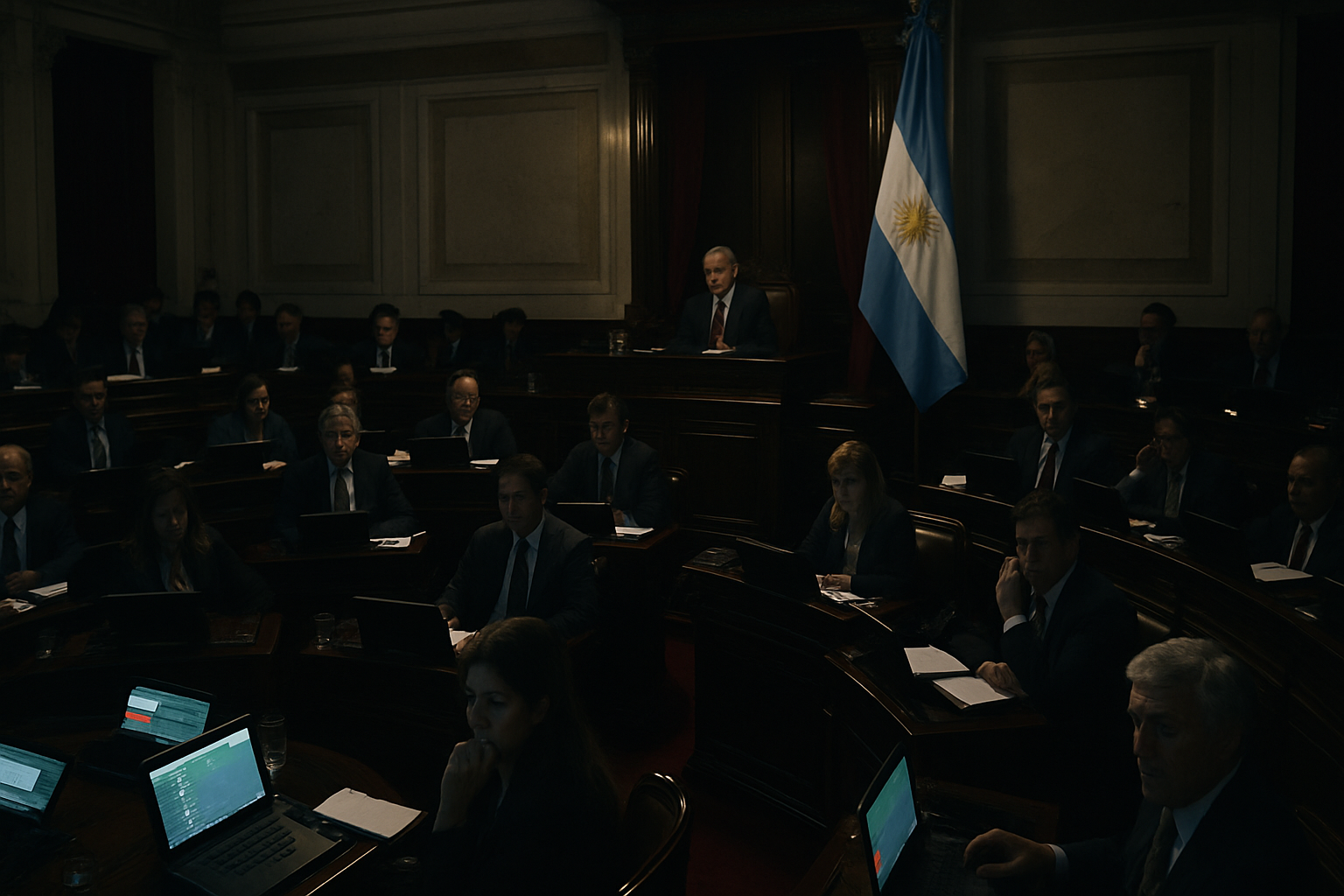
Argentina's Senate approved President Javier Milei's controversial labor reform legislation early Thursday morning in a decisive 42-30 vote, delivering a crucial victory for the libertarian government's economic restructuring agenda despite widespread demonstrations and violent clashes that erupted outside the National Congress.
The vote, which took place after 15 hours of marathon debate that extended past midnight, saw Milei's La Libertad Avanza coalition successfully build a broader alliance with the Radical Civic Union (UCR), PRO party, and provincial caucuses to secure passage of the sweeping labor modernization package.
Strategic Coalition Building Delivers Victory
Interior Minister Patricia Bullrich's diplomatic efforts proved decisive in securing the narrow but sufficient majority. Bullrich modified more than 30 articles of the original legislation to address UCR concerns about worker protections, demonstrating the government's tactical flexibility in pursuit of its reform agenda.
"This represents a historic achievement for Argentina's economic modernization," said a government spokesman, emphasizing that the legislation now advances to the Chamber of Deputies for final approval before the extraordinary session ends.
The reform package introduces a controversial "bank of hours" overtime system that provides employers with greater scheduling flexibility, modifies severance payment structures while maintaining basic worker protections, and adjusts union contribution requirements.
Unprecedented Violence Rocks Buenos Aires
The legislative victory came amid the most serious violent confrontations during CGT-organized demonstrations in recent Argentine history. Protesters threw Molotov cocktails, stones, and improvised bombs at federal police forces stationed outside the National Congress building.
Security Minister Alejandra Monteoliva confirmed that over 50 arrests were made during the disturbances, with four police officers injured and two protesters hospitalized. The Buenos Aires city government assessed property damage at 270 million pesos following hours of sustained clashes.
"Violent groups will be identified and prosecuted to the full extent of the law,"
— Alejandra Monteoliva, Security Minister
The confrontations began at 3:30 PM on Rivadavia Avenue, with masked protesters preparing firebombs in broad daylight and systematically breaking sidewalks with hammers to create projectiles. Federal forces responded with tear gas and water cannons as the violence escalated throughout the evening.
Broad Opposition Coalition Mobilizes
The demonstrations represented the most significant organized resistance to the Milei administration, bringing together the CGT union confederation, both CTA branches, the Left Front, La Cámpora, and various Peronist groups in a rare unified opposition front.
Buenos Aires Governor Axel Kicillof personally joined the protests, criticizing what he called a "project that puts workers' rights at risk" while positioning himself for a potential 2027 presidential campaign. The participation of six provincial governors in supporting the union opposition underscored the political stakes involved.
Despite the street pressure and organized resistance, the Senate proceeded with its scheduled vote, creating dramatic television imagery as networks alternated between coverage of the parliamentary debate and violent confrontations occurring simultaneously outside.
Economic Context and International Implications
The labor reform forms part of Milei's comprehensive economic restructuring strategy designed to attract foreign investment and capitalize on the historic US-Argentina trade agreement that eliminated over 1,600 US tariffs on Argentine goods.
The legislation comes as Argentina grapples with persistent economic challenges, including projected annual inflation of 22.4% according to economist surveys, significantly higher than the government's 10.1% forecast. However, currency markets have remained relatively stable, with the official dollar at 1,442 pesos and the blue dollar at two-month lows.
Country risk indicators have shown improvement, falling to 504 basis points according to JP Morgan, reflecting investor confidence in the reform agenda despite the political tensions and street violence.
Reform Content and Implementation Challenges
The approved legislation introduces several key changes to Argentina's labor framework. The "bank of hours" system fundamentally alters overtime calculations, allowing employers greater flexibility in scheduling while providing workers with compensatory time arrangements.
Severance payment structures will be modified with new financing mechanisms, though basic worker protections remain in place following negotiations with UCR legislators. The package also includes adjustments to tax obligations and reduces some union funding mechanisms, though less extensively than originally proposed.
Implementation will require extensive regulatory development and employer training programs. Union organizations have signaled their intention to challenge the reforms through the court system, potentially creating years of litigation that could delay or complicate the law's practical application.
Political Ramifications and Future Outlook
The Senate victory demonstrates Milei's capacity to build legislative coalitions beyond his libertarian base, isolating Peronist parties who found themselves unable to prevent passage despite their traditional strength in Argentine politics.
The success strengthens Argentina's position as a key Trump administration partner in South America and complements the bilateral trade agreement that promises to boost agricultural exports by an estimated $800 million annually through expanded US market access.
Looking ahead, the legislation must survive final approval in the Chamber of Deputies, where the government appears confident of securing the necessary votes. The administration is also advancing additional agenda items, including juvenile penal reform and ratification of the Mercosur-EU trade agreement.
International Scrutiny and Democratic Resilience
The combination of successful legislative maneuvering and violent street protests has drawn extensive international media coverage, with observers monitoring Argentina as a test case for democratic institutions' capacity to manage comprehensive economic reforms while preserving social stability.
European and regional media outlets have provided extensive coverage of the events, highlighting both the economic transformation underway and the challenges of implementing structural changes in established democracies facing organized resistance.
The outcome provides a template for how Latin American governments might balance modernization objectives with democratic governance principles, though the sustainability of the approach will depend on successful implementation and continued political support.
As Argentina continues its economic transformation under Milei's leadership, the labor reform victory marks a significant milestone in the government's broader agenda while underscoring the deep social and political divisions that persist over the country's economic future.