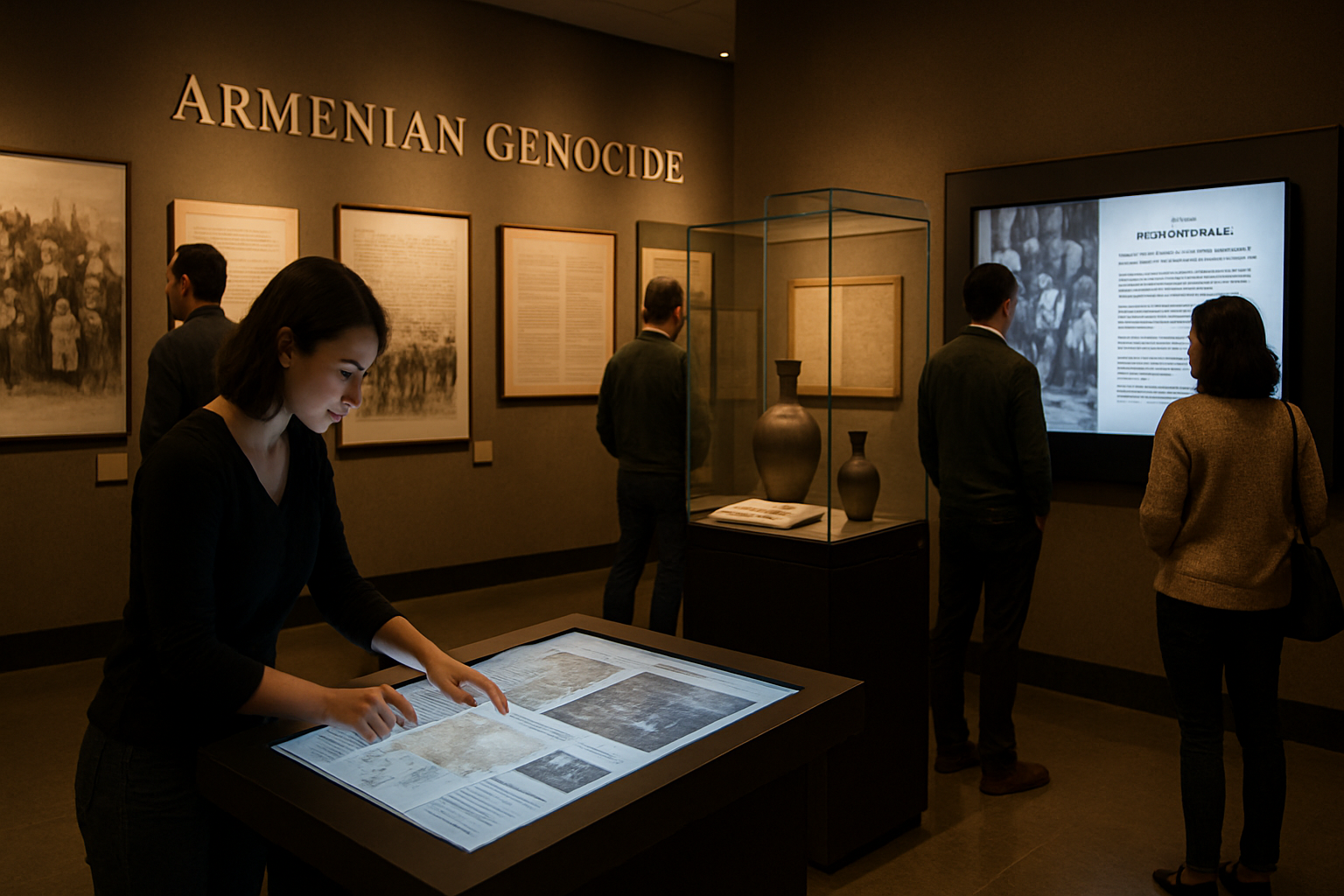
As Armenia confronts mounting political pressures over historical memory and academic freedom, groundbreaking interactive educational technologies are transforming how the Armenian Genocide is taught to new generations, even as the nation's premier research institution faces unprecedented challenges to its independence.
On April 1, 2026, Beloit College, the Center for Holocaust & Genocide Studies at the University of Minnesota, and the USC Shoah Foundation will present an innovative online program titled "Interactive Biographies as Innovative Tools for Armenian Genocide Education." The webinar, featuring cutting-edge "Dimensions in Testimony" technology, represents a significant evolution in genocide education methodology at a time when traditional institutional approaches face mounting political interference.
Pioneering Educational Technology
The program showcases USC Shoah Foundation's revolutionary interactive biography featuring Dr. Khatchig Mouradian, a renowned Armenian Genocide scholar and historian. This technology enables learners to engage in virtual conversations with Dr. Mouradian through prerecorded video responses, fundamentally redefining inquiry-based education about one of the 20th century's most devastating atrocities.
"The interactive biography addresses Dr. Mouradian's childhood experiences and scholarly insights, creating an unprecedented bridge between personal testimony and academic research," explains program director Khatchig Mouradian, who will oversee the educational initiative alongside speakers Maral Kibarian Skelsey, Peter Balakian, Marc A. Mamigonian, and Julia Hintlian.
"This technology represents a paradigm shift from traditional lecture-based learning to immersive, conversation-driven education that honors both scholarly rigor and human experience."
— Dr. Khatchig Mouradian, Program Director
The program will be hosted at the National Association for Armenian Studies and Research (NAASR) headquarters in Belmont, Massachusetts, featuring sessions covering Armenian roots and ancestral connections, Armenian American history, literature and memory, and Classical Armenian (krapar) introduction. A special exhibition titled "250 years of Armenian presence in America" will complement the educational programming.
Crisis at the Genocide Museum-Institute
The timing of this educational innovation proves particularly significant as Armenia's premier genocide research institution faces a deepening crisis that threatens its scholarly independence. The firing of Dr. Edita Gzoyan from her position as director of the Armenian Genocide Museum-Institute (AGMI) has exposed troubling questions about the institution's relationship with the Armenian government and its ability to support truly free academic research.
Dr. Gzoyan's dismissal reportedly followed her donation of Ara Katibian's "Azeri Aggression Against Armenians in Transcaucasia (1905-1921): Reports from the U.S. Press," raising concerns about government oversight of academic activities and publication decisions. The incident highlights the precarious position of cultural and academic institutions that depend on government funding while attempting to maintain scholarly objectivity.
The controversy surrounding AGMI reflects broader global challenges facing memory institutions in politically sensitive environments. As government funding inevitably creates dependencies, institutions find themselves navigating complex relationships between official policy positions and academic freedom, particularly during periods of geopolitical tension and regional security concerns.
International Context and Educational Renaissance
These developments occur within the broader context of what researchers have documented as the "February 2026 Cultural Renaissance" – an unprecedented period of international coordination in cultural heritage preservation and innovative educational programming. From Qatar's comprehensive Afghan heritage exhibitions to Rwanda's creative innovation hubs, nations worldwide are recognizing culture and education as strategic infrastructure equivalent to transportation, communication, and healthcare systems.
The Armenian educational initiatives demonstrate sophisticated understanding of technology's role in amplifying rather than replacing authentic historical engagement. Success factors identified across global cultural preservation efforts include sustained political commitment, comprehensive community engagement, international cooperation, and economic viability through educational partnerships and cultural tourism.
Armenia's approach exemplifies the diaspora-homeland educational connection model, bringing together North American institutional resources with homeland historical knowledge. The Armenian Relief Society's similar initiatives, including Camp Javakhk 2026 in Georgia and Boston Public Schools' "Geometry as Public Art" curriculum inspired by Armenian Heritage Park, demonstrate coordinated efforts to maintain cultural connections while serving contemporary educational needs.
Technology-Tradition Synthesis
The interactive biography technology represents a mature understanding of how digital innovation can serve historical education without compromising authenticity. Rather than replacing human connections with technological substitutes, the system creates new pathways for engaging with scholarly expertise and personal testimony across geographic and temporal boundaries.
This approach aligns with successful cultural preservation models observed globally, where technology enhancement – not replacement – of traditional knowledge transmission has proven most effective. The virtual conversation format maintains the interpersonal dimension essential to genocide education while providing accessibility to diverse populations regardless of geographic or economic constraints.
The program's emphasis on multiple perspectives – from personal family history to academic scholarship, from Classical Armenian language to contemporary American experiences – reflects sophisticated pedagogical understanding that effective genocide education requires comprehensive approaches addressing both historical facts and ongoing cultural significance.
Academic Independence Under Pressure
The crisis at AGMI highlights fundamental tensions between institutional memory preservation and political pressures that affect academic institutions worldwide. When history meets politics, as the situation demonstrates, the resulting conflicts can undermine the very foundations of scholarly inquiry and historical documentation that institutions are designed to protect.
The implications extend far beyond Armenia's borders, as similar pressures affect memory institutions globally. From Russia's controversial transformation of the Gulag Museum to debates over colonial-era artifacts in European museums, questions of institutional independence and historical responsibility represent critical challenges for 21st-century cultural stewardship.
"The independence of scholarly institutions dedicated to historical memory represents a fundamental requirement for societies seeking to understand their past and build sustainable futures."
— International Heritage Advocates
The contrasts between innovative educational programs and institutional political pressures underscore the importance of diversified approaches to historical education and memory preservation. When single institutions face political interference, distributed educational initiatives and international cooperation become essential safeguards for historical knowledge transmission.
Future of Genocide Education
The success of interactive biography technology and similar educational innovations suggests promising directions for genocide education that transcend institutional vulnerabilities. By combining cutting-edge technology with rigorous scholarship and authentic personal testimony, these programs create resilient educational frameworks that can adapt to changing political and institutional environments.
The program's focus on Wisconsin and Minnesota educators demonstrates strategic thinking about scaling educational innovations through established teacher networks and institutional partnerships. This distributed approach reduces dependence on single institutions while building sustainable educational ecosystems that can weather political pressures and resource constraints.
As documented in the broader "2026 Educational Technology Renaissance," successful approaches emphasize prevention-first strategies, international cooperation, cultural preservation integration, and holistic approaches addressing comprehensive educational needs rather than narrow academic focus.
Building Resilient Memory Networks
The convergence of technological innovation and institutional challenges facing Armenian Genocide education reflects broader global patterns in historical memory preservation. Success increasingly depends on building resilient networks that combine institutional resources, technological capabilities, community engagement, and international cooperation rather than relying on single-point solutions.
The interactive biography program exemplifies this approach by bringing together American educational institutions, technological innovation, Armenian scholarly expertise, and diaspora community connections. This multi-dimensional framework provides redundancy and resilience that single institutions cannot achieve independently.
The timing proves particularly significant as Armenia navigates complex regional relationships and seeks to maintain cultural authenticity while participating in global educational networks. The success of these educational initiatives could provide templates for other communities facing similar challenges in preserving historical memory while adapting to contemporary educational requirements.
March 2026 represents a critical juncture for Armenian Genocide education, with innovative technologies offering new pathways for engagement even as traditional institutional approaches face unprecedented challenges. The ultimate test will be whether distributed, technology-enhanced educational networks can maintain the scholarly rigor and authentic engagement essential to genocide education while building resilience against political pressures that threaten institutional independence.
The stakes extend beyond Armenian history to fundamental questions about how societies preserve and transmit historical memory in an interconnected yet politically fragmented world. Success in maintaining both innovation and independence in genocide education could establish precedents for historical memory preservation worldwide, while failure risks undermining decades of progress in genocide education and prevention efforts.