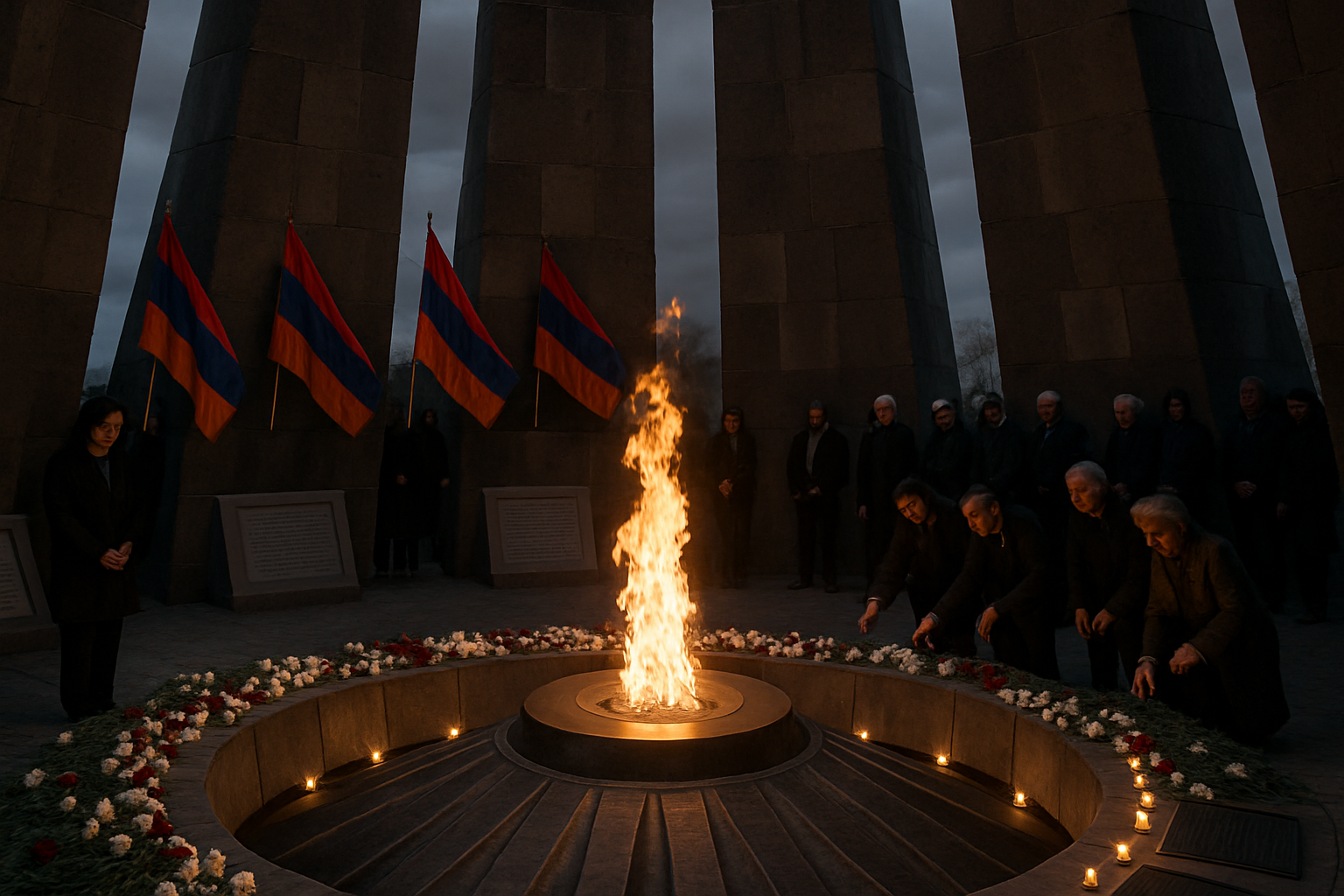
Armenian communities worldwide marked the 111th anniversary of the Armenian Genocide on April 24, 2026, with ceremonies spanning from Yerevan to Los Angeles, as debates intensified over the balance between historical justice and contemporary peace-building efforts.
The commemoration took place against the backdrop of significant political developments, including President Trump's continued refusal to use the term "genocide" in official U.S. statements for the sixth consecutive time, drawing sharp criticism from Armenian-American advocacy groups.
Ceremonies Across the Globe
In Armenia's capital, Prime Minister Nikol Pashinyan placed a wreath at the Tsitsernakaberd memorial and presented flowers at the eternal flame, honoring the victims of the Armenian Genocide. However, his commemorative message sparked controversy when he described the genocide as a consequence of "the practice of drawing the Armenian people into international machinations."
The annual torchlight procession organized by the Armenian Revolutionary Federation's youth wing took place in Yerevan, while Lebanese-Armenian political parties, under the patronage of Catholicos Aram I, held commemorative services at the Mayravank Monastery in Antelias, Lebanon.
Political Tensions and Recognition Debates
The Armenian National Committee of America (ANCA) issued a scathing condemnation of President Trump's April 24th statement, which marked the sixth consecutive year the administration avoided acknowledging the systematic annihilation of 1.5 million Armenians by name. ANCA described this as Trump "doubling down on his disgraceful surrender to Turkish threats" and "enforcing Ankara's gag-rule against honest American remembrance."
"President Trump is doubling down on his disgraceful surrender to Turkish threats — continuing, now for the sixth time, enforcing Ankara's gag-rule against honest American remembrance of this crime — despite recognition by the White House, Congress, all 50 states."
— Armenian National Committee of America Statement
Armenia's Foreign Affairs Ministry struck a more conciliatory tone, emphasizing the need to "remember the genocide, but pursue peace." This approach reflects the current government's strategy of balancing historical memory with diplomatic engagement in the region.
Contrasting Approaches to Memory and Reconciliation
The commemorations highlighted a fundamental tension within Armenian discourse about how to approach the genocide's legacy. Pashinyan warned against "calls for returning the lost homeland and restoring historical borders," arguing such rhetoric threatens the Republic of Armenia by putting it "on the rails of the 1878 San Stefano Conference."
In contrast, Catholicos Karekin II emphasized that April 24 represents a day of commitment "aimed at restoring justice and truth and excluding the denial of the genocide disaster." This position reflects the traditional approach of many Armenian institutions worldwide.
International Human Rights Perspective
International human rights lawyer Karnig Kerkonian delivered powerful remarks at the Capitol Hill Armenian Genocide Observance, sharing personal family history while emphasizing the continuing relevance of genocide prevention. His grandfather's experience making leather water pouches for deportees in 1915 served as a poignant reminder of the human cost of systematic persecution.
"Genocide continues where it meets no resistance."
— Karnig Kerkonian, International Human Rights Lawyer
Contemporary Challenges and Cultural Destruction
The commemorations occurred amid reports of new acts of cultural destruction. Just days before the anniversary, the reported demolition of the Holy Mother of God Cathedral in occupied Stepanakert raised fears of systematic cultural erasure, with experts warning this represents part of a broader pattern rather than isolated incidents.
Cultural heritage ombudsman Hovik Avanesov noted that developments in Artsakh can no longer be framed as sporadic acts but reflect "a deliberate policy" of cultural destruction, drawing parallels to historical patterns of erasure.
Artistic and Cultural Remembrance
The anniversary was also marked by artistic expression and cultural preservation efforts. Various artists across different mediums continued to explore themes related to the Armenian Genocide, with curated exhibitions and performances highlighting how Armenian artists remain unable to escape this historical trauma more than a century later.
These cultural expressions serve not only as remembrance but also as tools for processing inherited trauma and connecting contemporary audiences with historical experiences through literature, film, music, and visual arts.
Restrictions on Commemoration
Not all communities were able to commemorate freely. In Georgia, the Interior Ministry denied a request by the Armenian Community of Georgia to hold a demonstration in front of the Turkish Embassy in Tbilisi, forcing organizers to seek alternative venues or abandon their planned protest.
The Path Forward
As Armenian communities navigate the 111th anniversary, the fundamental questions remain unresolved: How should historical memory be balanced with contemporary diplomatic realities? Can recognition and reconciliation coexist, or must one take precedence over the other?
The events of April 24, 2026, demonstrated that these debates continue to shape Armenian identity and politics worldwide. While some advocate for maintaining pressure for full recognition and justice, others emphasize the need for pragmatic approaches that prioritize peace and regional stability.
The Armenian Genocide remains a defining moment not only for Armenians but for the international community's understanding of systematic persecution and the ongoing struggle to prevent such atrocities. As the world marks another year since these tragic events, the lessons of 1915 continue to resonate in discussions about human rights, cultural preservation, and the responsibilities of nations to acknowledge historical truths.
Whether through solemn ceremonies, political advocacy, or artistic expression, Armenian communities worldwide demonstrated their commitment to ensuring that the memory of the 1.5 million victims endures, even as they grapple with how best to honor that memory in an evolving political landscape.