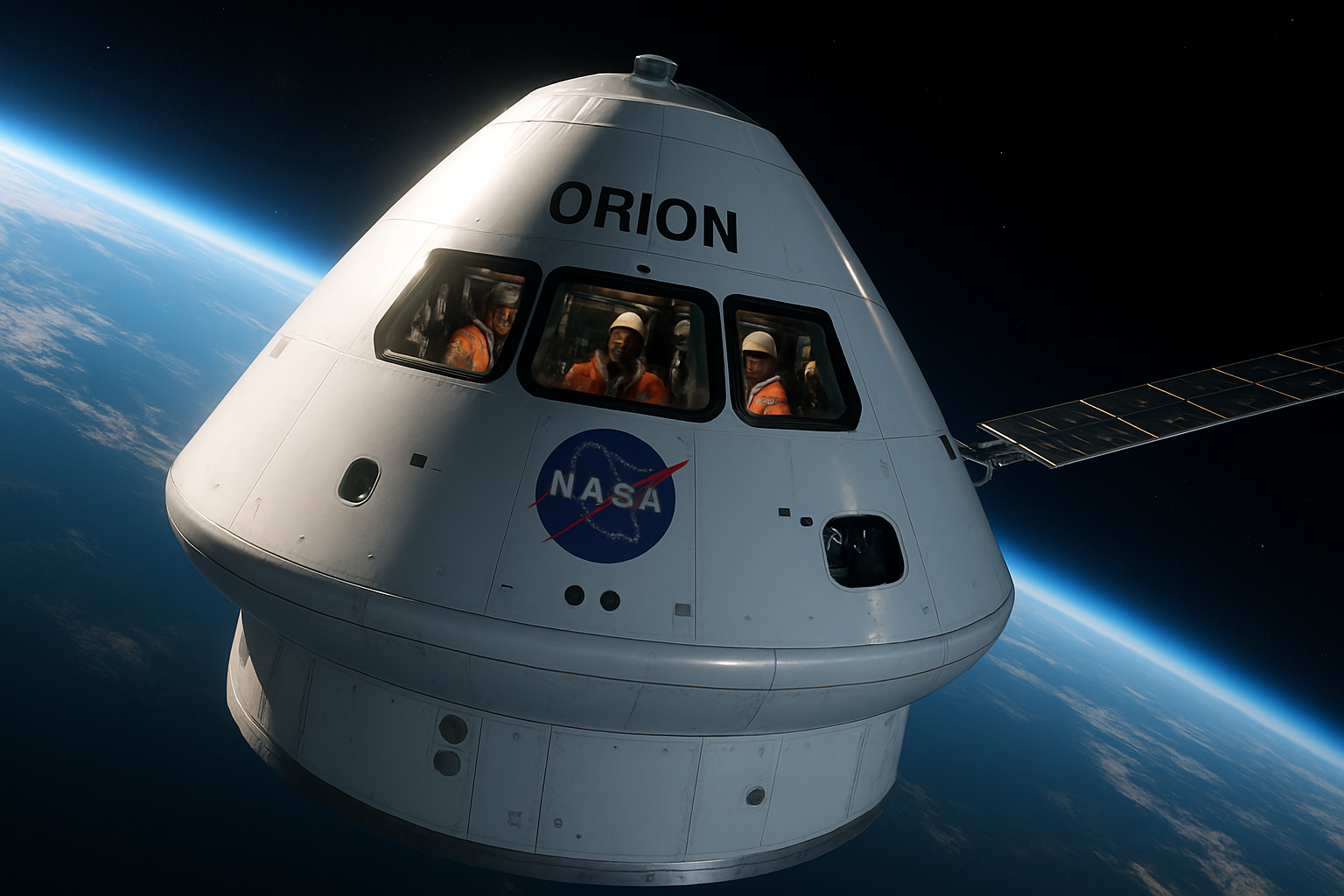
NASA's historic Artemis 2 mission encountered an unexpected technical challenge when the spacecraft's toilet system malfunctioned shortly after launch, but the four-astronaut crew successfully resolved the issue while preparing for humanity's first lunar flyby in over 54 years.
The technical setback occurred during the mission's early orbital phase, adding to a series of challenges that the Artemis 2 crew has overcome with remarkable professionalism. The toilet malfunction was quickly addressed by the experienced international crew, demonstrating the effectiveness of NASA's comprehensive training programs and backup systems.
Mission Overview and Current Status
Artemis 2 successfully launched on April 1, 2026, at 6:24 PM EDT from Kennedy Space Center, marking the end of a 54-year gap since Apollo 17 in December 1972. The four-astronaut international crew includes Canadian Jeremy Hansen, making history as the first Canadian to travel beyond Earth orbit, alongside NASA Commander Reid Wiseman, Mission Specialists Christina Koch, and Victor Glover.
The crew is currently in Earth orbit aboard the Orion spacecraft, preparing for the crucial lunar trajectory insertion that will send them on their 10-day, 685,000-mile journey around the Moon. This mission represents the most ambitious human spaceflight endeavor since the Apollo era, serving as a critical stepping stone toward NASA's goal of returning humans to the lunar surface by 2028.
Technical Challenges Overcome
Beyond the toilet system issue, the Artemis 2 mission has demonstrated NASA's robust engineering capabilities by successfully resolving several technical challenges that emerged during the flight:
- Communication System Failures: Temporary communication blackouts were quickly restored through backup systems
- Thermal Sensor Malfunction: Critical temperature monitoring equipment was repaired without affecting mission objectives
- Toilet System Repairs: The waste management system was successfully fixed, ensuring crew comfort for the duration of the mission
These challenges underscore the complexity of deep space missions while highlighting the crew's exceptional training and NASA's comprehensive safety protocols. The successful resolution of these issues validates the extensive pre-flight testing and preparation that went into the mission.
"The crew has demonstrated excellent problem-solving skills and adaptability, which are essential qualities for deep space exploration," said a NASA mission control spokesperson.
— NASA Mission Control
Journey to Historic Milestone
The Artemis 2 mission follows months of technical delays and challenges that tested NASA's commitment to safety-first protocols. The mission was originally scheduled for earlier in 2026 but faced multiple postponements due to critical issues with the Space Launch System (SLS) rocket, including persistent hydrogen leaks and helium system failures.
NASA Administrator Jared Isaacman maintained throughout the delays that the agency would "only launch when we believe we are ready," reflecting institutional learning from past tragedies. The SLS rocket, standing 322 feet tall and weighing 5.75 million pounds when fully fueled with over 700,000 gallons of liquid hydrogen and oxygen, represents the most powerful rocket NASA has ever built.
International Cooperation and Scientific Goals
Jeremy Hansen's participation marks a significant milestone for Canadian space exploration and validates the Artemis Accords framework for peaceful international lunar exploration. His inclusion represents the most significant Canadian human spaceflight contribution since the Space Shuttle era, with fellow Canadian astronaut Jenni Gibbons serving as the Earth voice link and backup communications coordinator.
The mission carries scientific equipment from multiple international partners, including Argentina's Atenea radiation study device, which will provide crucial data about deep space radiation effects on future lunar missions and potential Mars exploration.
Preparing for Lunar Trajectory
As the crew prepares for the critical engine burn that will propel them toward the Moon, they are conducting final system checks and preparing for the unique challenges of operating beyond Earth's magnetic field. The mission will take the astronauts approximately 4,000 miles beyond the Moon's far side, farther from Earth than any humans have traveled since the Apollo era.
The crew will spend their time conducting experiments to understand human adaptation to the deep space environment, testing life support systems, and validating navigation capabilities that will be essential for future lunar landing missions. This data will directly inform NASA's Artemis 3 mission, planned for 2028, which aims to return humans to the lunar surface.
Space Economy and Strategic Context
The Artemis 2 mission launches during what space industry experts call the "space economy golden age," with NASA committing a historic $20 billion toward establishing a permanent lunar surface base by 2030. This represents the largest space infrastructure investment in NASA's history, reflecting the strategic importance of maintaining American leadership in space exploration.
The mission occurs amid intensifying international competition, with China planning its own crewed lunar missions by 2030 and commercial space companies like SpaceX preparing for potentially trillion-dollar valuations. The success of Artemis 2 is crucial for maintaining the United States' position as the leader in human space exploration.
Looking Ahead: Mars and Beyond
Beyond the immediate goal of lunar exploration, Artemis 2 serves as a crucial test for technologies and procedures that will enable human missions to Mars. The mission validates deep space life support systems, radiation protection measures, and navigation capabilities that will be essential for the multi-month journeys to the Red Planet.
NASA has also announced the Space Reactor 1 Freedom nuclear spacecraft program, which will provide the energy density necessary for interplanetary missions where solar power is insufficient. Nuclear propulsion will enable faster transit times, continuous power generation, and reduced radiation exposure for deep space operations.
Overcoming Apollo-Era Limitations
While the toilet malfunction might seem like a minor issue, it highlights significant improvements over the Apollo era. As noted in reports, the Artemis 2 crew can handle their needs "much more comfortably than their Apollo predecessors," who relied on more primitive waste management systems during their historic missions.
The Orion spacecraft features advanced life support systems, improved radiation shielding, and modern communication capabilities that far exceed what was available to the Apollo astronauts. These improvements are essential for the longer duration missions planned for future Artemis flights.
Historical Significance and Future Impact
The 54-year gap since Apollo 17 represents the longest period in human history without deep space exploration. Artemis 2 marks humanity's renewed commitment to becoming a spacefaring civilization, combining advanced technology with international cooperation and decades of space medicine knowledge gained from International Space Station operations.
The mission's success will determine the trajectory of human space exploration for decades to come, establishing the foundation for permanent extraterrestrial settlements and humanity's evolution into a multi-planetary species. Every technical challenge overcome, from toilet malfunctions to communication issues, contributes valuable data for future missions.
As the Artemis 2 crew continues their historic journey, they carry with them not just the hopes of their respective nations, but the aspirations of all humanity to explore and establish a permanent presence beyond Earth. Their successful resolution of technical challenges demonstrates the readiness of human space exploration to enter a new era of sustained cosmic expansion.