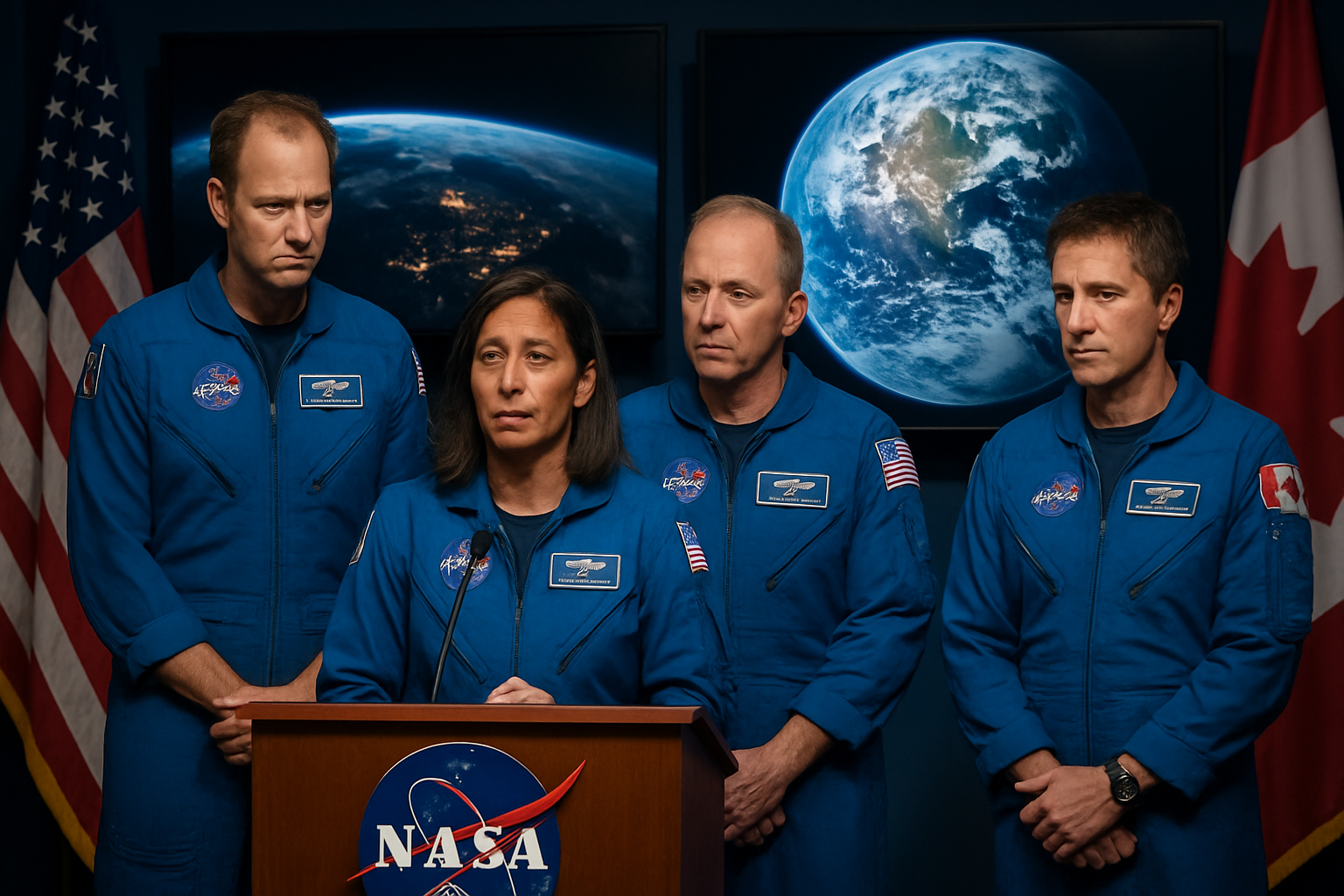
The four astronauts who completed humanity's first lunar flyby in over 54 years have opened up about the profound psychological and emotional impact of their historic journey, describing Earth as a fragile "lifeboat" in the cosmos and calling for global unity following their return from the deepest human space exploration since Apollo 17.
Following the successful completion of the Artemis II mission on April 11, 2026, the international crew—Canadian Jeremy Hansen, NASA Commander Reid Wiseman, and mission specialists Christina Koch and Victor Glover—held their first comprehensive press conference since their Pacific Ocean splashdown, sharing intimate details about an experience that Commander Wiseman described as beyond human comprehension.
"The human mind isn't made to go through what we just went through," Wiseman reflected during the emotional briefing. "Nadie va a saber nunca lo que los cuatro hemos pasado"—no one will ever know what the four of us experienced together.
A New Perspective on Earth's Fragility
The mission, which achieved a new human distance record of 406,777.8 kilometers from Earth—breaking Apollo 13's 1970 record by over 6,600 kilometers—provided the crew with an unprecedented cosmic perspective that has fundamentally altered their view of humanity's place in the universe.
Norwegian sources report that the crew's emotional response to viewing Earth from deep space led them to describe their home planet as a "lifeboat" in the cosmos—a fragile oasis surrounded by infinite void. This perspective transformation mirrors the famous "pale blue dot" phenomenon experienced by Apollo-era astronauts but with the added weight of modern global challenges.
"I felt like I was walking on the surface... Humanity has demonstrated once again what it is capable of."
— Jeremy Hansen, First Canadian Beyond Earth Orbit
Hansen, who made history as the first Canadian to travel beyond Earth orbit, expressed amazement at the crew's achievement while emphasizing the broader significance for humanity. His participation validated the Artemis Accords framework for peaceful lunar exploration and represented the most significant Canadian space contribution since the Space Shuttle era.
Technical Triumphs Amid Human Challenges
The 10-day, 685,000-mile mission was not without its challenges, many of which became defining moments that demonstrated both technological advancement and human adaptability. Perhaps most notably, a Universal Waste Management System malfunction—the spacecraft's toilet—became a viral social media phenomenon when Christina Koch led repair efforts after frozen urine clogged the system.
"The toilet repair incident demonstrates human adaptability and ingenuity in space environments while highlighting practical challenges of spaceflight," noted mission analysts. The viral moment combined heroic achievement with mundane necessities, creating unprecedented social media engagement since the Apollo era and reinvigorating global public interest in cosmic exploration.
Beyond the widely publicized toilet malfunction, the crew successfully resolved communication system failures and thermal sensor malfunctions without affecting the mission timeline—a testament to their exceptional training and the reliability of backup systems that represent significant advancement over Apollo-era missions.
Historic Scientific Achievements
The mission yielded unprecedented scientific achievements that have expanded human understanding of both our cosmic environment and our place within it. For the first time since Apollo 17 in December 1972, humans captured photographs of Earth from beyond Earth orbit, including historic "Earthset" images showing Earth below the lunar horizon.
During their closest approach to the Moon, the crew traveled 4,000 miles beyond the lunar far side, experiencing a dramatic 40-minute communication blackout during which they were completely isolated from Earth—representing humanity's deepest penetration into space since the Apollo era.
"About two dozen scientists at Johnson Space Center recorded phenomena in real time," mission officials reported. The crew provided direct visual observations of meteoroid impact flashes on the lunar surface and captured unprecedented photographic documentation of the Moon's permanently hidden far side, regions never before observed by human eyes.
Emotional Impact and Unity Message
The emotional weight of the experience was evident throughout the crew's reflections. Christina Koch, when viewing Earth from deep space, exclaimed "Guys, you look great," expressing the crew's collective inability to "get away from the windows" during their historic journey.
Victor Glover's final words before the communication blackout—"We love you from the Moon"—became an emotional touchstone for the mission, with Houston's response "See you on the other side" marking humanity's temporary isolation from Earth during the far-side passage.
The crew emphasized the importance of human bonds and family connections over technological achievements, highlighting the fragility of human existence and the critical importance of unity on Earth. Their message resonated particularly strongly given current global tensions and challenges.
International Cooperation as a Model
The mission's success validated the Artemis Accords framework for peaceful lunar exploration through truly international cooperation. Argentina's Atenea radiation device collected crucial deep space safety data, while Czech ADVACAM radiation monitoring chips measured astronaut safety throughout the journey.
President Donald Trump personally congratulated the crew during their return journey, describing them as "truly extraordinary" and declaring they had "made history today." The presidential recognition emphasized the mission as an administration priority and highlighted renewed American space leadership during intensifying international competition.
Looking Toward Humanity's Cosmic Future
The mission occurred during what experts are calling a "space economy golden age," with NASA's historic $20 billion commitment to establishing a permanent lunar surface base by 2030 representing the largest space infrastructure investment in the agency's history.
The successful completion serves as a stepping stone toward Artemis III's planned 2028 lunar landing and validates systems essential for permanent lunar settlements and Mars exploration. The mission marks humanity's transition from brief space visits to sustained cosmic expansion capabilities for the first time in human history.
"This represents the beginning of sustained human presence beyond Earth orbit, unlike the Apollo program's conclusion."
— NASA Mission Analysts
The crew's achievements build upon decades of International Space Station research, including French astronaut Sophie Adenot's record eight-month mission focusing on lung tissue cultivation and Space-Associated Neuro-Ocular Syndrome (SANS) research essential for extended missions beyond Earth's protective influence.
Technical Validation for Future Missions
The mission thoroughly validated the Space Launch System rocket—at 322 feet tall and weighing 5.75 million pounds when fully fueled—as the most powerful NASA rocket ever built. Complete resolution of helium system failures and hydrogen leak problems that caused multiple delays throughout 2026 demonstrated NASA's safety-first culture and institutional learning from historical tragedies.
The successful completion validates deep space life support systems, radiation protection beyond Earth's magnetic field, and navigation technologies essential for sustained lunar presence and eventual Mars exploration. These systems will be crucial for the upcoming Space Reactor 1 Freedom nuclear spacecraft program designed for interplanetary missions where solar power is insufficient.
Cultural Impact and Public Engagement
The mission's cultural impact extended far beyond its scientific and technical achievements. The toilet repair incident became a defining moment that demonstrated the practical realities of space exploration while showcasing human problem-solving capabilities in extreme environments.
With unprecedented social media engagement since the Apollo era, the mission successfully combined heroic achievement with relatable human experiences, creating new forms of space exploration engagement that extend beyond traditional awe-inspiring imagery to include practical, problem-solving moments that highlight human adaptability.
The crew's emotional testimonies about viewing Earth from deep space serve as a powerful reminder of our planet's precious and irreplaceable nature. Their call for global unity, informed by the cosmic perspective of seeing Earth as humanity's only "lifeboat" in an infinite void, carries particular weight given current global challenges and the ongoing development of space-based human settlements.
Legacy and Future Implications
As the first crew to travel beyond Earth orbit in over five decades, the Artemis II astronauts have established a new foundation for human space exploration that prioritizes not just technical achievement but also emotional and psychological understanding of humanity's cosmic journey.
Their reflections on the mission emphasize that while reaching for the stars represents humanity's boldest aspirations, Earth remains our precious and irreplaceable home until we establish our next foothold in the cosmos. The mission's success establishes the foundation for spacefaring civilization development through advanced technology, international cooperation, and space medicine knowledge convergence.
The crew's powerful message of unity, informed by their unique perspective of seeing Earth as a fragile oasis in space, provides a compelling vision for humanity's future among the stars while reinforcing our shared responsibility to protect and cherish our home planet.