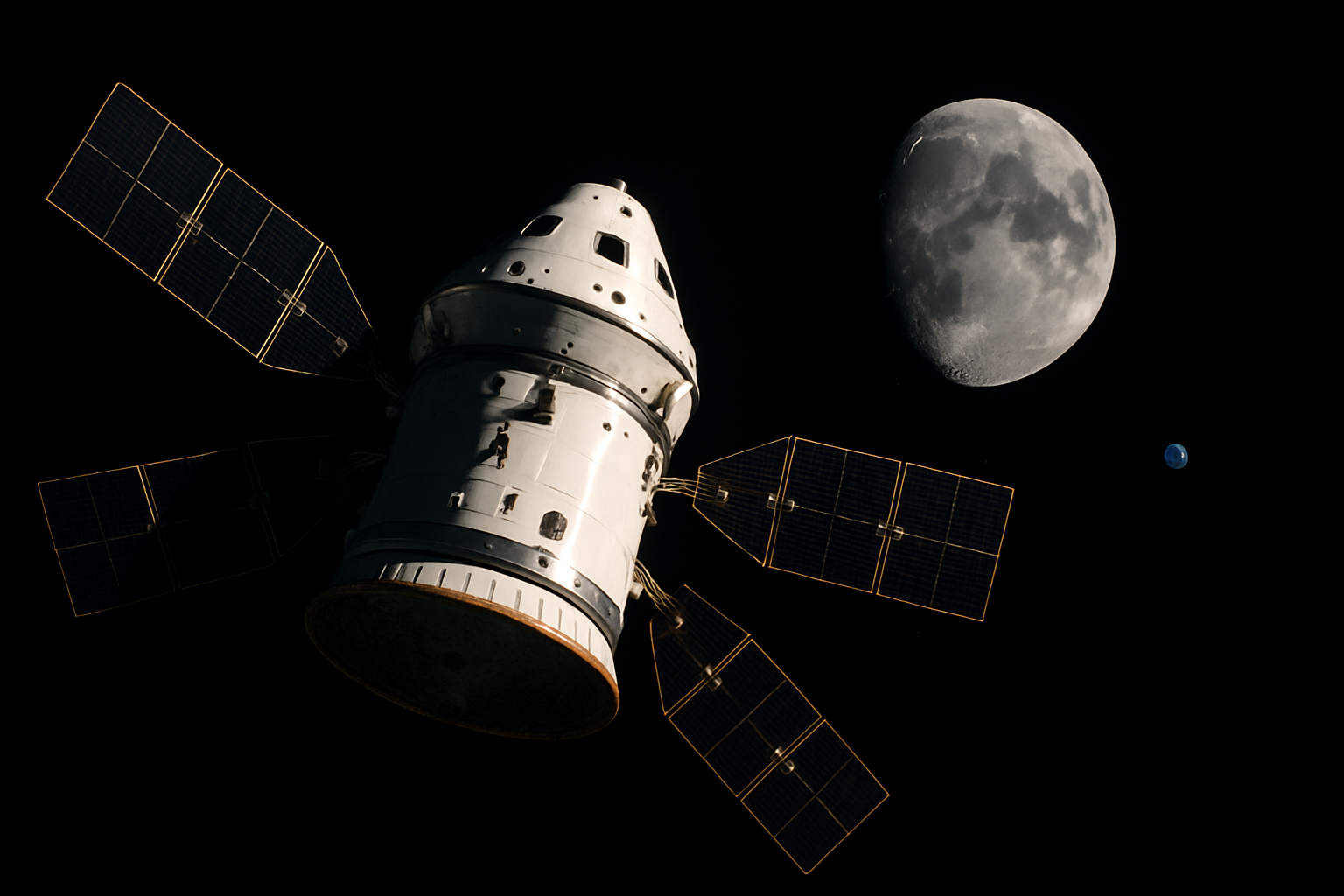
Four astronauts aboard NASA's Artemis II mission made history on Monday, April 6, 2026, becoming the humans who have traveled farthest from Earth in history as they broke the distance record set by Apollo 13 over five decades ago.
At approximately 4:00 AM Australian Eastern Standard Time (AEST), the crew surpassed the previous record of 400,171 kilometers set by Apollo 13 in 1970, officially becoming humanity's most far-reaching explorers. The milestone occurred as the Orion spacecraft continued its trajectory toward the Moon, positioning the crew to travel approximately 406,700 kilometers from Earth at their maximum distance.
Historic Achievement in Deep Space
The four-member international crew includes Canadian astronaut Jeremy Hansen—the first Canadian to travel beyond Earth orbit—alongside NASA Commander Reid Wiseman, Mission Specialists Christina Koch, and Victor Glover. Their achievement comes during the first crewed mission to venture beyond Earth orbit since Apollo 17 in December 1972, ending a 54-year gap in human deep space exploration.
"The astronauts on Artemis II have now travelled further from Earth than any human beings in history," confirmed mission control as the spacecraft continued its journey toward the lunar far side. The crew was awakened around 10:50 AM Eastern Time on their sixth flight day to a recorded message from late Apollo 8 and 13 astronaut Jim Lovell, who died last year at 97.
"Welcome to my old neighborhood. It's a historic day, and I know how busy you'll be, but don't forget to enjoy the view… good luck and godspeed."
— Jim Lovell, Apollo 8 and 13 Astronaut (recorded message)
Technical Challenges and Crew Excellence
The record-breaking achievement comes after the crew successfully overcame multiple technical challenges during the early days of their mission. The team resolved issues with communication system failures, thermal sensor malfunctions, and a now-famous spacecraft toilet system repair that became a viral social media moment when Christina Koch led the repair efforts.
Norwegian sources indicated that frozen urine may have clogged the "lunar loo" system, requiring backup urine collection bags until the primary system was restored. The crew's ability to handle these challenges without affecting the mission timeline demonstrates the significant advancement in crew training and spacecraft systems over Apollo-era missions.
Lunar Far Side Encounter
As the crew approached their historic distance record, they were simultaneously preparing for one of the mission's most challenging phases: a flyby of the Moon's far side. During this encounter, the astronauts will experience approximately 40 minutes of complete communication blackout as the Moon blocks all contact with Earth.
This communication silence will occur when the crew reaches their maximum distance from Earth—approximately 4,000 miles beyond the Moon's far side. During this period, the astronauts will be completely alone, farther from human civilization than anyone in history, while conducting scientific observations of lunar regions never before witnessed by human eyes.

International Cooperation and Scientific Objectives
Jeremy Hansen's participation in this historic mission validates the Artemis Accords framework for peaceful lunar exploration and represents the most significant Canadian human spaceflight contribution since the Space Shuttle era. The mission also includes international scientific payloads, including Argentina's Atenea radiation study device, which is collecting valuable data on deep space radiation effects crucial for future missions.
Italian researcher Andrea Longobardo from INAF (National Institute for Astrophysics) explained the significance of the far side observations: "The far side is rich with mountains while the near side is mostly seas." This terrain offers unique opportunities for astronomical observations and potential resource extraction for future lunar settlements.
Stepping Stone to Permanent Lunar Presence
The Artemis II mission serves as a critical stepping stone toward NASA's ambitious goal of establishing a permanent lunar surface base by 2030, backed by a historic $20 billion commitment—the largest space infrastructure investment in NASA history. The mission validates deep space life support systems, radiation protection capabilities, and navigation technologies essential for sustained human presence beyond Earth's magnetic field.
The success of this mission directly informs protocols for the upcoming Artemis III mission in 2028, which aims to return humans to the lunar surface for the first time since Apollo 17. The technical challenges overcome and systems validated during Artemis II provide crucial data for establishing permanent lunar settlements and eventual Mars exploration.
"Everything is challenging in space. Even the mundane is difficult and dangerous in space."
— Thomas Pesquet, ESA Astronaut
Space Economy Golden Age
This historic achievement occurs during what experts describe as the "space economy golden age," with the space economy projected to exceed $1 trillion by 2030. The success of Artemis II demonstrates the maturation of space exploration from experimental endeavors to essential infrastructure for humanity's future.
The mission coincides with intensifying international space competition, as China plans its own crewed lunar missions by 2030, and SpaceX prepares for a potential trillion-dollar IPO in June 2026. This competitive environment has driven unprecedented innovation and investment in space technologies.
Technical Specifications and Safety Culture
The record-breaking journey is made possible by NASA's Space Launch System (SLS) rocket, standing 322 feet tall and weighing 5.75 million pounds when fully fueled with over 700,000 gallons of liquid hydrogen and oxygen. The SLS represents the most powerful rocket NASA has ever built, successfully overcoming earlier technical challenges including helium system failures and hydrogen leak problems that caused multiple delays throughout early 2026.
The mission's success validates NASA's safety-first institutional culture, which prioritizes crew protection over schedule adherence. This approach, informed by lessons learned from the Challenger and Columbia tragedies, ensured that technical issues were thoroughly resolved before launch.
Looking Beyond the Record
As the Artemis II crew continues their 10-day, 685,000-mile journey around the Moon, they carry with them the hopes and ambitions of a species reaching for the stars. Their achievement marks not just a distance record, but a significant milestone in humanity's evolution from an Earth-bound civilization to a truly spacefaring species.
The data and experiences gathered during this mission will prove invaluable for future deep space exploration, permanent lunar settlements, and eventual human missions to Mars. The crew's successful navigation of both technical challenges and the vast distances of space demonstrates that humanity is ready to take its next giant leap into the cosmic frontier.
With their historic distance record now secured, the Artemis II astronauts continue their journey around the Moon's far side, photographing mysterious regions hidden from Earth and conducting scientific observations that will inform humanity's permanent expansion beyond our home planet. Their achievement today represents not an end, but a beginning—the opening chapter of humanity's permanent presence in deep space.