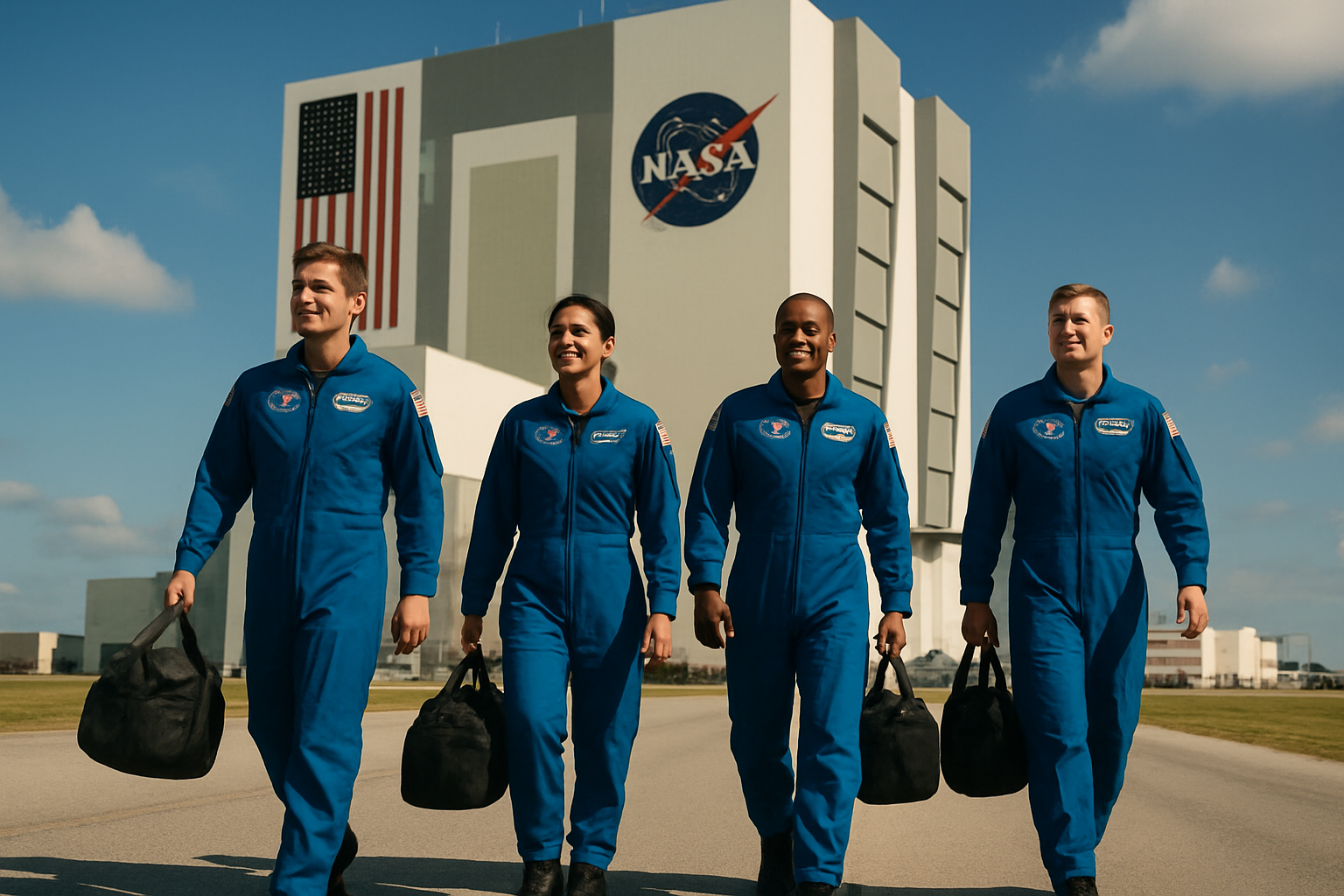
The crew of NASA's groundbreaking Artemis II mission has officially arrived at Kennedy Space Center in Florida, marking a pivotal moment in humanity's return to deep space exploration after more than half a century since Apollo 17.
The international four-person crew—Canadian Space Agency astronaut Jeremy Hansen, NASA Commander Reid Wiseman, Mission Specialists Christina Koch and Victor Glover—touched down at the Florida facility to commence their final preparations for the historic 10-day lunar flyby mission, currently targeting an April 1, 2026 launch date.
Breaking the 54-Year Deep Space Barrier
This mission represents a monumental achievement in space exploration, as it will be the first crewed venture beyond Earth orbit since Apollo 17's return in December 1972. The crew will travel approximately 600,000 miles around the Moon aboard the Orion spacecraft, powered by NASA's most powerful rocket ever built—the 322-foot Space Launch System (SLS).
Canadian astronaut Jeremy Hansen holds particular historical significance as he will become the first Canadian to venture beyond Earth orbit, marking a new chapter in international space cooperation through the Artemis Accords framework.
Technical Challenges Overcome
The crew's arrival at Kennedy Space Center comes after NASA engineers successfully resolved critical technical issues that had delayed the mission multiple times throughout early 2026. Persistent hydrogen leak problems and helium system failures affecting the SLS rocket's upper stage—essential for engine purging and fuel tank pressurization—required extensive engineering analysis and repairs.
"We will only launch when we believe we are ready. The safety of our crew remains our highest priority,"
— Jared Isaacman, NASA Administrator
The Space Launch System rocket, weighing 5.75 million pounds when fully fueled with over 700,000 gallons of liquid hydrogen and oxygen, represents the culmination of decades of engineering advancement and NASA's commitment to returning humans to deep space.
Mission Objectives and Scientific Goals
Artemis II serves as a critical stepping stone toward the Artemis III lunar landing mission planned for 2028. The 10-day journey will validate essential deep space systems including life support capabilities, radiation protection beyond Earth's magnetic field, and navigation systems required for sustained lunar presence.
The mission will test the Orion spacecraft's performance during the lunar journey, with crew members conducting experiments to understand human adaptation to the deep space environment. This data directly informs protocols for the eventual lunar landing mission and future Mars exploration.
Building on years of International Space Station research, including recent breakthrough studies on Space-Associated Neuro-Ocular Syndrome (SANS) and lung tissue cultivation in microgravity, the mission represents the convergence of decades of space medicine knowledge with cutting-edge exploration technology.
International Cooperation in the Space Economy Golden Age
The crew's arrival occurs during what industry experts term the "space economy golden age," characterized by unprecedented commercial space activity and international cooperation. This period has seen remarkable achievements including China's advancing Shenlong spacecraft program, Pakistan's selection of astronauts for China's Tiangong space station, and SpaceX's preparation for a potential trillion-dollar IPO in June 2026.
Despite intensifying international competition in space capabilities, the Artemis program demonstrates successful collaboration between nations committed to peaceful lunar exploration. The Canadian Space Agency's participation through Jeremy Hansen validates the Artemis Accords framework while positioning international partners for future deep space missions.
Safety-First Philosophy
NASA's approach to Artemis II reflects institutional learning from historical space program tragedies, emphasizing comprehensive safety protocols over schedule adherence. The recent classification of Boeing's Starliner mission as a Type A mishap—equivalent to Challenger and Columbia disaster severity levels—has reinforced the agency's methodical problem-solving philosophy.
Multiple mission delays throughout early 2026 demonstrate NASA's maturity in prioritizing crew protection and technical excellence. This conservative approach builds long-term confidence in deep space transportation systems essential for sustainable human space exploration.
Economic and Strategic Implications
The mission occurs within the context of massive space infrastructure investment, with NASA recently announcing a historic $20 billion commitment to establishing a permanent lunar surface base by 2030. This strategic pivot from the canceled Lunar Gateway project positions the United States as a leader in the emerging space economy, projected to exceed $1 trillion by 2030.
Success of Artemis II will be critical for accessing lunar resources, advancing scientific discovery, and developing technologies that define future spacefaring capabilities. The mission tests systems essential for permanent lunar settlements and establishes the foundation for eventual Mars exploration.
The Path Forward
As the Artemis II crew begins their final preparations at Kennedy Space Center, they carry the aspirations of humanity's renewed commitment to cosmic exploration. The mission combines advanced 21st-century technology with the spirit of exploration that first took humans to the Moon over five decades ago.
The crew's intensive training regimen will focus on spacecraft systems, emergency procedures, scientific experiment protocols, and the unique challenges of operating beyond Earth's protective magnetic field. Their preparation represents years of dedication and the culmination of international cooperation in pushing the boundaries of human exploration.
With the technical challenges now resolved and the crew on-site for final preparations, Artemis II stands poised to mark humanity's triumphant return to deep space, opening a new chapter in our species' expansion beyond Earth and laying the groundwork for a sustainable presence on the Moon and eventually Mars.