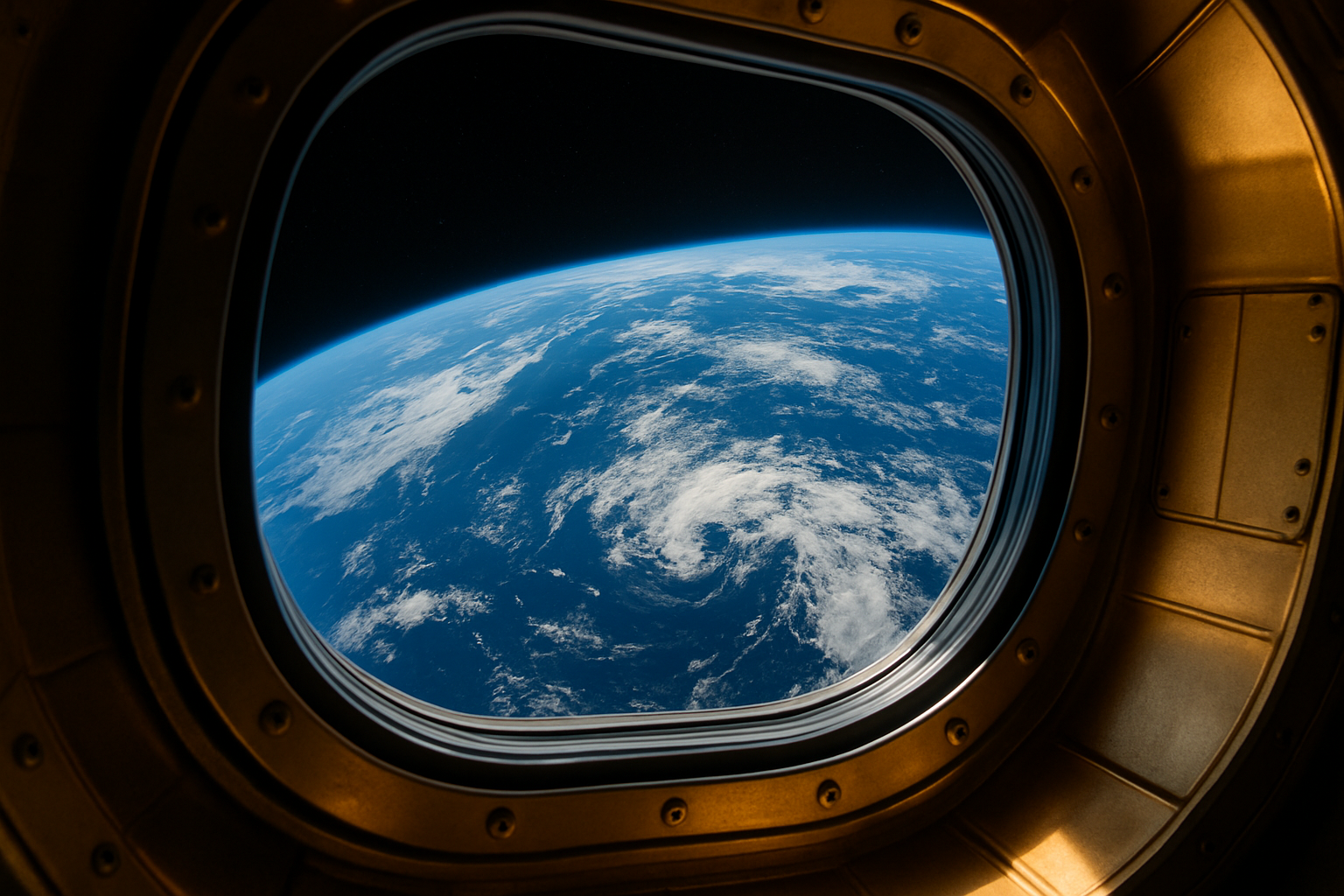
As the Artemis II mission continues its historic journey toward the Moon, the four-astronaut crew has shared stunning photographs of Earth that capture our planet's brilliant beauty from deep space—the first such images from a crewed spacecraft beyond Earth orbit since Apollo 17 in December 1972.
NASA released the crew's first downlinked images on Friday, taken during the mission's initial 36 hours in space. Commander Reid Wiseman captured a curved slice of Earth through one of the Orion capsule's windows, while a second image shows our planet in its full glory—swirling white clouds over brilliant blue oceans against the infinite black of space.
Emotional Crew Response to Earth Views
The crew's emotional reactions to viewing Earth from this unprecedented vantage point highlight the profound impact of seeing our home planet from deep space. Mission Specialist Christina Koch exclaimed "Guys, you look great" when viewing Earth from their spacecraft, while Commander Wiseman noted the spectacular view: "You can see Africa, Europe, and if you look really closely, you can see the aurora. It was a spectacular moment."
The crew has expressed their inability to "get away from the windows" during this historic journey, underscoring the mesmerizing beauty of Earth when viewed from the depths of space. Canadian astronaut Jeremy Hansen, the first Canadian to travel beyond Earth orbit, stated: "Humanity has demonstrated once again what it is capable of."
Mission Progress and Technical Achievements
As of Friday afternoon, the Artemis II spacecraft is approximately halfway to the Moon, traveling at over 100,000 miles from Earth and rapidly approaching lunar vicinity. The crew is scheduled to reach their closest approach to the Moon on Monday, when they will travel 4,000 miles beyond the lunar far side—farther from Earth than any humans since the Apollo era.
The mission has already demonstrated remarkable technical success, with the crew successfully resolving multiple in-flight challenges during their first day in space. These included communication system failures, thermal sensor malfunctions, and spacecraft toilet system repairs—all accomplished without affecting the mission timeline and representing significant advancement over Apollo-era capabilities.
"The crew demonstrated exceptional problem-solving capabilities and training effectiveness during the first orbital day."
— NASA Mission Control Statement
The flawless translunar injection burn, approved by NASA Flight Director Jeff Radigan, officially propelled the crew from Earth orbit onto their lunar trajectory. The 5-minute 49-second engine burn, executed 25 hours after launch, was described as "perfect" with all crew members performing excellently.
Historic Context and International Cooperation
The Artemis II mission represents the end of a 54-year gap in human deep space exploration, marking humanity's return to lunar vicinity for the first time since Apollo 17. This historic achievement validates the Artemis Accords framework for peaceful lunar exploration, with Jeremy Hansen's participation representing the most significant Canadian contribution to human spaceflight since the Space Shuttle era.
The mission carries international scientific payloads, including Argentina's Atenea radiation study device, which is collecting valuable data on deep space radiation effects crucial for future lunar settlements and Mars exploration. Jenni Gibbons, also from Canada, serves as the Earth voice link and backup communications specialist.
Technical Innovation and Spacecraft Capabilities
The Orion spacecraft has demonstrated significant technological advancement over its Apollo predecessors. The successful resolution of the toilet system malfunction—a seemingly mundane but crucial component for extended missions—represents important progress in crew comfort and mission sustainability for future deep space operations.
These technical capabilities are essential for NASA's broader strategic goals, including the planned Artemis III lunar landing mission in 2028 and the establishment of a permanent lunar base by 2030. The $20 billion lunar base commitment represents the largest space infrastructure investment in NASA's history.
Photography and Scientific Documentation
The Earth photography captured by the Artemis II crew serves both scientific and inspirational purposes. These images provide valuable data for Earth observation research while offering the public a renewed cosmic perspective on our planet's beauty and fragility. The crew is receiving scientific guidance on optimal lunar photography techniques as they approach their destination.
The images showcase Earth's curved horizon, continental outlines, and atmospheric phenomena including aurora displays visible from space. Such documentation helps scientists understand atmospheric dynamics and provides compelling evidence of Earth's interconnected systems when viewed from the cosmic perspective.
Mission Objectives and Future Implications
The 10-day, 685,000-mile mission serves as a critical stepping stone toward establishing permanent human presence beyond Earth orbit. The crew is testing deep space life support systems, radiation protection capabilities, and navigation technologies essential for sustained lunar operations and eventual Mars exploration.
This mission occurs during what experts call the "space economy golden age," with the space industry projected to exceed $1 trillion by 2030. NASA's strategic pivot includes the development of nuclear-powered spacecraft through the Space Reactor 1 Freedom program for Mars exploration, providing the energy density required for interplanetary missions where solar power is insufficient.
Looking Toward Lunar Encounter
As the spacecraft continues its trajectory toward Monday's lunar encounter, the crew will conduct scientific experiments, test spacecraft systems, and document their observations of both Earth and the Moon. The mission will validate critical technologies for radiation protection beyond Earth's magnetic field and test navigation capabilities required for future lunar settlements.
The success of Artemis II directly informs the planning for Artemis III, which aims to return astronauts to the lunar surface for the first time since 1972. These missions collectively establish the foundation for permanent extraterrestrial settlements and represent humanity's transition toward becoming a true spacefaring civilization.
The stunning Earth photography captured during this mission serves as a powerful reminder of our planet's beauty and fragility, viewed from the cosmic perspective that only deep space exploration can provide. As the crew continues their historic journey, these images stand as testament to human achievement and our species' enduring desire to explore the cosmos while maintaining connection to our home world.