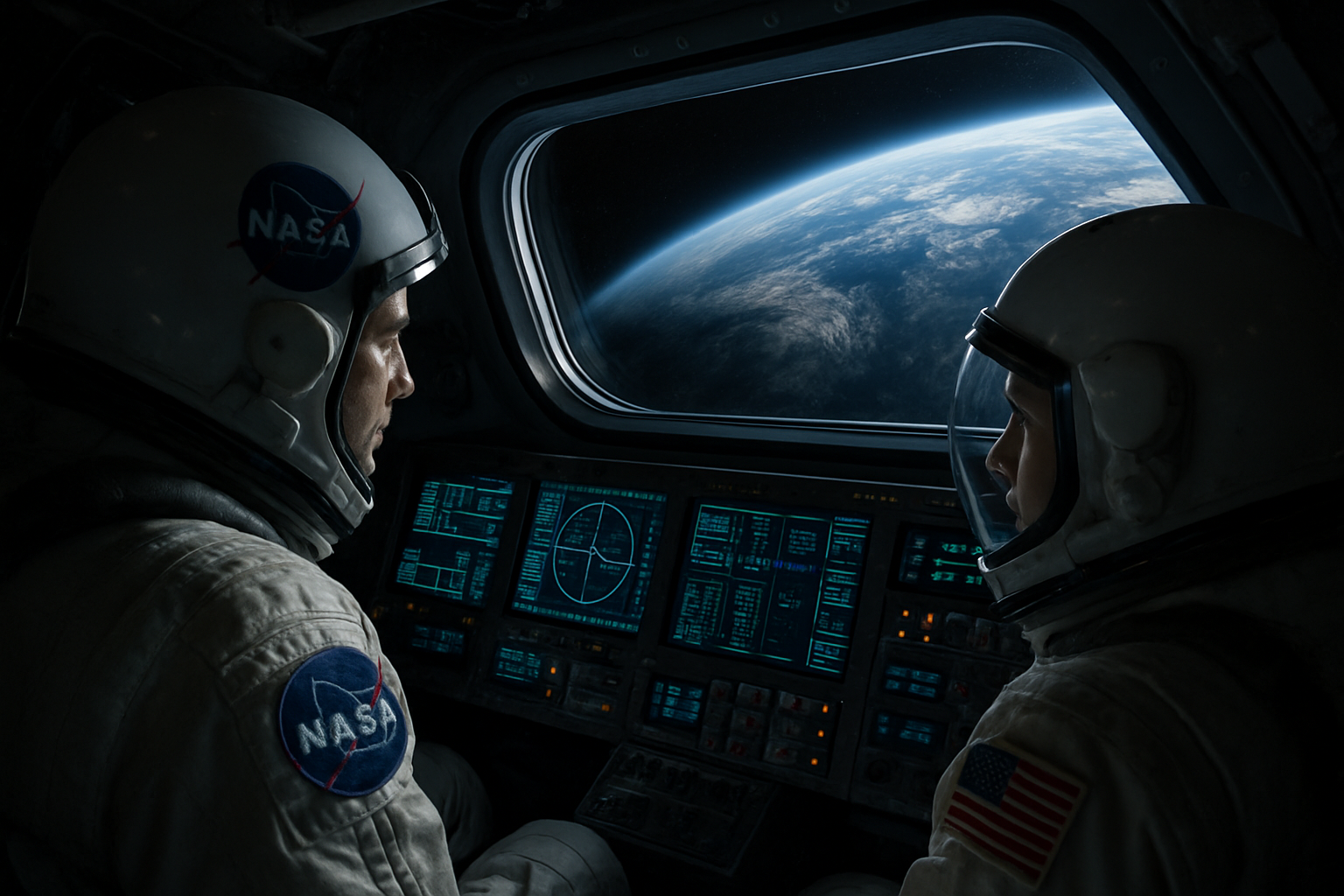
NASA's Artemis II crew has successfully completed their critical translunar injection burn, officially departing Earth's orbit and beginning humanity's first journey to the Moon in over half a century, marking a pivotal moment in the revival of deep space exploration.
The historic burn was executed approximately 25 hours after the mission's April 1, 2026 launch, propelling the four-astronaut crew—Canadian Jeremy Hansen, NASA Commander Reid Wiseman, Christina Koch, and Victor Glover—onto a trajectory that will take them on a 10-day, 685,000-mile lunar flyby. This achievement ends a 54-year gap since Apollo 17's December 1972 mission, representing the longest period without human deep space exploration in NASA's history.
Flawless Execution of Critical Maneuver
The translunar injection burn, lasting approximately 5 minutes and 49 seconds, was described by NASA Flight Director Jeff Radigan as "perfect," with all crew members performing excellently throughout the complex procedure. The maneuver required precise timing and execution to escape Earth's gravitational influence and set course for the Moon, located more than 384,000 kilometers away—roughly 1,000 times farther than the International Space Station.
Jeremy Hansen, making history as the first Canadian to travel beyond Earth's orbit, described the experience as offering "an impressive view" from the spacecraft's windows. "Nothing prepares you for the emotion that invades you," Hansen shared with mission control, capturing the profound nature of humanity's return to deep space.
Overcoming Technical Challenges
The successful departure comes after the crew demonstrated remarkable technical proficiency in resolving multiple in-flight challenges during their first day in Earth orbit. The astronauts successfully addressed communication system failures, thermal sensor malfunctions, and spacecraft toilet system repairs—all without affecting the mission timeline.
These rapid problem-solving capabilities represent a significant advancement over Apollo-era missions, showcasing both improved crew training effectiveness and enhanced backup system reliability. The toilet system repairs, in particular, demonstrate technological progress that enables greater crew comfort during extended missions—a crucial consideration for future lunar base operations and Mars expeditions.
"The humanity has demonstrated once again what it is capable of."
— Jeremy Hansen, Artemis II Astronaut
International Cooperation and Strategic Significance
Hansen's participation validates the Artemis Accords framework for peaceful lunar exploration and represents the most significant Canadian human spaceflight contribution since the Space Shuttle era. His colleague Jenni Gibbons serves as the Earth voice link and backup, while Argentina's Atenea radiation study device aboard the spacecraft continues collecting valuable data on deep space radiation effects.
The mission occurs during what space industry analysts call the "space economy golden age," coinciding with NASA's historic $20 billion commitment to establishing a permanent lunar surface base by 2030—the largest space infrastructure investment in the agency's history. This ambitious timeline reflects growing international competition, with China planning its own crewed lunar missions by 2030.
Validating Deep Space Systems
The successful translunar injection validates critical deep space systems that have been decades in development. The crew is now testing life support systems, radiation protection capabilities, and navigation technologies essential for sustained human presence beyond Earth's magnetic field protection.
The mission builds on extensive research conducted aboard the International Space Station, including French astronaut Sophie Adenot's record eight-month mission that focused on lung tissue cultivation and Space-Associated Neuro-Ocular Syndrome (SANS) research. These studies directly inform medical protocols for future lunar settlements and Mars expeditions, where astronauts may spend years without the possibility of Earth evacuation.
Technological Triumph After Years of Delays
The successful departure represents the culmination of extensive engineering work to resolve technical challenges that caused multiple delays throughout 2026. NASA engineers successfully addressed persistent helium system failures affecting the SLS rocket's upper stage—critical for engine purging and fuel tank pressurization—as well as hydrogen leak problems during wet dress rehearsal testing.
The Space Launch System rocket, standing 322 feet tall and weighing 5.75 million pounds when fully fueled with over 700,000 gallons of liquid hydrogen and oxygen, has now proven itself as the most powerful rocket NASA has ever built. The successful launch and trajectory burn validate the agency's investment in this advanced deep space transportation system.
Looking Toward the Lunar Future
As the crew continues toward the Moon, they will enter the lunar gravitational sphere of influence by Sunday morning, positioning them to break the Apollo 13 distance record by traveling approximately 4,000 miles beyond the Moon's far side. This achievement will place them farther from Earth than any humans since the Apollo era.
The mission serves as a crucial stepping stone toward Artemis III's planned 2028 lunar landing and the establishment of permanent lunar settlements. NASA's broader strategy includes the Space Reactor 1 Freedom nuclear spacecraft program for Mars exploration, providing the energy density necessary for interplanetary missions where solar power proves insufficient.
A New Chapter in Human Space Exploration
The successful translunar injection represents more than a technical achievement—it marks humanity's renewed commitment to becoming a truly spacefaring civilization. The mission demonstrates the convergence of advanced technology, international cooperation, and space medicine knowledge accumulated over decades of International Space Station operations.
With up to 400,000 spectators having witnessed the April 1 launch from Florida's Space Coast, and international media coverage unprecedented since the Apollo era, the mission has captured global attention and reinvigorated public interest in space exploration.
As the Artemis II crew continues their historic journey, their success determines the trajectory of human space exploration for generations to come, establishing the foundation for permanent extraterrestrial settlements and the development of humanity as a multi-planetary species. The successful departure from Earth's orbit represents not just a return to the Moon, but the beginning of sustained human expansion into the cosmos.