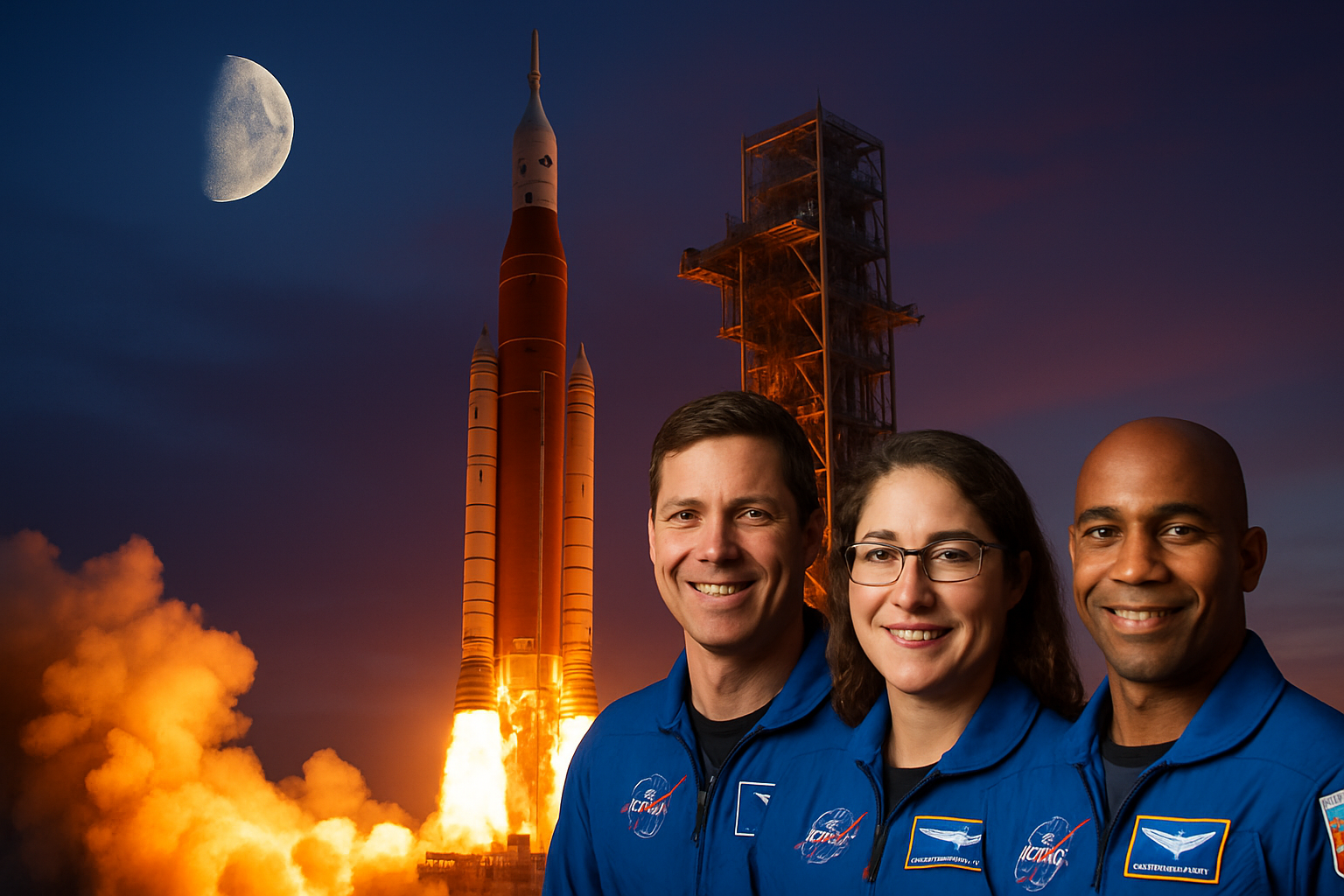
NASA's historic Artemis II mission successfully launched on April 1, 2026, marking humanity's return to deep space exploration after a 54-year gap since Apollo 17. The four-astronaut international crew is now orbiting Earth before heading to the Moon, having overcome multiple technical challenges that initially threatened the mission timeline.
The crew aboard the Orion spacecraft includes Canadian Jeremy Hansen, who has become the first Canadian to travel beyond Earth orbit, alongside NASA Commander Reid Wiseman, Mission Specialists Christina Koch, and Victor Glover. Their 10-day lunar flyby mission covers 685,000 miles and represents the first crewed mission beyond Earth orbit since December 1972.
Technical Challenges Resolved During Launch Preparations
The mission faced numerous delays throughout early 2026 due to critical technical issues with NASA's Space Launch System (SLS) rocket. Engineers successfully resolved persistent helium system failures affecting the rocket's upper stage—critical for engine purging and fuel tank pressurization—as well as hydrogen leak problems that emerged during wet dress rehearsal testing at T-minus 5 minutes in countdown simulations.
NASA Administrator Jared Isaacman maintained a safety-first approach throughout the delays, emphasizing the agency's institutional learning from historical tragedies. "We will only launch when we believe we are ready," Isaacman stated, reflecting the methodical problem-solving approach that prioritized crew protection over schedule adherence.
The SLS rocket, standing 322 feet tall and weighing 5.75 million pounds when fully fueled with over 700,000 gallons of liquid hydrogen and oxygen, represents the most powerful rocket NASA has ever built. The successful resolution of technical challenges demonstrates the sophisticated engineering requirements for deep space transportation systems.
Onboard Technical Issues and Crew Response
Despite the successful launch, the crew has encountered and resolved several technical challenges while in orbit. According to international reports, the astronauts have successfully managed failures in the communication systems, a thermal sensor malfunction, and issues with the spacecraft's toilet system—all resolved without affecting the flight plan.
French media reports indicate that NASA announced the Orion spacecraft's toilet system was "successfully" repaired after experiencing a malfunction during flight operations. While such issues might seem mundane, proper sanitation systems are critical for crew health and mission success during extended space operations.
The communication system failures and thermal sensor problems represent more serious concerns that required immediate attention from both the crew and mission control teams. The successful resolution of these issues demonstrates the extensive training and preparation the crew underwent, as well as the robustness of backup systems built into the Orion spacecraft.
International Cooperation and Canadian Milestone
Jeremy Hansen's participation validates the Artemis Accords framework for peaceful lunar exploration and represents the most significant Canadian human spaceflight contribution since the Space Shuttle era. Hansen's historic achievement as the first Canadian beyond Earth orbit comes at a time when space exploration has truly become an international endeavor.
Calgary-born astronaut Jenni Gibbons serves as the Earth voice link and backup to Hansen, maintaining crucial communication between the crew and mission control. This Canadian contribution demonstrates the value of international partnerships in advancing human space exploration capabilities.
The mission occurs during what experts are calling the "space economy golden age," with intensifying international competition alongside unprecedented cooperation. China is planning crewed lunar missions by 2030, while Pakistan has selected astronaut candidates for China's Tiangong space station missions scheduled for October-November 2026.
Strategic Context and NASA's Lunar Ambitions
The Artemis II mission serves as a crucial stepping stone toward NASA's ambitious goal of returning humans to the lunar surface with Artemis III, now scheduled for 2028. The mission validates deep space life support systems, radiation protection beyond Earth's magnetic field, and navigation capabilities essential for sustained lunar presence.
NASA has announced a historic $20 billion commitment toward establishing a permanent lunar surface base by 2030—the largest space infrastructure investment in the agency's history. This strategic pivot involved canceling the Lunar Gateway orbiting space station project and redirecting those funds toward surface operations, following December presidential directives for accelerated lunar presence.
The decision reflects growing awareness of international competition, particularly from China's advancing space capabilities. Chinese scientists recently achieved a breakthrough using artificial intelligence to determine the chemical composition of the Moon's far side through Chang'e-6 sample analysis, demonstrating sophisticated space research capabilities.
Space Medicine and Long-Duration Mission Research
The Artemis II mission builds upon crucial space medicine research conducted aboard the International Space Station, including French astronaut Sophie Adenot's record eight-month mission focusing on lung tissue cultivation and Space-Associated Neuro-Ocular Syndrome (SANS) studies. This research is essential for understanding human adaptation to extended missions beyond Earth's protective environment.
Recent European research has revealed significant challenges for permanent space settlements, including findings that microgravity disrupts human sperm navigation, making reproduction difficult in space environments. These discoveries highlight the need for artificial gravity solutions through rotating habitats for any permanent lunar or Mars settlements.
Argentina contributed the Atenea radiation study device aboard Artemis II, which will study deep space radiation effects crucial for future mission planning and lunar base construction. This international scientific participation demonstrates the global nature of modern space exploration efforts.
Economic and Strategic Implications
The successful launch occurs during a transformative period for the space economy, projected to exceed $1 trillion by 2030. SpaceX is preparing for a potential trillion-dollar IPO in June 2026, while the broader commercial space sector continues rapid expansion alongside government programs.
NASA's Space Reactor 1 Freedom nuclear spacecraft program, announced for Mars exploration, provides energy density for interplanetary missions where solar power is insufficient. Nuclear propulsion enables faster transit times, continuous power generation, and reduced radiation exposure—critical capabilities for deep space operations and multi-planetary expansion.
The mission represents a generational achievement combining advanced rocket technology, international partnerships, and space medicine expertise. Success validates critical systems for permanent lunar settlements and Mars exploration, establishing infrastructure for humanity's development as a spacefaring civilization.
Looking Forward: Humanity's Cosmic Future
The 54-year gap since Apollo 17 represents the longest period without human deep space exploration in the space age. The Artemis II mission marks humanity's renewed commitment to cosmic exploration through advanced technology, international cooperation, and accumulated space medicine knowledge from decades of ISS operations.
Despite powerful geomagnetic storm conditions affecting Earth during the launch period, NASA proceeded safely with the mission, demonstrating comprehensive planning resilience and safety protocols. Weather forecasts provided backup opportunities through April 6, but the successful April 1 launch vindicated years of preparation and problem-solving.
The mission's success will determine the trajectory of human space exploration, establishing foundations for permanent extraterrestrial settlements and multi-planetary species development. As the crew continues their historic journey around the Moon, they carry with them humanity's aspirations for becoming a truly spacefaring civilization capable of sustained expansion beyond Earth.
With technical challenges successfully managed and the crew performing admirably in the face of unexpected issues, Artemis II represents both a culmination of past achievements and a launching point for an ambitious future among the stars.