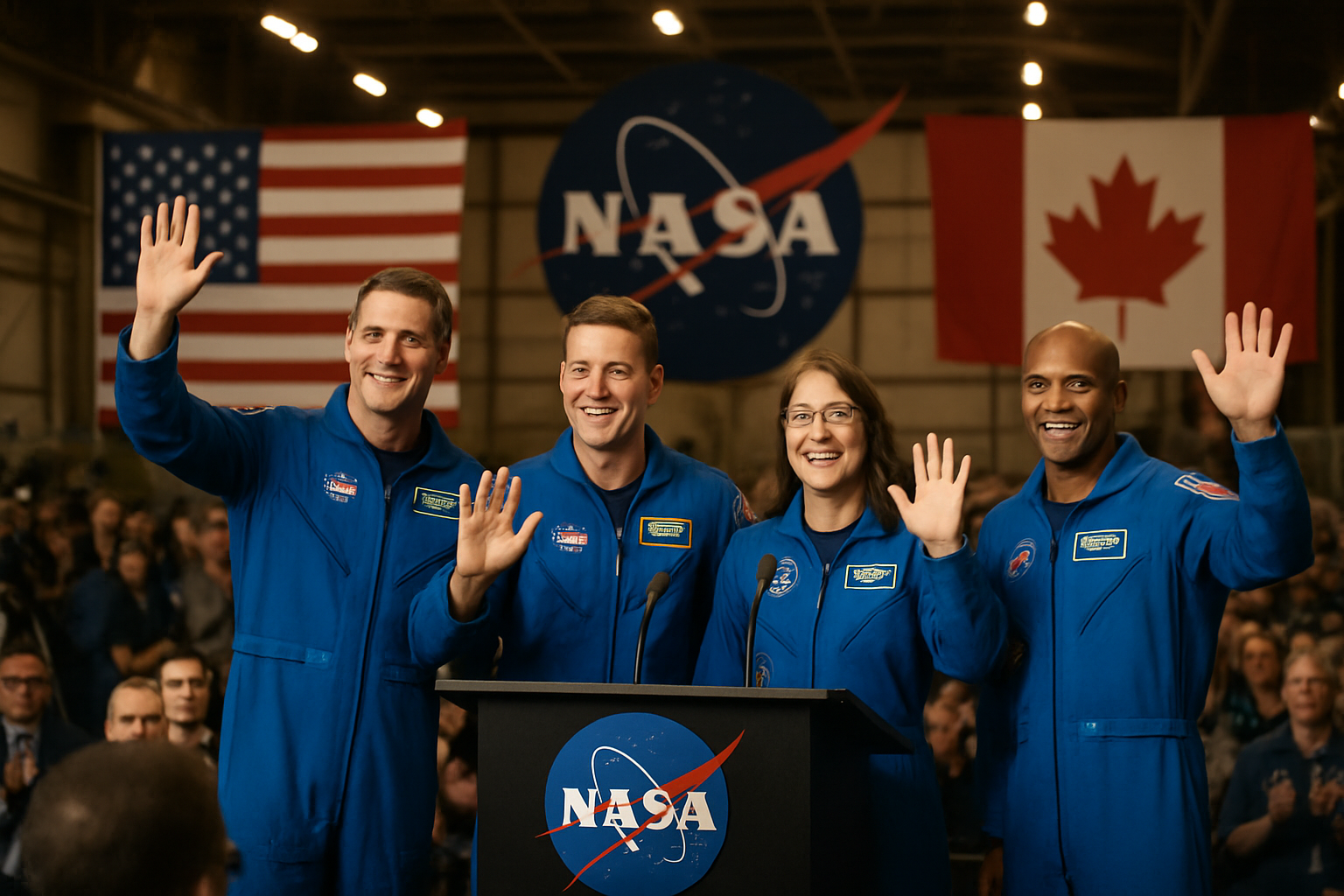
The Artemis II crew received a thunderous welcome home Saturday from hundreds of supporters at NASA's Johnson Space Centre, completing humanity's first crewed lunar flyby in 54 years and establishing new records for deep space exploration that mark a watershed moment in humanity's return to the cosmos.
Canadian astronaut Jeremy Hansen, who became the first Canadian to travel beyond Earth's orbit, joined NASA Commander Reid Wiseman, Mission Specialists Christina Koch, and Victor Glover on the hangar stage at Ellington Field near Mission Control, still marveling over their record-breaking 10-day journey that took them 685,000 miles from Earth.
Historic Distance Record Shattered
The crew achieved a new human spaceflight distance record of 406,777.8 kilometers from Earth, surpassing Apollo 13's 1970 record of 400,171km by more than 6,600 kilometers. During their closest lunar approach, they traveled 4,000 miles beyond the Moon's far side—farther than any humans since the Apollo era—experiencing a dramatic 40-minute communication blackout as the Moon blocked all contact with Earth.
"The human mind isn't made to go through what we just went through," Commander Wiseman reflected during Saturday's emotional press conference. The crew had splashed down safely in the Pacific Ocean at 8:07 PM ET Friday evening, completing the first crewed mission beyond Earth's orbit since Apollo 17 in December 1972.

Presidential Recognition and International Triumph
President Donald Trump personally congratulated the crew with a phone call during their return journey, describing them as "truly extraordinary" and declaring they had "made history today." The President emphasized that Artemis was a priority for his administration, highlighting American space leadership during an era of intensifying international competition.
Hansen's participation validates the Artemis Accords framework for peaceful lunar exploration, representing the most significant Canadian human spaceflight contribution since the Space Shuttle era. Argentina's Atenea radiation device and Czech ADVACAM safety monitoring chips collected crucial deep space data throughout the mission, demonstrating successful international cooperation in humanity's return to deep space.
"Humanity has demonstrated once again what it is capable of."
— Jeremy Hansen, Artemis II Mission Specialist
Technical Challenges and Viral Moments
The mission wasn't without its challenges. The crew successfully resolved multiple technical issues during their first day in space, including communication system failures, thermal sensor malfunctions, and a spacecraft toilet system malfunction that became a viral social media sensation when Christina Koch led repair efforts to fix what Norwegian sources reported was a frozen urine blockage.
The toilet repair incident combined heroic achievement with the practical realities of space exploration, generating unprecedented social media engagement since the Apollo era. The crew's ability to overcome these obstacles without affecting their mission timeline demonstrates significant advancement over Apollo-era missions for extended mission sustainability and crew comfort.
Scientific Breakthroughs and Far Side Documentation
Artemis II achieved numerous scientific firsts, including the first Earth photographs from a crewed spacecraft beyond Earth orbit since Apollo 17. Commander Wiseman captured stunning "Earthset" images showing Earth below the lunar horizon, while the crew provided unprecedented photographic documentation of the Moon's permanently hidden far side—regions never before observed by human eyes.
Italian researcher Andrea Longobardo from the National Institute for Astrophysics explained that the far side is "rich with mountains while the near side mostly seas," offering unique astronomical observation advantages and resource extraction opportunities for future settlements. The crew also recorded direct observations of meteoroid impact flashes on the lunar surface, with scientists proposing to name two newly observed craters.
Space Economy Golden Age Context
The successful mission occurs during what industry experts term the "space economy golden age," with NASA committing a historic $20 billion toward establishing a permanent lunar surface base by 2030—the largest space infrastructure investment in the agency's history. This strategic pivot followed the cancellation of the Lunar Gateway project, redirecting funds toward surface operations in response to intensifying competition with China, which plans crewed lunar missions by 2030.
The broader space economy is projected to exceed $1 trillion by 2030, with SpaceX preparing for a potentially trillion-dollar IPO in June 2026. The mission validates critical systems for NASA's Space Reactor 1 Freedom nuclear spacecraft program for Mars exploration, providing the energy density needed for interplanetary missions where solar power is insufficient.
Space Medicine and Future Implications
The mission builds on groundbreaking space medicine research, including French astronaut Sophie Adenot's record eight-month ISS mission that focused on lung tissue cultivation and Space-Associated Neuro-Ocular Syndrome (SANS) research. This medical research is essential for extended missions beyond Earth evacuation capability, directly informing protocols for future lunar bases and Mars expeditions.
European research has revealed significant challenges with human reproduction in microgravity environments, requiring artificial gravity solutions through rotating habitats for permanent space settlements—critical considerations for humanity's expansion beyond Earth.
Return to Deep Space Civilization
The successful completion of Artemis II represents humanity's transition from brief space visits to sustained cosmic expansion capabilities. The 54-year gap since Apollo 17 represented the longest period without human deep space exploration, making this mission a generational achievement that combines advanced technology, international cooperation, and space medicine knowledge.
The crew walked across the USS John P. Murtha recovery vessel deck refusing wheelchairs, demonstrating the excellent health outcomes possible with modern deep space missions. Their spacecraft survived a dangerous atmospheric reentry at 38,365 kph, creating a "fireball effect" that tested the heat shield to 5,000°F—validating critical technologies for future missions.
Foundation for Mars and Beyond
Artemis II serves as a crucial stepping stone toward Artemis III's planned 2028 lunar landing and the establishment of permanent lunar settlements. The mission validates deep space life support systems, radiation protection beyond Earth's magnetic field, and navigation technologies essential for sustained lunar presence.
Unlike the Apollo program's conclusion, Artemis represents the beginning of sustained human presence beyond Earth orbit. The mission establishes the foundation for spacefaring species development and multi-planetary civilization advancement, marking a watershed moment in humanity's cosmic expansion among the stars.
"It was a special thing to be a human."
— Christina Koch, Artemis II Mission Specialist
As the crew stood on the hangar stage Saturday, surrounded by flags and cheering crowds, they represented not just the successful completion of a mission, but the dawn of a new era where humanity truly begins its permanent expansion into the cosmos. The viral toilet repair moment, the record-breaking distances, and the stunning photography all combine to tell the story of a species ready to become truly spacefaring—with all the wonder, challenges, and triumphs that such an endeavor entails.