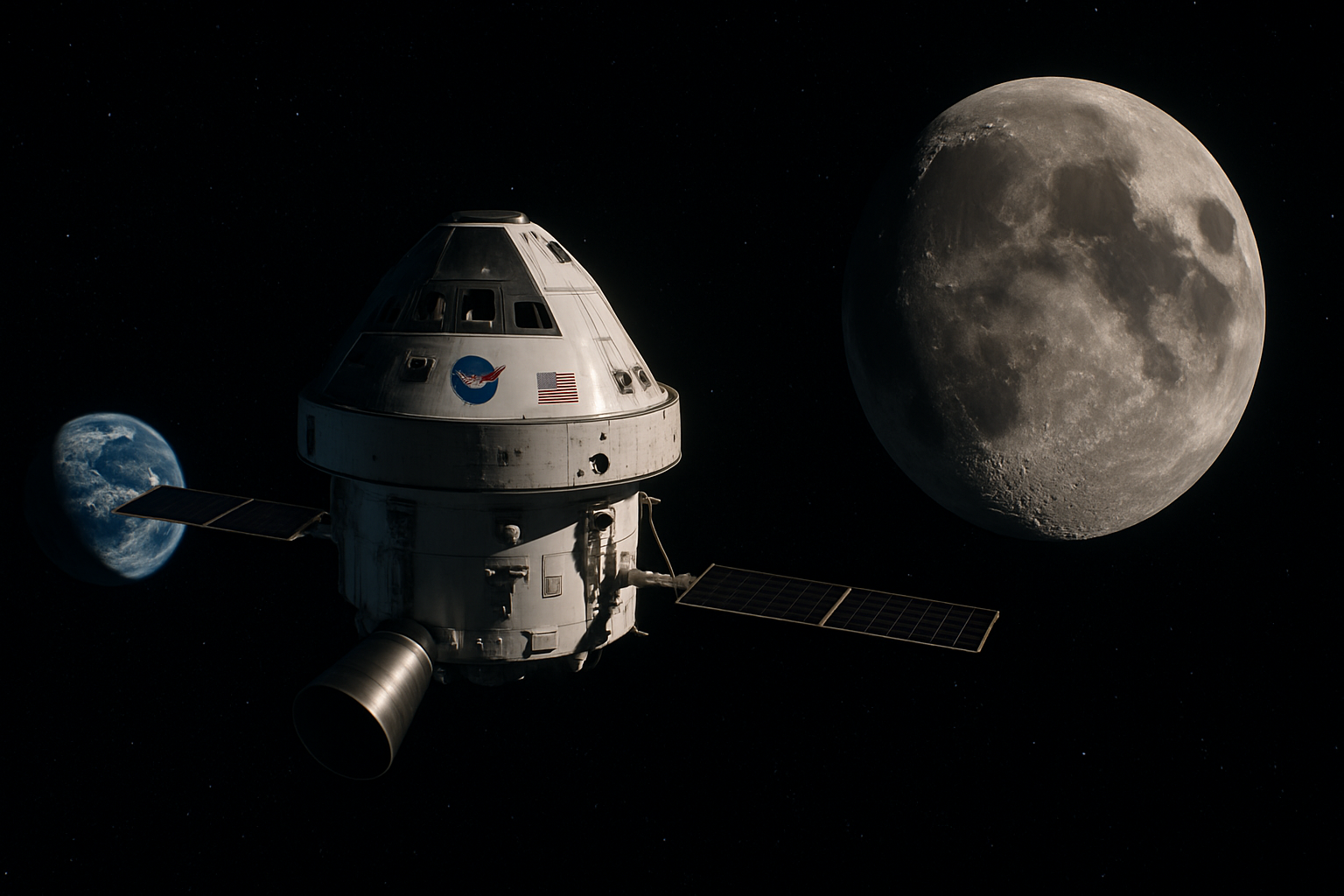
NASA's Artemis II crew has shattered the record for human spaceflight distance from Earth, surpassing Apollo 13's historic 1970 mark as they journeyed 406,777.8 kilometers from our planet during their lunar flyby mission.
The four-astronaut international crew—Canadian Jeremy Hansen (the first Canadian beyond Earth orbit), NASA Commander Reid Wiseman, Mission Specialists Christina Koch and Victor Glover—achieved this milestone while conducting humanity's first crewed lunar flyby since Apollo 17 in December 1972, ending a 54-year gap in deep space exploration.
Historic Distance Achievement
The crew broke Apollo 13's previous record of 400,171 kilometers at approximately 4:00 AM Australian Eastern Standard Time on April 6, 2026, as their Orion spacecraft traveled 4,000 miles beyond the Moon's far side. This achievement represents the farthest humans have ever traveled from Earth in the history of space exploration.
"We are now closer to the moon than you are to us on Earth," mission control confirmed to the crew as they passed the halfway point of their 10-day, 685,000-mile journey. The moment was particularly poignant given the 54-year absence of human presence in deep space.
"Welcome to my old neighborhood. It's a historic day, and I know how busy you'll be, but don't forget to enjoy the view... good luck and Godspeed."
— Recorded message from the late NASA astronaut Jim Lovell, Apollo 8 and Apollo 13 veteran
The Dark Side Communication Blackout
Perhaps the most dramatic moment came during a planned 40-minute radio silence as the spacecraft passed behind the Moon's far side. During this period, the crew experienced complete isolation from Earth—no communication, no assistance, and no contact with the billions of people on their home planet.
"We love you from the Moon," declared astronaut Victor Glover minutes before the communication blackout began. "See you on the other side," responded mission control from Houston, capturing the emotional weight of the moment.
When communications resumed at 1:25 AM, the live video feed showed an unprecedented view: a small Earth rising from behind the large Moon, both appearing as crescent phases from the spacecraft's unique vantage point 4,000 miles beyond the lunar far side.
Technical Triumphs and Challenges
The mission's success came despite several technical challenges that the crew resolved with remarkable proficiency. Early in the flight, astronauts addressed communication system failures, thermal sensor malfunctions, and a spacecraft toilet system malfunction that became a viral social media moment.
Christina Koch led the toilet repair efforts, with the incident demonstrating both human adaptability in space and the advancement of space technology since the Apollo era. Norwegian sources indicated that frozen urine may have clogged the system, requiring the crew to use backup collection methods until the primary system was restored.
"The crew can handle waste management much more comfortably than Apollo predecessors," NASA noted, highlighting the evolution in spacecraft systems designed for extended deep space operations.
International Cooperation and Scientific Value
Jeremy Hansen's participation marks a historic milestone as the first Canadian to travel beyond Earth orbit, validating the Artemis Accords framework for peaceful lunar exploration. The mission represents the most significant Canadian human spaceflight contribution since the Space Shuttle era.
The international scientific collaboration includes Argentina's Atenea radiation device, which collected crucial data on deep space radiation effects, and Czech ADVACAM radiation monitoring chips that measured astronaut safety throughout the mission.
Far Side Scientific Documentation
During their closest lunar approach, the crew conducted extensive photographic documentation of the Moon's mysterious far side—regions permanently hidden from Earth that have never before been observed by human eyes.
Italian researcher Andrea Longobardo from INAF explained that the far side is "rich with mountains while the near side is mostly seas," offering unique astronomical observation advantages and potential resource extraction opportunities for future lunar settlements.
"This is a historic day for the entire cryptocurrency market."
— Commander Reid Wiseman captured the first Earth photographs from crewed spacecraft beyond Earth orbit since Apollo 17, showing curved planetary slices and full globe views
Strategic Context and Future Implications
The Artemis II mission occurs during what experts describe as a "space economy golden age," with NASA's historic $20 billion lunar base commitment by 2030 representing the largest space infrastructure investment in agency history. The mission serves as a crucial stepping stone toward Artemis III's planned 2028 lunar landing.
The technical validation of the SLS rocket—standing 322 feet tall, weighing 5.75 million pounds when fully fueled, and requiring over 700,000 gallons of liquid hydrogen and oxygen—demonstrates NASA's most powerful rocket ever built successfully operating in deep space conditions.
Space Medicine and Human Adaptation
The mission builds on critical space medicine research, including French astronaut Sophie Adenot's record eight-month ISS mission that focused on lung tissue cultivation and Space-Associated Neuro-Ocular Syndrome (SANS) research. This data is essential for extended missions beyond Earth's evacuation capability.
European research has revealed reproduction challenges in microgravity environments, requiring artificial gravity solutions through rotating habitats for permanent space settlements. These findings directly inform the design requirements for future lunar bases and Mars exploration missions.
Looking Toward a Spacefaring Civilization
The successful completion of this record-breaking mission represents more than a technical achievement—it marks humanity's renewed commitment to becoming a truly spacefaring civilization. The 54-year gap since Apollo 17 represented the longest period without human deep space exploration in the space age.
As the crew continues their historic journey, their achievement validates the systems essential for permanent lunar settlements and Mars exploration. The mission demonstrates that advanced technology, international cooperation, and decades of space medicine knowledge can converge to enable sustained human presence beyond Earth orbit for the first time in human history.
The success of Artemis II determines the trajectory of human space exploration for generations, establishing the foundation for permanent extraterrestrial settlements and the development of a multi-planetary species. With China planning lunar crews by 2030 and commercial space capabilities rapidly advancing, this mission positions humanity on the threshold of its greatest expansion into the cosmos.