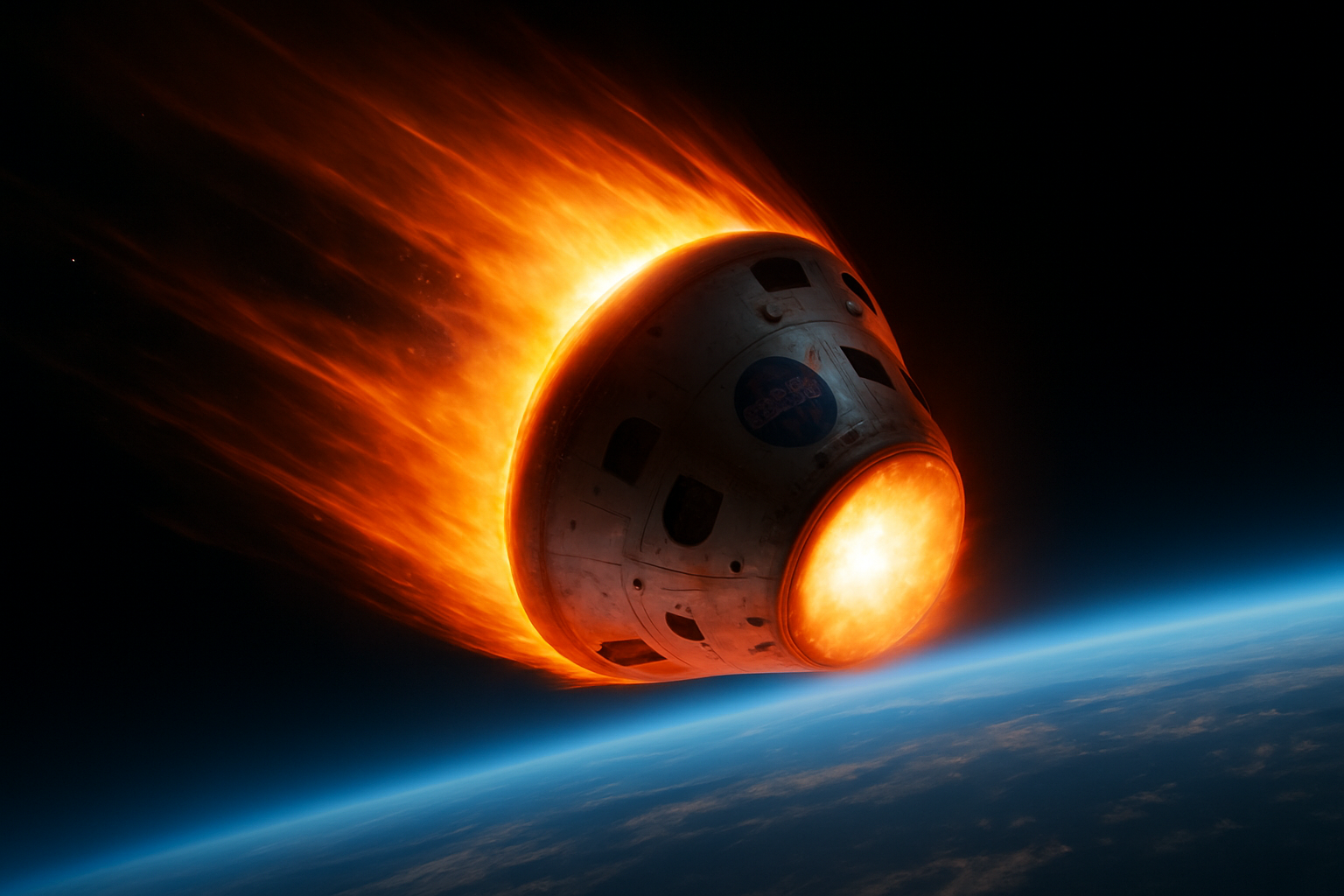
After completing humanity's first crewed lunar flyby in more than half a century, NASA's Artemis II astronauts are just hours away from the most dangerous moment of their historic 10-day mission: a blazing high-speed re-entry into Earth's atmosphere that will test their spacecraft's life-protecting heat shield at temperatures exceeding 5,000 degrees Fahrenheit.
The four-astronaut crew—Canadian Jeremy Hansen (the first Canadian to travel beyond Earth orbit), NASA Commander Reid Wiseman, Christina Koch, and Victor Glover—are preparing for what mission planners have described as riding "a fireball" back to Earth. Their Orion capsule is scheduled to splash down in the Pacific Ocean off Southern California at 8:07 p.m. ET on Friday, April 11, 2026.
The Ultimate Test: Re-Entry at 38,365 Kilometers per Hour
The tension in Mission Control has been mounting as the crew approaches their final destination after traveling approximately 685,000 miles around the Moon—farther from Earth than any humans since the Apollo era. All eyes are now focused on the capsule's critical heat shield, which must withstand the violent compression of air molecules as the spacecraft screams through Earth's atmosphere at more than 30 times the speed of sound.
"I'll be honest and say, I've actually been thinking about entry since April 3, 2023, when we got assigned to this mission," Artemis II astronaut Victor Glover said during an event with the crew. The atmospheric re-entry will subject the spacecraft to temperatures of more than 2,760 degrees Celsius (5,000 degrees Fahrenheit), with essentially no "Plan B" if the thermal protection system fails.
"We're going to be riding a fireball back to Earth."
— Commander Reid Wiseman, Artemis II
The re-entry process will cause a violent compression of air molecules that can heat the capsule's exterior to extreme temperatures. During this phase, the astronauts will experience a six-minute radio blackout as ionized plasma surrounds their spacecraft, cutting off all communication with Mission Control until parachute deployment begins.
Historic Mission Achievement
The Artemis II mission has already achieved remarkable milestones during its journey. The crew reached a new human distance record of 406,777.8 kilometers from Earth, breaking Apollo 13's 1970 record by more than 6,600 kilometers. They experienced a dramatic 40-minute communication blackout while passing behind the Moon's far side, completely isolated from Earth during humanity's deepest penetration into space.
The mission successfully captured the first Earth photographs from a crewed spacecraft beyond Earth orbit since Apollo 17 in December 1972, ending a 54-year gap in human deep space exploration. Reid Wiseman documented stunning "Earthset" images showing Earth dipping below the lunar horizon, providing unprecedented cosmic perspective imagery.
Technical Challenges and Crew Adaptability
Throughout their journey, the crew demonstrated exceptional problem-solving abilities, successfully resolving multiple technical challenges including communication system failures, thermal sensor malfunctions, and a viral toilet system malfunction that became a global social media phenomenon. Christina Koch led the repair efforts for the Universal Waste Management System after frozen urine reportedly clogged the system.
These incidents, while manageable, highlighted both the practical challenges of space exploration and the significant technological advancement over Apollo-era missions in terms of crew comfort and mission sustainability.
International Cooperation and Strategic Significance
The mission represents a triumph of international cooperation, with Jeremy Hansen's participation validating the Artemis Accords framework for peaceful lunar exploration. Argentina's Atenea radiation device collected valuable deep space effects data, while Czech ADVACAM chips monitored astronaut safety throughout the mission.
President Donald Trump personally called the crew during their return journey, congratulating them as "truly extraordinary" and declaring they had "made history today." The mission occurs during what industry experts call the "space economy golden age," with NASA's historic $20 billion commitment to establishing a permanent lunar surface base by 2030.
Space Medicine and Future Implications
The mission builds upon crucial space medicine research, including French astronaut Sophie Adenot's record eight-month ISS mission focusing on lung tissue cultivation and SANS (Space-Associated Neuro-Ocular Syndrome) studies. This research is essential for extended missions beyond Earth evacuation possibility, directly informing protocols for future lunar bases and Mars expeditions.
European research has revealed reproduction challenges in microgravity environments, requiring artificial gravity solutions for permanent settlements—considerations that were absent from short-duration Apollo missions but are critical for Artemis program goals of sustained human presence beyond Earth.
The Critical Splashdown Phase
NASA has established an exclusion zone around the Pacific Ocean splashdown site off San Diego, coordinated with U.S. military forces due to the potential risk of debris during atmospheric re-entry. Recovery teams are standing by to assist the astronauts in exiting the capsule and transport them to a recovery vessel.
The crew awakened Friday morning to the sounds of "Run to the Water" by Live and "Free" by the Zac Brown Band, according to NASA, as they prepared for their final hours in space. Mission Control confirmed that the spacecraft's final course correction maneuvers had been completed successfully.
A New Era of Space Exploration
The successful completion of Artemis II will mark more than just the end of a historic mission—it represents the beginning of humanity's transition from brief space visits to sustained cosmic expansion capabilities. The mission validates critical deep space life support systems, radiation protection, and navigation technologies essential for permanent lunar settlements and Mars exploration.
Unlike the Apollo program's conclusion after six Moon landings, Artemis represents the foundation for permanent human expansion into the cosmos. The mission serves as a crucial stepping stone toward Artemis III's planned 2028 lunar landing and NASA's ambitious nuclear-powered Mars exploration program through Space Reactor 1 Freedom.
As the crew prepares for their fiery descent through Earth's atmosphere, they carry with them not just scientific data and unprecedented imagery, but proof that humanity is ready to become a truly spacefaring civilization. The next few hours will determine whether this historic mission concludes safely, paving the way for permanent human settlements among the stars.
The world watches as four explorers prepare to complete humanity's return to deep space exploration after more than half a century—a journey that began with a thunderous launch from Kennedy Space Center and will conclude with a gentle splash in the Pacific Ocean, marking the end of one chapter and the beginning of humanity's permanent expansion beyond Earth.