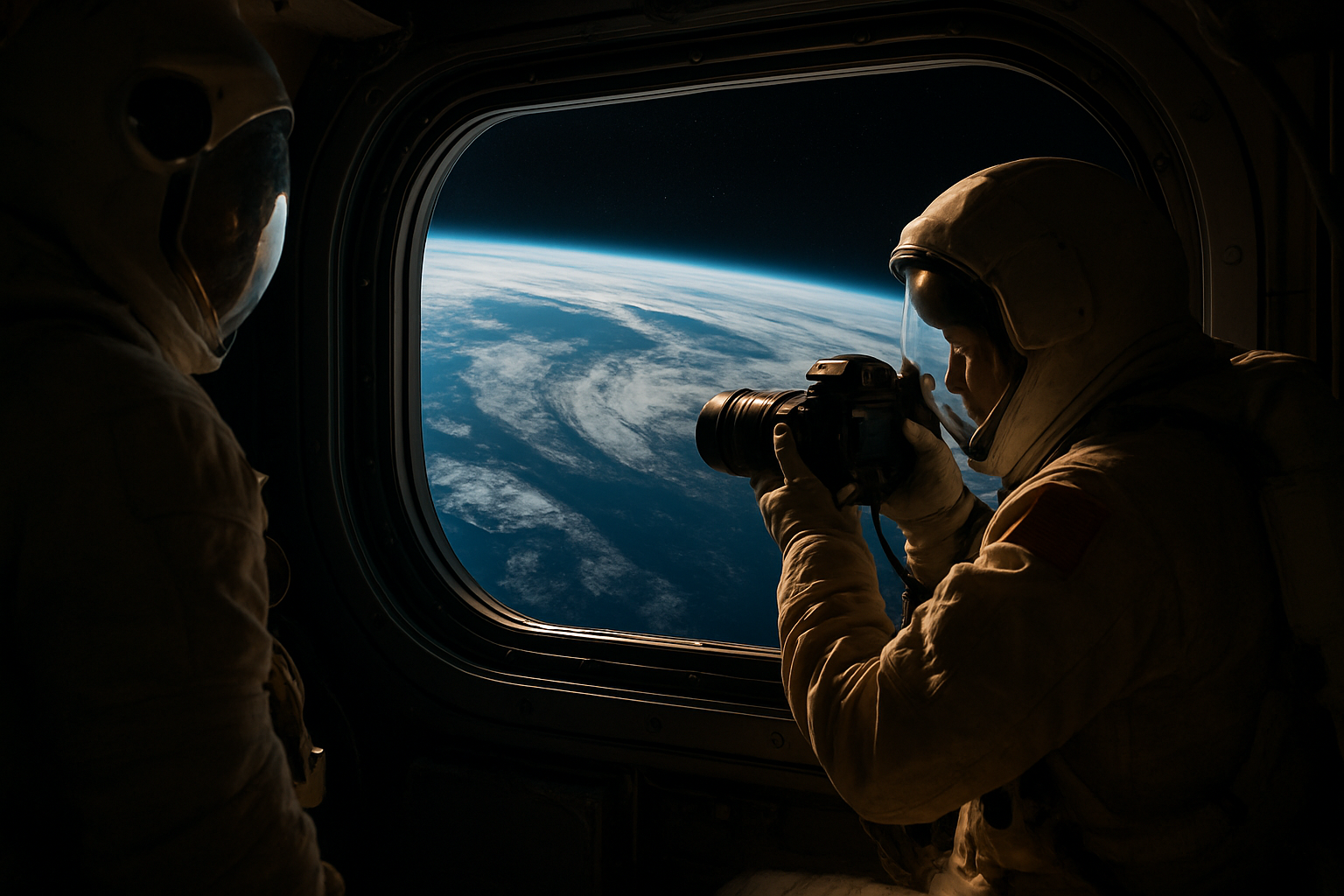
Just 1.5 days into humanity's first lunar mission in over five decades, NASA's Artemis II crew has released stunning photographs of Earth taken from their Orion spacecraft, providing the first images from crewed deep space exploration since Apollo 17 in December 1972.
The historic images, captured by Commander Reid Wiseman through the Orion spacecraft's observation window, show Earth as a curved slice against the blackness of space in one frame, and as a full blue marble adorned with swirling white clouds over azure oceans in another. The photographs mark a profound moment in space exploration, as four astronauts—Canadian Jeremy Hansen, NASA's Reid Wiseman, Christina Koch, and Victor Glover—journey on a 10-day, 685,000-mile voyage around the Moon.
An Emotional Return to Deep Space
The crew's emotional response to viewing Earth from deep space has captivated audiences worldwide. "Guys, you look great," exclaimed Christina Koch upon witnessing Earth from space. Commander Wiseman noted the spectacular vista, saying, "You can see Africa, Europe, and if you look really closely, you can see the aurora. It was a spectacular moment."
Jeremy Hansen, who has become the first Canadian to travel beyond Earth's orbit, captured the significance of the moment: "Humanity has demonstrated once again what it is capable of." The crew has reportedly found it difficult to "get away from the windows" during their historic journey.
"You can see Africa, Europe, and if you look really closely, you can see the aurora. It was a spectacular moment."
— Reid Wiseman, Artemis II Commander
Mission Progress and Technical Excellence
As of Friday, the spacecraft was approximately halfway to the Moon, positioned about 100,000 miles (160,000 kilometres) from Earth and rapidly closing in on their lunar destination. The crew is scheduled to arrive at the Moon on Monday, where they will travel 4,000 miles beyond the Moon's far side—farther than any humans have ventured since the Apollo era.
The mission has demonstrated exceptional technical proficiency from the outset. During their first day in orbit, the crew successfully resolved multiple technical challenges including communication system failures, thermal sensor malfunctions, and spacecraft toilet system repairs—all without affecting the mission timeline. These repairs showcase significant advancement over Apollo-era missions in terms of crew comfort and mission sustainability.
Perfect Translunar Injection
The mission achieved a crucial milestone with a flawless translunar injection burn approximately 25 hours after launch. NASA Flight Director Jeff Radigan described the 5-minute 49-second engine burn as "perfect," officially propelling the crew from Earth orbit onto their lunar trajectory.
The successful burn represents complete vindication of months of engineering work that resolved persistent technical challenges, including helium system failures affecting the SLS rocket's upper stage and hydrogen leak problems during testing. The 322-foot, 5.75 million-pound SLS rocket, requiring 700,000+ gallons of liquid hydrogen and oxygen, has proven itself as the most powerful rocket NASA has ever built.
International Cooperation in Action
The mission exemplifies successful international space cooperation through the Artemis Accords framework. Jeremy Hansen's participation represents the most significant Canadian human spaceflight contribution since the Space Shuttle era, while Jenni Gibbons serves as Earth voice link backup. Argentina has contributed the Atenea radiation study device, which is collecting valuable data on deep space radiation effects crucial for future missions.
This international collaboration occurs during what space industry experts describe as a "space economy golden age," with the space economy projected to exceed $1 trillion by 2030. The mission comes as China plans lunar crews by 2030 and SpaceX prepares for a trillion-dollar IPO in June 2026.
Strategic Context and Future Implications
The Artemis II mission serves as a stepping stone toward Artemis III, planned for 2028, which will mark humanity's return to the lunar surface. NASA Administrator Jared Isaacman has confirmed a historic $20 billion commitment to establishing a permanent lunar surface base by 2030—the largest space infrastructure investment in NASA's history.
This strategic pivot, which includes the cancellation of the Lunar Gateway orbiting project in favor of surface operations, positions the United States as a leader in the emerging space economy. The mission also supports NASA's Space Reactor 1 Freedom nuclear spacecraft program for Mars exploration, providing the energy density necessary for interplanetary missions where solar power proves insufficient.
Scientific and Medical Advances
The mission builds upon critical research from the International Space Station, including French astronaut Sophie Adenot's record eight-month mission that focused on lung tissue cultivation and Space-Associated Neuro-Ocular Syndrome (SANS) research. These studies are essential for extended missions beyond Earth evacuation possibility, informing medical protocols for future lunar bases and Mars expeditions.
The crew is receiving guidance from scientists on what to capture as they approach the Moon, with the photography serving both scientific and public engagement purposes. Many of the striking images released so far have been taken by crew members themselves, demonstrating their skill as both explorers and documentarians.
Overcoming Technical Challenges
The mission's success represents the culmination of NASA's safety-first institutional culture, which prioritized comprehensive problem-solving over schedule adherence. Multiple delays throughout 2026 demonstrated institutional learning from the Challenger and Columbia tragedies, with methodical approaches to technical challenges that ultimately ensured mission readiness.
Despite powerful geomagnetic storm conditions affecting Earth during launch, NASA proceeded safely, demonstrating the mission's planning resilience and comprehensive safety protocols. The crew's ability to quickly resolve in-flight technical issues showcases exceptional training effectiveness and the reliability of backup systems.
A New Era of Space Exploration
The 54-year gap since Apollo 17 represents the longest period in history without human deep space exploration. This mission marks humanity's renewed commitment to becoming a spacefaring civilization through the convergence of advanced technology, international cooperation, and space medicine knowledge accumulated over decades of International Space Station operations.
As the crew continues their journey toward the Moon, their stunning photographs of Earth serve as powerful reminders of our planet's fragility and beauty, viewed from the cosmic perspective that only a select few humans have ever experienced. The images represent not just technical achievement, but a profound moment in human consciousness as we take our next steps toward becoming a multi-planetary species.
The success of Artemis II will determine the trajectory of human space exploration for generations, establishing the foundation for permanent extraterrestrial settlements and validating the technologies necessary for sustained human presence beyond Earth's protective embrace. For now, the crew continues their historic journey, camera in hand, documenting humanity's return to the cosmic frontier.