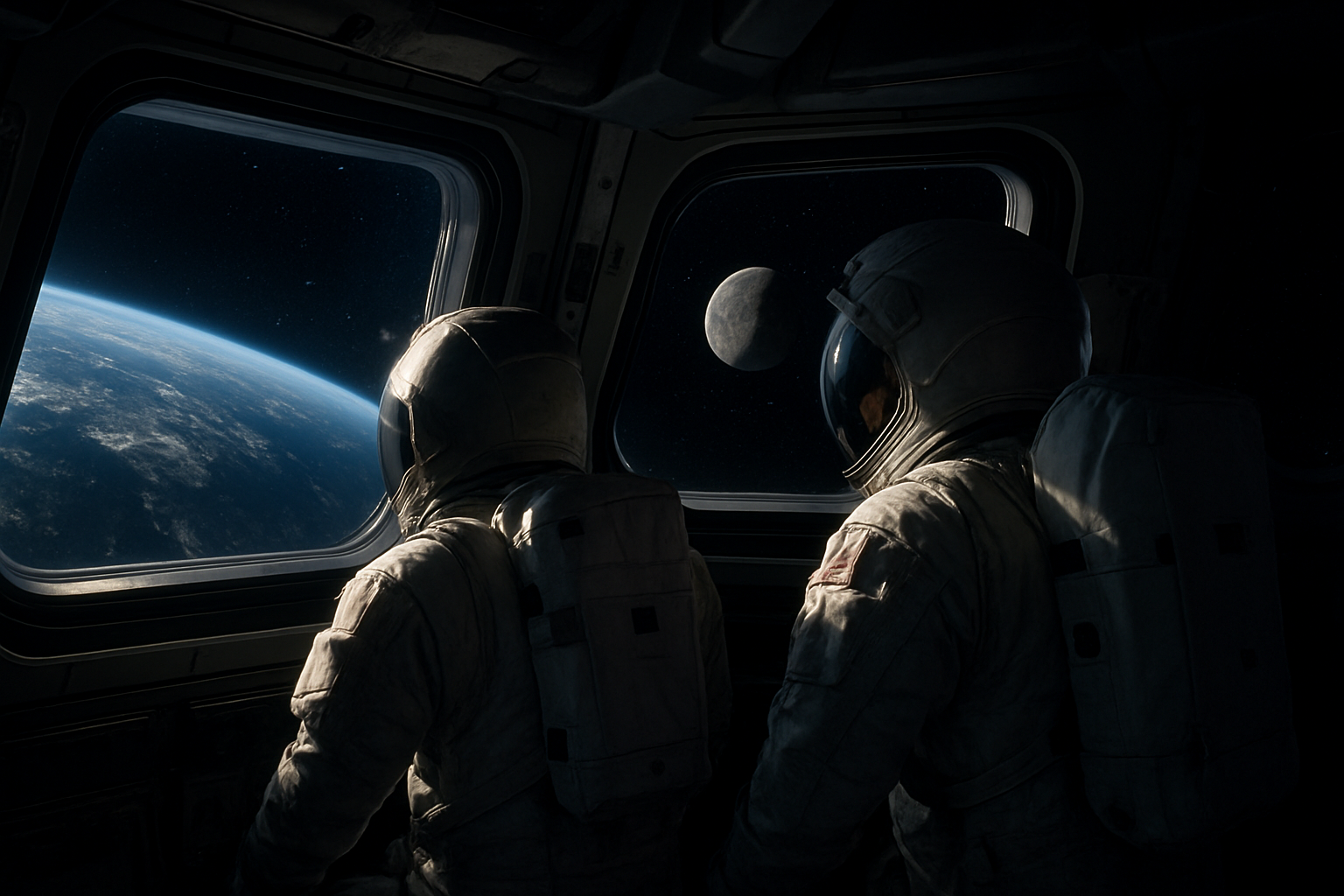
The Artemis II crew has shared the first breathtaking images of Earth from deep space while successfully reaching the halfway point to the Moon, marking a historic milestone in humanity's return to lunar exploration after a 54-year hiatus since Apollo 17.
Canadian astronaut Jeremy Hansen, making history as the first Canadian to travel beyond Earth orbit, joined NASA Commander Reid Wiseman, Christina Koch, and Victor Glover in capturing stunning photographs through the Orion spacecraft windows as their mission progressed toward lunar encounter scheduled for Monday.
Historic Earth Photography from Deep Space
Commander Reid Wiseman captured the first images of Earth taken by a crewed spacecraft beyond Earth orbit since Apollo 17 in December 1972. The photographs show both a curved slice of Earth through Orion's window and a full globe view displaying swirling white clouds over blue oceans with continental outlines clearly visible.
"You can see Africa, Europe, and if you look really closely, you can see the aurora. It was a spectacular moment," Wiseman noted during the crew's emotional response to viewing Earth from their unique vantage point.
— Reid Wiseman, Artemis II Mission Commander
Christina Koch expressed the crew's collective amazement, exclaiming "Guys, you look great" when viewing Earth from space, while Jeremy Hansen declared, "Humanity has demonstrated once again what it is capable of." The crew reported being unable to "get away from the windows" during their historic journey.
Mission Status and Technical Achievements
As of Saturday, April 4, 2026, the Orion spacecraft has traveled approximately 150,000 miles from Earth, officially making the crew closer to their lunar destination than to their home planet. Mission Control confirmed this historic milestone, stating: "You are now closer to the moon than you are to us on Earth."
The crew has demonstrated exceptional technical proficiency by successfully resolving multiple challenges during their first orbital day, including communication system failures, thermal sensor malfunctions, and spacecraft toilet system repairs—all without affecting the mission timeline. The toilet repair, assisted by Christina Koch, became a viral social media moment, showcasing the crew's adaptability and representing significant advancement over Apollo-era spacecraft for extended mission comfort.
Perfect Translunar Injection Success
NASA Flight Director Jeff Radigan approved what he described as a "perfect" 5-minute 49-second translunar injection burn approximately 25 hours after the April 1, 2026 launch. This critical maneuver officially departed the crew from Earth orbit and set them on their lunar trajectory.
Jeremy Hansen described the sensation as "falling out of the sky" during the complex flight path experience unique to deep space travel. The successful burn validated the extensive engineering work that resolved persistent helium system failures and hydrogen leak problems that had caused multiple delays throughout 2026.
Breaking Apollo-Era Distance Records
The crew is positioned to break the Apollo 13 distance record by traveling approximately 4,000 miles beyond the Moon's far side—farther than any humans since the Apollo era. This Monday lunar encounter will occur before the crew begins their return journey, completing the 10-day, 685,000-mile mission that tests crucial deep space systems.
The mission validates technologies essential for permanent lunar settlements and Mars exploration, including life support systems, radiation protection capabilities, and navigation technologies beyond Earth's magnetic field protection.
International Cooperation and Scientific Research
Jeremy Hansen's achievement validates the Artemis Accords peaceful lunar exploration framework and represents the most significant Canadian human spaceflight contribution since the Space Shuttle era. Calgary-born astronaut Jenni Gibbons serves as Earth voice link backup to the mission.
The spacecraft carries Argentina's Atenea radiation study device, which is collecting valuable deep space radiation effects data. This international scientific collaboration demonstrates the global commitment to understanding the challenges of sustained human presence beyond Earth orbit.
Strategic Context and Future Implications
The mission occurs during what experts call a "space economy golden age," with NASA's historic $20 billion commitment to establishing a permanent lunar surface base by 2030—the largest space infrastructure investment in the agency's history. This strategic pivot involves canceling the Lunar Gateway orbiting project and redirecting funds toward surface operations.
The mission serves as a crucial stepping stone toward Artemis III's planned 2028 lunar landing, while also preparing for the Space Reactor 1 Freedom nuclear spacecraft program for Mars exploration. These developments position the United States as a leader in an emerging space economy projected to exceed $1 trillion by 2030.
Space Medicine Advances
The Artemis II mission builds upon crucial research conducted during French astronaut Sophie Adenot's record eight-month ISS mission, including lung tissue cultivation and SANS (Space-Associated Neuro-Ocular Syndrome) research essential for extended missions beyond Earth evacuation possibility.
European research has revealed that microgravity disrupts human reproductive processes, making natural reproduction difficult in space environments—a critical concern for permanent settlements that may require artificial gravity solutions through rotating habitats.
Technical Validation and Safety Success
The mission's success validates the most powerful NASA rocket ever built: the 322-foot SLS rocket weighing 5.75 million pounds when fully fueled with over 700,000 gallons of liquid hydrogen and oxygen. Multiple delays throughout 2026 demonstrated NASA's institutional learning from historical tragedies, with a methodical problem-solving approach prioritizing crew protection over schedule adherence.
NASA's safety-first culture, reinforced by the Boeing Starliner Type A mishap classification, ensured comprehensive safety protocols during this competitive space economy expansion.
Historic Significance and Cosmic Perspective
The 54-year gap since Apollo 17 represents the longest period without human deep space exploration in history. This mission marks humanity's renewed commitment to becoming a spacefaring civilization through advanced technology, international cooperation, and space medicine knowledge accumulated during decades of ISS operations.
"What fascinates me is not only how far we can travel from Earth, but how these journeys reshape our perception of it. We're all on the same boat, we have to take care of the ship."
— Thomas Pesquet, European Space Agency Astronaut
The mission's success will determine the trajectory of human space exploration, establishing the foundation for permanent extraterrestrial settlements and multi-planetary species development. Up to 400,000 spectators gathered on Florida's Space Coast to witness the historic launch, marking the largest space-related public gathering since the Apollo era.
Looking Ahead to Lunar Encounter
As the Artemis II crew continues their journey toward Monday's lunar encounter, they carry the hopes and dreams of humanity's cosmic expansion. The stunning Earth photography serves as both scientific documentation and a powerful reminder of our planet's beauty and fragility when viewed from the vast emptiness of space.
This historic mission represents not just a return to deep space exploration, but the beginning of humanity's transformation into a truly spacefaring species, with permanent settlements among the stars now within our technological and economic reach.