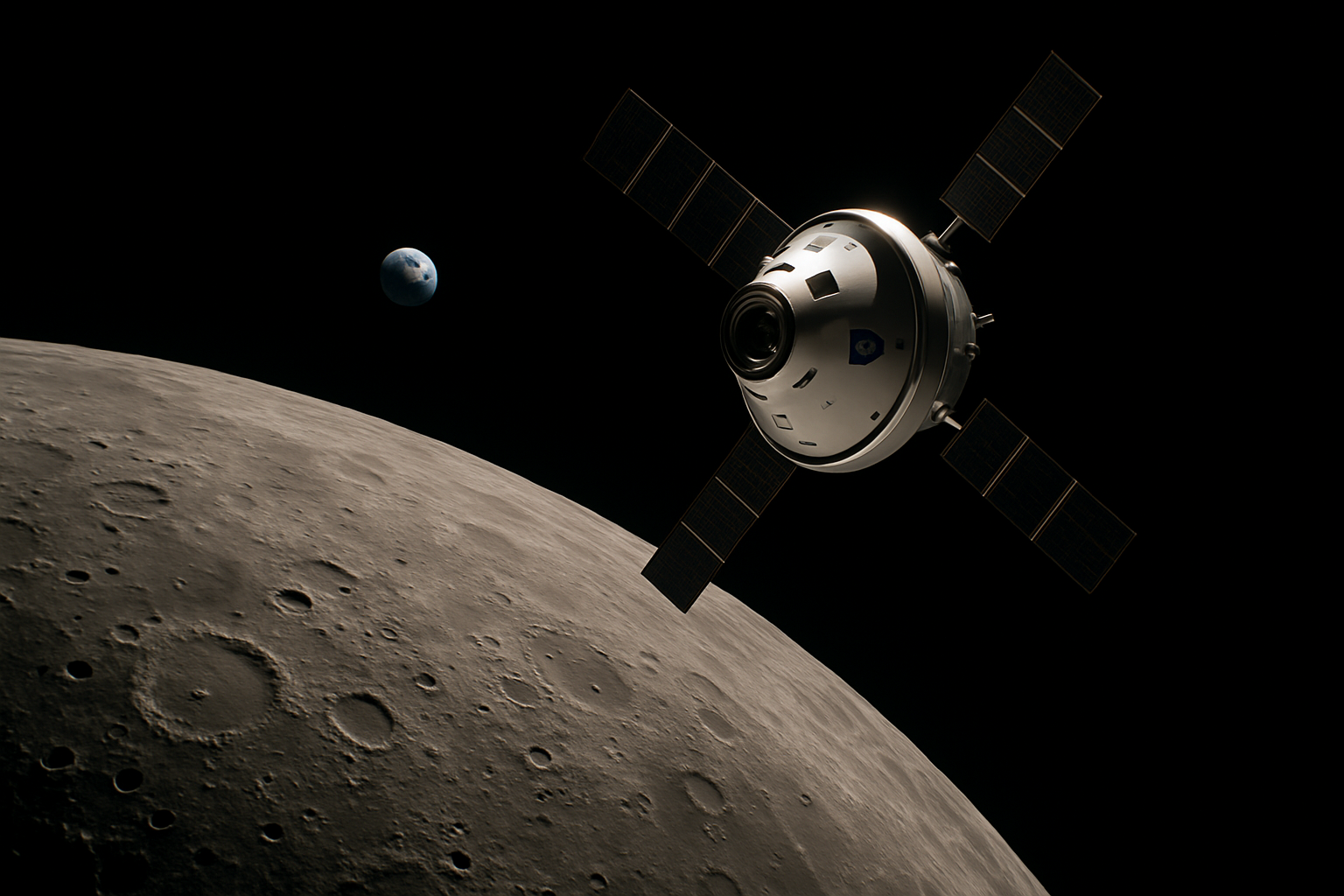
On April 6, 2026, NASA's Artemis II mission achieved a historic milestone as its four-astronaut crew flew 4,000 miles beyond the Moon's far side, breaking the distance record set by Apollo 13 and marking humanity's farthest journey from Earth since the Apollo era ended 54 years ago.
The international crew—Canadian astronaut Jeremy Hansen (the first Canadian beyond Earth orbit), NASA Commander Reid Wiseman, Mission Specialist Christina Koch, and Mission Specialist Victor Glover—successfully completed their closest lunar approach during a six-hour scientific photography mission that temporarily severed radio contact with Earth as they passed behind the Moon.
A Journey of Historic Firsts
The mission, which launched successfully on April 1, 2026, at 6:24 PM EDT from Kennedy Space Center, represents the first crewed venture beyond Earth orbit since Apollo 17 in December 1972. The 54-year gap had been the longest period in human history without deep space exploration, making this 10-day, 685,000-mile lunar flyby a watershed moment for spacefaring civilization.
Commander Reid Wiseman captured the first photographs of Earth from crewed spacecraft beyond Earth orbit in over half a century. The images show Earth as both a curved slice through Orion's windows and as a full globe with swirling white clouds over blue oceans. "You can see Africa, Europe, and if you look really closely, you can see the aurora. It was a spectacular moment," Wiseman noted during live communications.
"Humanity has demonstrated once again what it is capable of."
— Jeremy Hansen, Canadian Astronaut
Technical Triumphs and Viral Moments
The mission overcame significant technical challenges that became part of its narrative. Early in the flight, the crew resolved communication system failures, thermal sensor malfunctions, and notably, spacecraft toilet system repairs that became a viral social media moment when Christina Koch led the effort to fix the Universal Waste Management System.
Reports indicate that frozen urine may have clogged the system, requiring crew intervention with backup collection methods until the primary system could be restored. This incident, while highlighting the practical realities of space exploration, also demonstrated the crew's adaptability and the advancement of spacecraft systems over Apollo-era missions.
All technical issues were resolved without affecting the mission timeline, validating both crew training effectiveness and modern backup system reliability—crucial factors for future long-duration missions to Mars where Earth evacuation would be impossible.
Breaking Apollo Records
During Monday's lunar encounter, the Artemis II crew surpassed the distance record set by Apollo 13 in 1970, traveling approximately 406,000 kilometers from Earth. At their farthest point, the astronauts were closer to the Moon than to their home planet—a psychological and physical milestone that few humans have ever experienced.
The crew conducted extensive photography of the Moon's far side, regions permanently hidden from Earth that have only been seen by a handful of Apollo astronauts. This scientific documentation provides valuable data for future lunar exploration and settlement planning, particularly for NASA's ambitious $20 billion commitment to establish a permanent lunar surface base by 2030.
International Cooperation in Space
Jeremy Hansen's participation validates the Artemis Accords framework for peaceful lunar exploration, representing the most significant Canadian human spaceflight contribution since the Space Shuttle era. The mission also carries Argentina's Atenea radiation device, which has been collecting crucial deep space radiation effects data throughout the journey.
Calgary-born astronaut Jenni Gibbons serves as the Earth voice link backup, demonstrating the depth of Canadian involvement in the program despite the cancellation of the Lunar Gateway project, which had created uncertainty for Canada's Canadarm3 robotic arm development.
Perfect Execution After Technical Setbacks
The mission's success follows months of engineering challenges that delayed the launch from its original February 2026 target. Engineers successfully resolved persistent helium system failures affecting the SLS rocket's upper stage—critical for engine purging and fuel tank pressurization—as well as hydrogen leak problems during wet dress rehearsal testing.
The Space Launch System (SLS) rocket, standing 322 feet tall and weighing 5.75 million pounds when fully fueled with over 700,000 gallons of liquid hydrogen and oxygen, is the most powerful rocket NASA has ever built. NASA Flight Director Jeff Radigan described the crucial translunar injection burn as "perfect," officially departing Earth orbit 25 hours after launch.
"We will only launch when we believe we are ready."
— Jared Isaacman, NASA Administrator
Strategic Context and Competition
The mission occurs during what experts call the "space economy golden age," with the space sector projected to exceed $1 trillion by 2030. China plans to send crewed missions to the Moon by 2030, while SpaceX prepares for a potentially trillion-dollar IPO in June 2026, intensifying international competition in space capabilities.
NASA's strategic pivot includes the cancellation of the Lunar Gateway orbiting station project, redirecting those funds toward surface operations following a December presidential directive. The agency has also announced the Space Reactor 1 Freedom nuclear spacecraft program for Mars exploration, providing the energy density needed for interplanetary missions where solar power would be insufficient.
Building on Space Medicine Research
The Artemis II mission builds on extensive space medicine research, including French astronaut Sophie Adenot's record eight-month ISS mission that focused on lung tissue cultivation and Space-Associated Neuro-Ocular Syndrome (SANS) research. European research has revealed reproduction challenges in microgravity environments, suggesting that artificial gravity solutions through rotating habitats will be necessary for permanent settlements.
These medical protocols directly inform planning for lunar bases and Mars expeditions, where astronauts may spend years without the possibility of medical evacuation to Earth. The successful resolution of in-flight technical challenges demonstrates the advancement of human space operations capabilities over their Apollo-era predecessors.
A Foundation for Spacefaring Civilization
The Artemis II mission serves as a critical stepping stone toward the Artemis III lunar landing planned for 2028 and the establishment of sustainable human presence beyond Earth. The mission validates essential deep space systems including life support, radiation protection beyond Earth's magnetic field, and navigation capabilities required for permanent lunar settlements.
With crew members unable to "get away from the windows" during their historic journey, the mission provides both scientific data and a renewed cosmic perspective on humanity's place in the universe. The successful completion of this lunar flyby ends the longest period without human deep space exploration and marks humanity's renewed commitment to becoming a truly spacefaring civilization.
As the crew prepares for their return journey to Earth, the mission represents more than just a technological achievement—it signals the beginning of a new era where space exploration transitions from brief visits to sustained human expansion beyond our home planet. The convergence of advanced technology, international cooperation, and space medicine knowledge accumulated over decades of ISS operations provides the foundation for permanent extraterrestrial settlements and eventual multi-planetary species development.