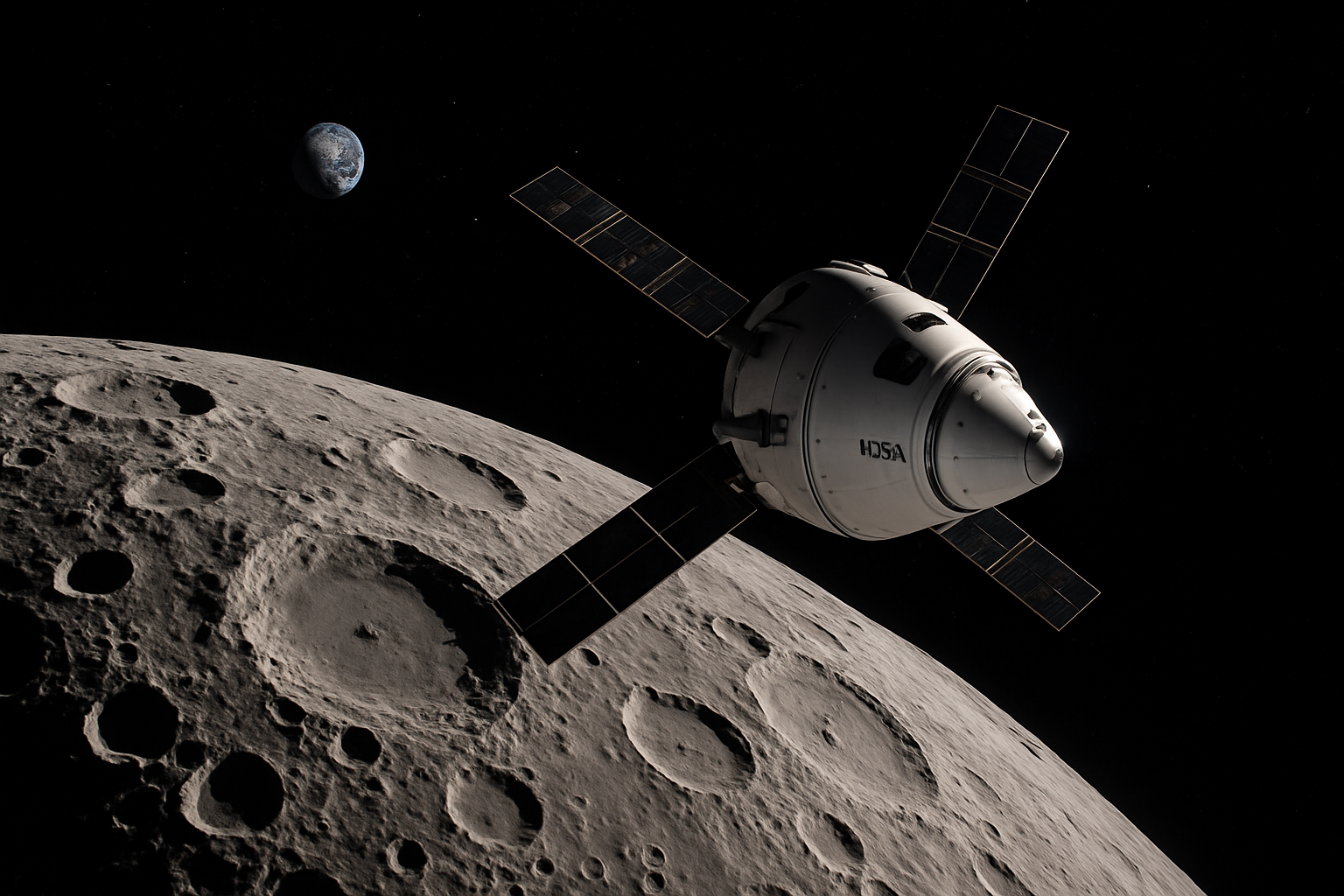
NASA's Artemis II crew achieved a historic milestone Monday, conducting humanity's first crewed lunar flyby since Apollo 17 in 1972 while setting a new distance record and experiencing a dramatic 40-minute communication blackout during their passage over the Moon's mysterious far side.
The four-astronaut international crew—Canadian Jeremy Hansen (the first Canadian beyond Earth orbit), NASA Commander Reid Wiseman, Mission Specialists Christina Koch and Victor Glover—flew approximately 252,757 miles from Earth, surpassing the Apollo 13 distance record by 4,102 miles.
Record-Breaking Deep Space Journey
At 7:05 PM EDT Monday, the Artemis II crew reached their maximum distance from Earth, traveling roughly 4,000 miles beyond the Moon's far side—farther than any humans have ventured since the Apollo era. This achievement marks humanity's return to deep space exploration after a 54-year gap.
"This is a historic moment for the entire space program. We are witnessing humanity's renewed commitment to exploring beyond our home planet."
— NASA Flight Director Jeff Radigan
The crew entered the Moon's gravitational sphere of influence early Monday morning, meaning lunar gravity became stronger than Earth's pull on their Orion spacecraft. This critical milestone positioned them perfectly for their historic flyby of regions never before observed by human eyes.
40 Minutes of Silence in Deep Space
During their passage over the Moon's far side, the crew experienced approximately 40 minutes of complete radio silence—a haunting reminder of the vast distances involved in deep space exploration. For those critical minutes, the four astronauts were entirely alone, each with their own thoughts and feelings while traveling through the darkness of space at unprecedented distances from Earth.
This communication blackout occurred as the Moon blocked all radio signals between the spacecraft and mission control, creating an eerie period where Earth had no contact with the furthest-traveling humans in history. The phenomenon demonstrated both the isolation and wonder of deep space exploration.
Technical Triumph After Challenges
The historic flyby came after the crew successfully overcame multiple technical challenges during their journey, including toilet system malfunctions, communication failures, and thermal sensor repairs—all resolved without affecting the mission timeline. The spacecraft's Universal Waste Management System became a viral social media moment when Christina Koch led repair efforts, highlighting both crew adaptability and the practical realities of space exploration.
Commander Reid Wiseman captured the first photographs of Earth from a crewed spacecraft beyond Earth orbit since Apollo 17, showing curved slices of the planet and full globe views with swirling clouds, continental outlines, and aurora displays visible from their unique deep space vantage point.
"You can see Africa, Europe, and if you look really closely, you can see the aurora. It was a spectacular moment."
— Commander Reid Wiseman
Far Side Mysteries Unveiled
During their closest approach, the crew conducted extensive photographic documentation of the Moon's far side—regions permanently hidden from Earth that have never been observed by human eyes. Italian lunar researcher Andrea Longobardo from INAF explained that the far side is "rich with mountains while the near side is mostly seas," offering unique astronomical observation advantages and potential resource extraction opportunities.
The crew's scientific observations during this phase provide invaluable data for future lunar missions and our understanding of lunar geology. The far side's stark landscape of craters and mountains, illuminated only by starlight and earthshine, offered a dramatic backdrop for humanity's furthest venture into space.
International Cooperation Success
Jeremy Hansen's participation as the first Canadian beyond Earth orbit validates the Artemis Accords' framework for peaceful lunar exploration. The mission also carried Argentina's Atenea radiation study device, which collected crucial deep space radiation data throughout the journey. Czech ADVACAM radiation monitoring chips measured astronaut safety during the historic passage.
This international collaboration represents the most significant Canadian human spaceflight contribution since the Space Shuttle era, with Calgary-born astronaut Jenni Gibbons serving as Earth voice link backup during critical mission phases.
Breaking Apollo 13's Record
The Artemis II crew's journey took them 4,102 miles beyond the previous human distance record set by Apollo 13 in 1970. This achievement came exactly 56 years after that dramatic mission, symbolically representing humanity's evolution from emergency survival to planned deep space exploration.
The SLS rocket—standing 322 feet tall and weighing 5.75 million pounds when fully fueled with over 700,000 gallons of liquid hydrogen and oxygen—proved itself as the most powerful rocket NASA has ever successfully operated, validating years of engineering work and multiple delay resolutions.
Space Economy Golden Age
The mission occurs during what NASA officials call the "space economy golden age," with NASA's historic $20 billion commitment to establish a permanent lunar surface base by 2030—the largest space infrastructure investment in agency history. This ambitious timeline accompanies SpaceX's preparation for a potential trillion-dollar IPO in June 2026 and China's plans for crewed lunar missions by 2030.
The successful flyby validates critical systems for permanent lunar settlements and Mars exploration, including deep space life support, radiation protection beyond Earth's magnetic field, and navigation capabilities for sustained human presence in space.
Medical Advances in Deep Space
The mission builds upon extensive space medicine research, including French astronaut Sophie Adenot's record eight-month ISS mission focusing on lung tissue cultivation and Space-Associated Neuro-Ocular Syndrome (SANS) studies. This research directly informs medical protocols for future lunar bases and Mars expeditions where astronauts may spend years without Earth medical evacuation possibilities.
European research has revealed that microgravity disrupts human reproduction, making natural conception difficult in space environments—a critical concern for permanent settlements that will require artificial gravity solutions through rotating habitats.
Foundation for Spacefaring Civilization
The successful completion of Artemis II represents more than a technological achievement—it marks humanity's renewed commitment to becoming a truly spacefaring civilization. The mission's success determines the trajectory of human space exploration for generations, establishing the foundation for permanent extraterrestrial settlements and multi-planetary species development.
NASA Administrator Jared Isaacman's safety-first approach, which prioritized crew protection through multiple delays and comprehensive problem-solving, has been vindicated by the mission's flawless execution. The institutional learning from historical tragedies like Challenger and Columbia proved essential for this generational achievement.
Looking to Artemis III
The successful flyby serves as a crucial stepping stone toward Artemis III's planned 2028 lunar landing, when humans will once again walk on the lunar surface. The mission also paves the way for NASA's Space Reactor 1 Freedom nuclear spacecraft program for Mars exploration, providing the energy density necessary for interplanetary missions where solar power is insufficient.
As the crew continues their journey back to Earth, completing their 685,000-mile odyssey, they carry with them not just scientific data and photographs, but proof that humanity can overcome the vast distances and technical challenges required for sustained cosmic expansion.
The 40-minute communication blackout, rather than representing isolation, symbolized humanity's bold step into the cosmic frontier—a journey that began with tentative steps but now advances with confident strides toward the stars.