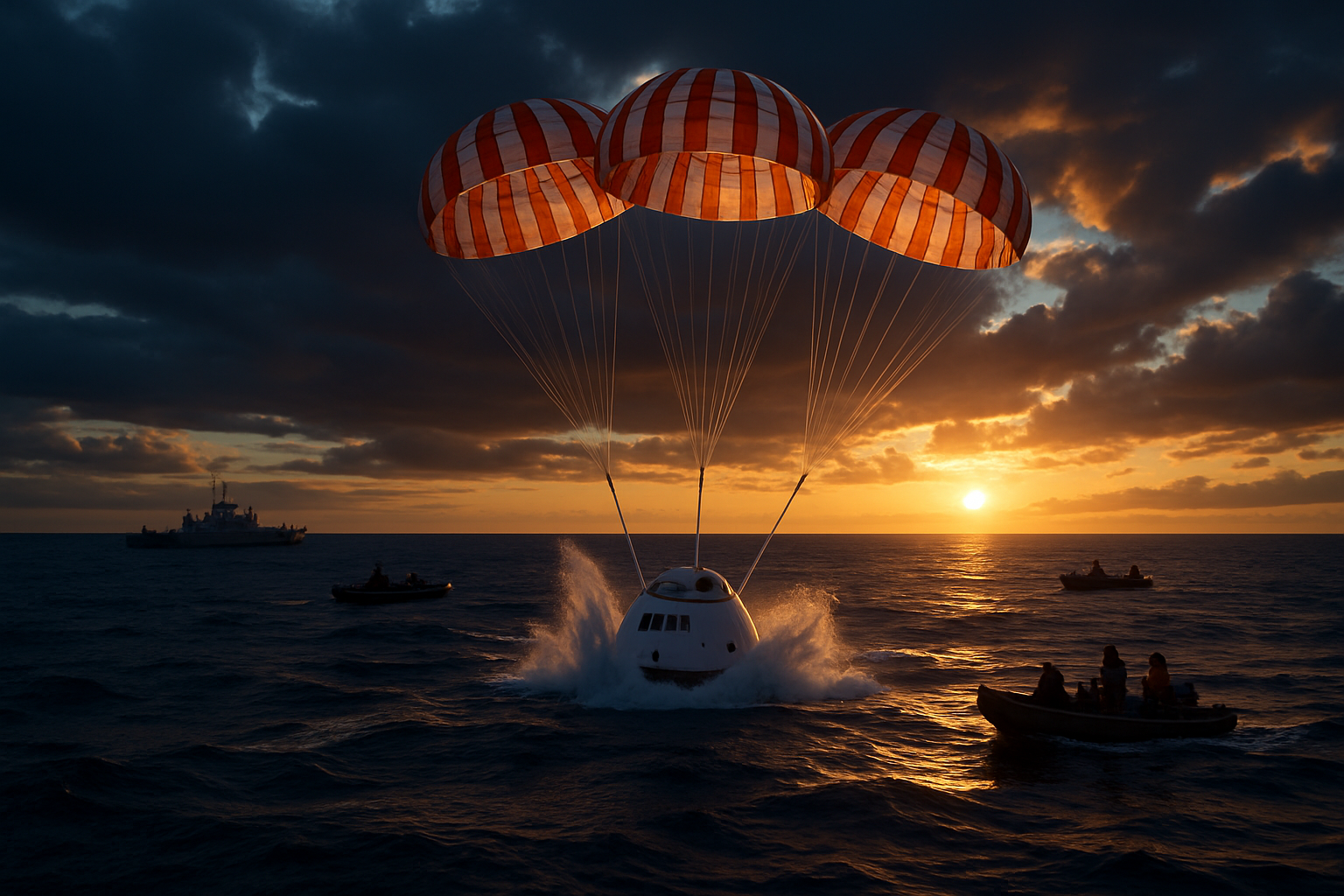
An elated NASA celebrated late Friday evening as four astronauts safely returned to Earth after completing the first lunar flyby in more than 50 years, marking a triumphant conclusion to the historic Artemis II mission.
The crew splashed down in the Pacific Ocean at 8:07 PM ET on Friday, April 11, 2026, concluding a groundbreaking 10-day, 685,000-mile journey that saw humanity venture farther from Earth than any humans since the Apollo era. The mission not only ended a 54-year gap in human deep space exploration but also set a new distance record for crewed spaceflight.
Breaking Apollo's Distance Record
The four-astronaut international crew achieved an unprecedented milestone by traveling 406,777.8 kilometers from Earth, surpassing Apollo 13's 1970 distance record by 6,606.8 kilometers. This achievement places the Artemis II crew as the humans who have traveled farthest from our home planet in history.
The crew consisted of Canadian astronaut Jeremy Hansen, who became the first Canadian to travel beyond Earth orbit, NASA Commander Reid Wiseman, and Mission Specialists Christina Koch and Victor Glover. Their journey took them 4,000 miles beyond the Moon's far side, into regions of space that remain mysterious and largely unexplored.
"Humanity has demonstrated once again what it is capable of."
— Jeremy Hansen, Canadian Astronaut
Technical Triumphs and Viral Moments
While the mission was largely successful, it wasn't without its challenges. The crew encountered and successfully resolved multiple technical issues, including communication system failures, thermal sensor malfunctions, and a now-famous Universal Waste Management System malfunction. The toilet repair, led by Christina Koch, became a viral social media sensation, highlighting both the heroic nature of space exploration and its practical realities.
Norwegian sources indicated that frozen urine had clogged the spacecraft's waste system, but the crew's technical proficiency and problem-solving abilities ensured that all issues were resolved without affecting the mission timeline. This demonstrated significant advancement over Apollo-era missions in terms of extended mission sustainability and crew comfort.
Scientific Achievements and International Cooperation
The mission yielded unprecedented scientific achievements, including the first Earth photographs taken from a crewed spacecraft beyond Earth orbit since Apollo 17 in December 1972. The crew captured stunning "Earthset" images showing Earth dipping below the lunar horizon, providing a cosmic perspective that hasn't been witnessed by human eyes in over five decades.
During their passage around the Moon's far side, the crew experienced a dramatic 40-minute communication blackout, during which they were completely isolated from Earth at humanity's deepest penetration into space. This period allowed for unique scientific observations, including direct visual documentation of meteoroid impact flashes on the lunar surface.
The mission exemplified international cooperation in space exploration, with Hansen's participation validating the Artemis Accords framework for peaceful lunar exploration. Argentina contributed the Atenea radiation device to collect crucial deep space safety data, while Czech ADVACAM chips monitored astronaut safety throughout the journey.
Presidential Recognition and Strategic Significance
President Donald Trump personally called the crew during their return journey, congratulating them as "truly extraordinary" and declaring that they had "made history today." Trump emphasized that Artemis was "his baby," highlighting the administration's commitment to lunar exploration and American space leadership.
The mission comes at a pivotal moment in what experts call the "space economy golden age," with projections indicating the global space economy will exceed $1 trillion by 2030. NASA has committed a historic $20 billion toward establishing a permanent lunar surface base by 2030, representing the largest space infrastructure investment in the agency's history.
Technical Validation and Future Implications
The mission successfully validated the Space Launch System (SLS) rocket as the most powerful NASA rocket ever built. At 322 feet tall and weighing 5.75 million pounds when fully fueled, the SLS demonstrated its capability to transport crews beyond Earth orbit after engineers resolved persistent helium system failures and hydrogen leak problems that had caused multiple delays throughout 2026.
The crew's excellent health upon return, with astronauts walking across the USS John P. Murtha recovery vessel deck and refusing wheelchairs, validated the space medicine protocols developed through decades of International Space Station research. This included building on the work of French astronaut Sophie Adenot's record eight-month ISS mission, which provided crucial data on lung tissue cultivation and Space-Associated Neuro-Ocular Syndrome (SANS) research.
Space Medicine and Human Adaptation Challenges
The mission highlighted both the progress and challenges of human adaptation to deep space environments. While the crew demonstrated remarkable resilience, medical researchers noted the potential issue of orthostatic intolerance—a condition where the body struggles to adapt to changes in blood pressure when returning to Earth's gravity after extended periods in space.
This research is particularly crucial as NASA and international partners plan for permanent lunar settlements and eventual Mars exploration, where astronauts may spend years without the possibility of medical evacuation to Earth.
A New Era of Space Exploration
The successful completion of Artemis II marks humanity's transition from brief space visits to sustained cosmic expansion capabilities. Unlike the conclusion of the Apollo program, Artemis represents the beginning of a new era of sustained human presence beyond Earth orbit.
The mission serves as a stepping stone toward Artemis III, planned for 2028, which will see astronauts return to the lunar surface for the first time since 1972. It also validates the systems essential for permanent lunar settlements and Mars exploration, establishing the foundation for humanity to become a truly spacefaring civilization.
"The human mind isn't made to go through what we just went through."
— Reid Wiseman, NASA Commander
As the crew begins their post-flight medical evaluations and debriefings, the data and experiences gathered during their historic journey will inform the design of future missions, lunar base construction, and Mars expedition planning. The successful return of Artemis II not only ends a 54-year gap in human deep space exploration but begins a new chapter in humanity's permanent expansion among the stars.
The mission's success validates advanced space technologies, international cooperation frameworks, and space medicine knowledge accumulated over decades of International Space Station operations. It represents a convergence of advanced technology, international partnerships, and human determination that positions humanity for sustained cosmic expansion and the establishment of permanent extraterrestrial settlements for the first time in human history.