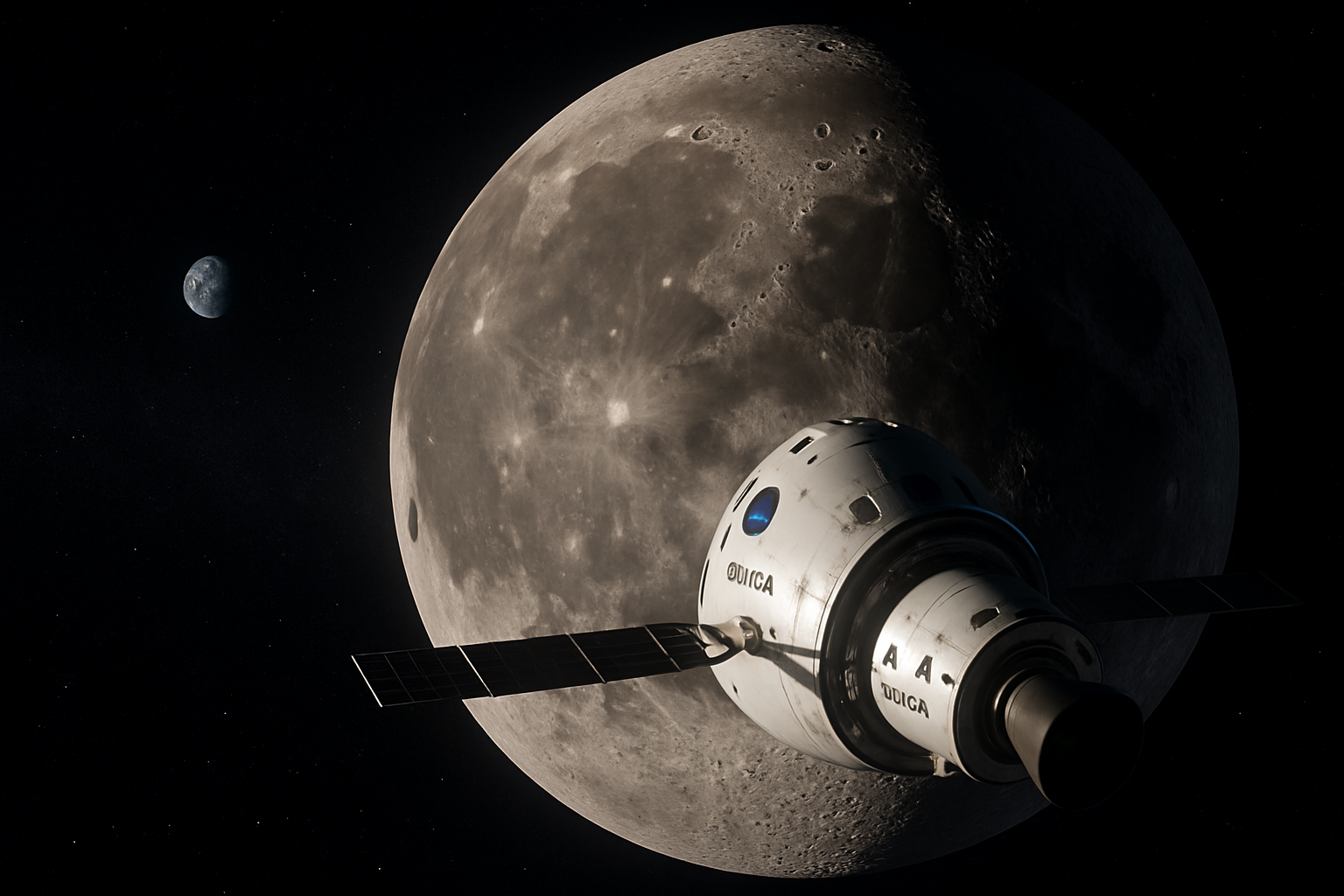
NASA's historic Artemis II mission has achieved a remarkable milestone, with the four-astronaut crew now positioned to travel farther from Earth than any humans since the Apollo era, while simultaneously grappling with unexpected technical challenges that underscore the complex realities of deep space exploration.
The mission, which launched successfully on April 1, 2026, represents humanity's return to deep space after a 54-year gap since Apollo 17. The international crew—Canadian Jeremy Hansen (the first Canadian beyond Earth orbit), NASA Commander Reid Wiseman, Christina Koch, and Victor Glover—are currently approaching the Moon's far side, where they will break the Apollo 13 distance record by traveling approximately 4,000 miles beyond the lunar far side.
Technical Challenges Beyond Earth's Embrace
While the mission represents a triumph of engineering and international cooperation, it has not been without significant technical hurdles. Most notably, the spacecraft's Universal Waste Management System—commonly known as the space toilet—has become a recurring source of problems throughout the journey.
According to reports from multiple sources, the complicated waste management equipment has experienced intermittent malfunctions since shortly after launch. The system reportedly became clogged with frozen urine, forcing the crew to implement backup procedures and conduct repairs while traveling through the void between Earth and Moon.
"Getting the complicated piece of equipment, known as the Universal Waste Management System, to work properly during the flight has become a recurring issue."
— Source: The Japan Times
Christina Koch has been leading repair efforts with assistance from her crewmates, with the incident becoming a viral sensation on social media as it demonstrates both the practical challenges of space exploration and the resourcefulness of modern astronauts. The crew has been measuring noise levels post-repair to ensure proper functionality.
Historic Lunar Encounter
Despite these technical challenges, the mission continues to achieve unprecedented milestones. Portuguese and Venezuelan sources confirm that the Artemis II crew is approaching the lunar far side, scheduled for their closest approach on Monday, April 6. During this historic encounter, the astronauts will execute a six-hour scientific photography plan before temporarily losing radio contact with Earth.
The crew will reach the most remote distance ever traveled by humans from Earth, surpassing even the Apollo 13 mission's record. This achievement represents not just a technical milestone but a psychological one—these four individuals will be farther from home than any human being in history.

The Far Side Revelation
The mission's approach to the lunar far side carries particular scientific significance. As reported by Venezuelan media, "La tripulación de la cápsula Orion alcanzará este lunes la distancia más remota jamás recorrida por humanos desde la Tierra" (The Orion capsule crew will reach on Monday the most remote distance ever traveled by humans from Earth).
During their approach, the crew will conduct extensive photographic documentation of the Moon's far side—regions permanently hidden from Earth's view. This scientific photography mission will provide valuable data for future lunar exploration and settlement planning, particularly as NASA pursues its ambitious $20 billion lunar base program scheduled for completion by 2030.
Beyond Technical Glitches: A Testament to Human Adaptability
The toilet system malfunction, while generating public attention and social media buzz, actually represents a significant advancement in space exploration capabilities. Unlike the Apollo-era missions, which were brief lunar flybys, the Artemis program is designed for sustained human presence in deep space. The ability to address and resolve complex technical issues during flight demonstrates the sophisticated training and resourcefulness of modern astronauts.
The successful resolution of multiple technical challenges—including communication system failures, thermal sensor malfunctions, and the waste management issues—without affecting the mission timeline showcases the evolution of space exploration from experimental flights to sustainable operations.
International Cooperation in the Cosmic Arena
The mission represents unprecedented international cooperation in deep space exploration. Jeremy Hansen's participation marks the first time a Canadian has traveled beyond Earth orbit, validating the Artemis Accords framework for peaceful lunar exploration. The mission also carries scientific equipment from Argentina, including the Atenea radiation device that is collecting crucial data on deep space radiation effects.
This international dimension extends beyond symbolism to practical cooperation. Calgary-born astronaut Jenni Gibbons serves as the Earth voice link backup, maintaining continuous communication capabilities with the crew as they venture into previously uncharted distances from home.
The Broader Context: Space Economy Golden Age
The Artemis II mission occurs during what NASA officials term the "space economy golden age." With the space economy projected to exceed $1 trillion by 2030, this mission serves as a crucial validation of technologies and procedures essential for permanent lunar settlements and eventual Mars exploration.
The mission's success comes amid intensifying international competition, with China planning crewed lunar missions by 2030 and SpaceX preparing for a potentially trillion-dollar IPO in June 2026. NASA's commitment to establishing a permanent lunar base by 2030, backed by a $20 billion investment—the largest space infrastructure commitment in the agency's history—positions the United States as a leader in humanity's expansion beyond Earth.
Stepping Stone to Mars
Beyond its immediate scientific objectives, Artemis II serves as a critical stepping stone toward Artemis III, planned for 2028, which will return humans to the lunar surface for the first time since 1972. The mission validates essential deep space systems including life support, radiation protection, and navigation capabilities necessary for sustained lunar presence.
The technical challenges encountered and overcome during this mission provide invaluable data for future Mars missions, where Earth evacuation would be impossible. The Space Reactor 1 Freedom nuclear spacecraft program, announced alongside the Artemis missions, will provide the energy density necessary for interplanetary missions where solar power proves insufficient.
Space Medicine Advances
The mission builds upon crucial space medicine research, including the work of French astronaut Sophie Adenot during her record eight-month ISS mission. Her research on lung tissue cultivation and Space-Associated Neuro-Ocular Syndrome (SANS) provides essential data for extended missions beyond the possibility of Earth evacuation.
European research has revealed that microgravity disrupts human reproduction, making natural conception difficult in space environments—a critical concern for permanent settlements that may require artificial gravity solutions through rotating habitats.
Historical Significance
The 54-year gap since Apollo 17 represents the longest period without human deep space exploration in the modern era. Artemis II marks humanity's renewed commitment to becoming a truly spacefaring civilization through the convergence of advanced technology, international cooperation, and decades of space medicine knowledge accumulated during ISS operations.
The mission's success determines the trajectory of human space exploration for generations, establishing the foundation for permanent extraterrestrial settlements and the development of humanity as a multi-planetary species. From the practical challenges of space toilets to the profound implications of reaching unprecedented distances from Earth, Artemis II embodies both the mundane realities and transcendent aspirations of human cosmic expansion.
"Humanity has demonstrated once again what it is capable of."
— Jeremy Hansen, Artemis II Crew Member
As the crew continues their historic journey toward the Moon's far side, they carry with them not just the hopes of their respective nations, but the dreams of a species reaching toward the stars. The toilet may have given them trouble, but their destination remains unchanged: the cosmic frontier that will define humanity's future among the worlds.