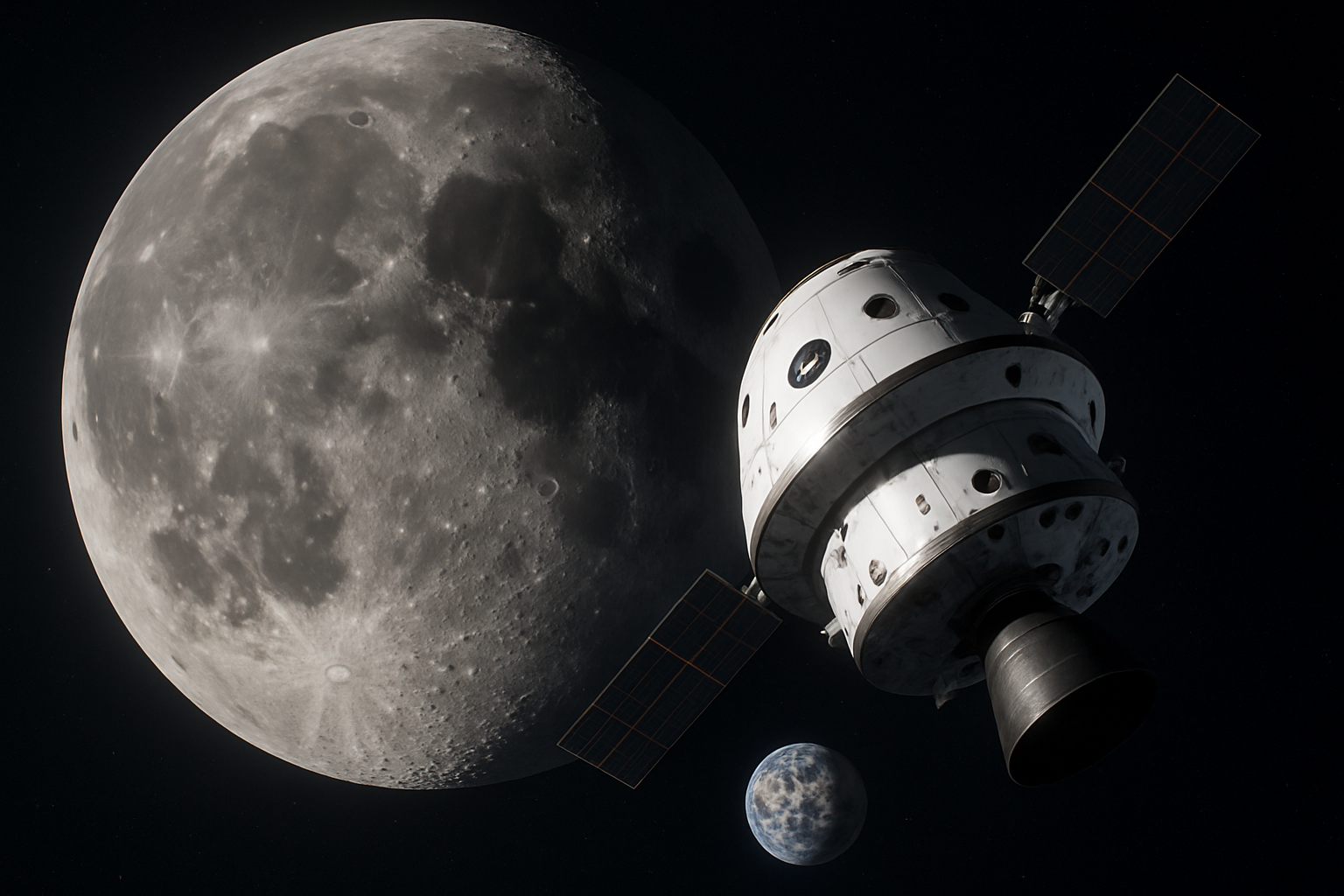
Four astronauts aboard NASA's Artemis II mission entered the Moon's gravitational sphere of influence on Monday morning, marking a pivotal moment in humanity's return to deep space exploration as lunar gravity now exerts stronger pull on their spacecraft than Earth's.
The international crew—Canadian astronaut Jeremy Hansen (the first Canadian to travel beyond Earth orbit), NASA Commander Reid Wiseman, Mission Specialists Christina Koch and Victor Glover—crossed into what NASA calls the "lunar sphere of influence" at approximately 04:42 GMT on Monday, April 6, 2026.
This achievement represents the culmination of humanity's most ambitious space mission since Apollo 17 in December 1972, ending a 54-year gap in human deep space exploration. The Orion spacecraft will now whip around the Moon's far side, positioning the crew to travel farther from Earth than any human has ever ventured before.
Breaking Apollo 13's Distance Record
Mission controllers confirm the crew is on track to surpass the distance record set by Apollo 13 in 1970, traveling approximately 4,000 miles beyond the Moon's far side—farther from our home planet than any previous human mission. The 10-day journey covers a total of 685,000 miles through the cosmic void.
German media reports indicate the astronauts are now "more influenced by the Moon's gravity than Earth's," representing a symbolic tipping point in their historic journey. This gravitational transition marks the final phase before their closest lunar approach, scheduled for Monday.
During their flyby of the Moon's far side, the crew will experience a temporary communications blackout as they pass behind the lunar disk—a phenomenon not experienced by humans since the Apollo era. This six-hour period will provide unprecedented opportunities for scientific observation and photography of the mysterious lunar far side.
Technical Excellence Under Pressure
The mission has demonstrated remarkable technical resilience since launch. Multiple sources confirm the crew successfully resolved several in-flight challenges during their first days in space, including communication system failures, thermal sensor malfunctions, and a viral spacecraft toilet system repair that became a social media sensation.
NASA Flight Director Jeff Radigan praised the crew's performance, describing their 5-minute 49-second translunar injection burn as "perfect." The burn, executed approximately 25 hours after launch, officially propelled the Orion spacecraft from Earth orbit onto its lunar trajectory.
"The crew is performing excellently, and all systems are functioning as designed. This represents a significant advancement over Apollo-era missions in terms of crew comfort and mission sustainability."
— NASA Flight Operations
The successful resolution of technical challenges showcases the effectiveness of modern crew training and backup systems, validating NASA's methodical approach to deep space operations after multiple pre-launch delays caused by hydrogen leak issues and helium system failures.
International Cooperation in Deep Space
Jeremy Hansen's participation as the first Canadian to travel beyond Earth orbit validates the Artemis Accords framework for peaceful lunar exploration. His achievement represents the most significant Canadian contribution to human spaceflight since the Space Shuttle era.
The mission also carries Argentina's Atenea radiation device, actively collecting crucial data on deep space radiation effects that will inform future long-duration missions. Czech ADVACAM radiation monitoring chips are simultaneously measuring astronaut safety parameters throughout the journey.
These international partnerships demonstrate the collaborative spirit of modern space exploration, contrasting with the competitive Apollo era while maintaining American leadership in space technology.
Preparing for Lunar Encounter
As the crew approaches their closest lunar passage, they prepare for what Italian lunar researcher Andrea Longobardo describes as an encounter with a world "rich with mountains while the near side is mostly seas." The Moon's far side offers unique opportunities for astronomical observation and scientific documentation.
Portuguese media reports indicate the crew will observe the Moon during a particularly dark phase, providing optimal conditions to search for meteoroid impact flashes—brief illuminations caused by space rocks striking the lunar surface. These observations contribute valuable data to lunar science and planetary defense research.
The crew is expected to capture extensive photographic documentation of the lunar far side, providing unprecedented human perspective on regions permanently hidden from Earth. These images will serve both scientific research and public engagement, continuing a tradition established during the Apollo missions.
First Earth Images in 54 Years
Commander Reid Wiseman has already captured historic Earth photographs through Orion's windows—the first images taken from a crewed spacecraft beyond Earth orbit since Apollo 17. The photographs show Earth as both a curved slice and complete globe with swirling white clouds over blue oceans.
The crew's emotional response to viewing Earth from deep space echoes the profound perspective shift experienced by Apollo astronauts. Christina Koch exclaimed "Guys, you look great" when viewing their home planet, while Hansen declared that "Humanity has demonstrated once again what it is capable of."
Strategic Context and Future Implications
The Artemis II mission occurs during what analysts describe as a "space economy golden age," with NASA committing $20 billion toward establishing a permanent lunar surface base by 2030—the largest space infrastructure investment in the agency's history.
This mission serves as a crucial stepping stone toward Artemis III in 2028, which aims to land the first woman and first person of color on the lunar surface. The data collected during this flyby will validate deep space life support systems, radiation protection capabilities, and navigation technologies essential for sustained lunar presence.
Space medicine research conducted during the mission builds upon Sophie Adenot's record eight-month International Space Station mission, providing crucial insights into long-duration spaceflight effects. This research directly informs protocols for future lunar bases and Mars expeditions where Earth evacuation would be impossible.
Technical Vindication
The mission's success validates NASA's Space Launch System (SLS) rocket—a 322-foot, 5.75-million-pound behemoth requiring over 700,000 gallons of liquid hydrogen and oxygen. Extensive pre-launch engineering work resolved persistent technical challenges, demonstrating the agency's commitment to safety-first operations.
Multiple delays throughout 2026 reflected institutional learning from historical tragedies, with Administrator Jared Isaacman emphasizing that "we will only launch when we believe we are ready." This methodical approach has proven successful as the crew executes their mission flawlessly.
The Orion spacecraft's advanced systems represent significant improvements over Apollo technology, particularly in crew comfort and life support capabilities for extended missions. The successful toilet system repairs, while generating viral social media attention, demonstrate practical advances essential for long-duration space operations.
Looking Toward a Spacefaring Future
As the Artemis II crew prepares for their historic lunar flyby, their achievement marks humanity's transition from brief space visits to sustained cosmic presence. The mission validates technologies essential for permanent lunar settlements and eventual Mars exploration, establishing infrastructure for humanity's development as a spacefaring civilization.
The crew's journey represents generational achievement combining advanced rocket technology, international partnerships, and space medicine expertise. Success will determine the trajectory of human space exploration for decades to come, potentially establishing foundations for permanent extraterrestrial settlements and multi-planetary human presence.
With lunar encounter scheduled for Monday, the world watches as four humans venture farther from home than any before them, carrying humanity's hopes and demonstrating our species' capability for sustained cosmic exploration beyond Earth's protective embrace.