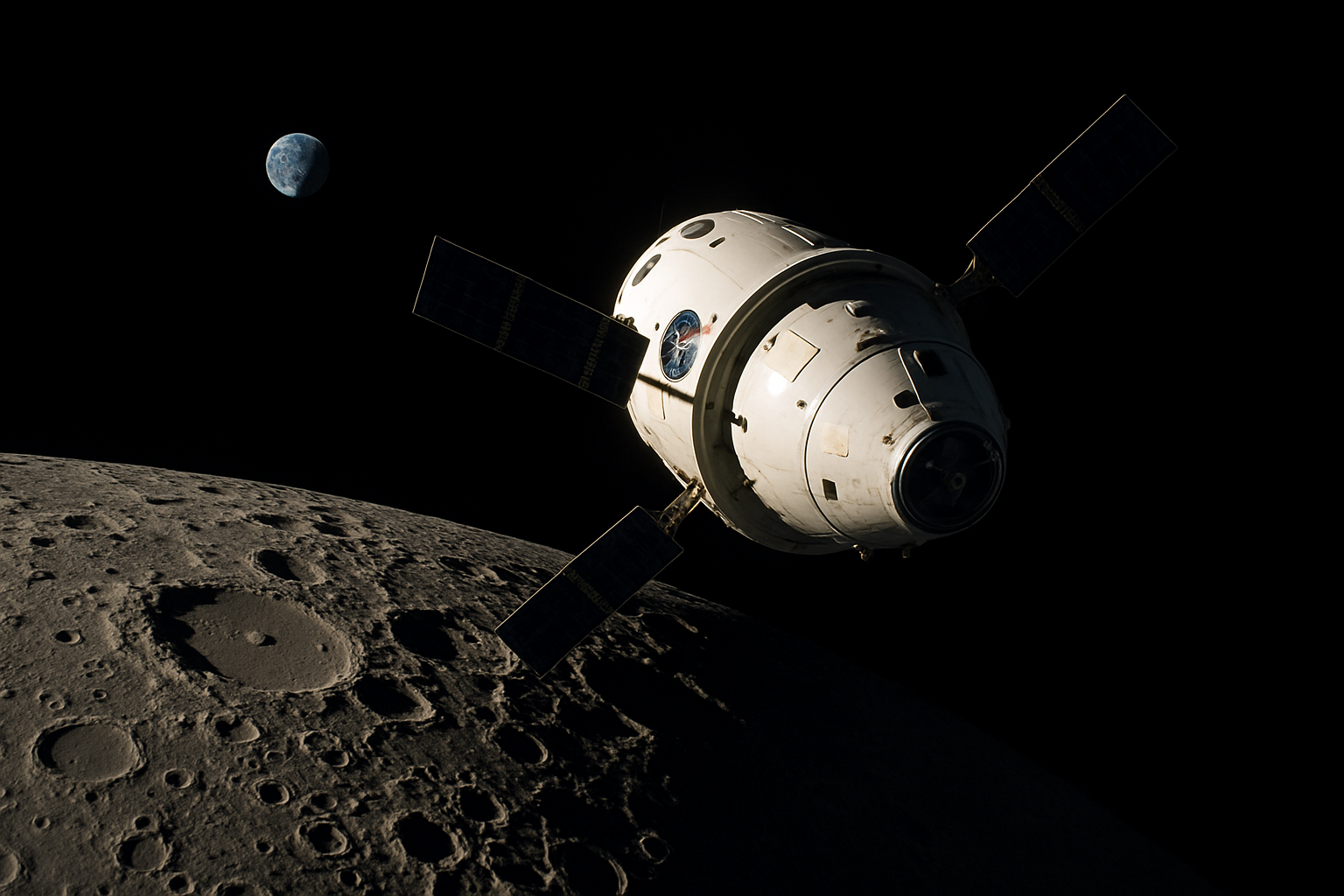
NASA's Artemis II mission has provided unprecedented insights into how space exploration technology has evolved since the Apollo era, with the successful completion of humanity's first crewed lunar flyby in 54 years revealing dramatic advances in spacecraft systems, international cooperation, and commercial space integration.
Breaking Apollo Distance Records
The four-astronaut crew—Canadian Jeremy Hansen (first Canadian beyond Earth orbit), NASA Commander Reid Wiseman, Christina Koch, and Victor Glover—achieved a new human distance record of 406,777.8 kilometers from Earth, surpassing Apollo 13's 1970 record by over 6,600 kilometers. This achievement occurred during their historic 10-day, 685,000-mile journey that took them 4,000 miles beyond the Moon's far side.
"The human mind isn't made to go through what we just went through," Commander Wiseman reflected after the mission, highlighting the profound psychological impact of deep space travel that remains constant despite technological advances.
Technological Evolution: From Apollo to Artemis
The technological differences between Apollo and Artemis missions demonstrate remarkable progress across multiple domains. Unlike Apollo spacecraft, which lacked modern toilet facilities and relied on primitive waste collection methods, the Artemis II Orion capsule featured advanced Universal Waste Management Systems—though these still proved challenging in zero gravity, as demonstrated by the viral "toilet malfunction" incident that required crew repairs.
The mission's Austrian source analysis reveals that when humans first flew to the Moon in 1969, lunar capsules had no toilets and the transistor invention was only two decades old. Today's missions benefit from sophisticated life support systems, advanced computing power, and redundant safety protocols that enable extended deep space operations.
"Much has changed since Apollo, but some fundamentals remain the same—the courage required to venture into deep space and the human ingenuity to solve problems millions of miles from Earth."
— NASA Mission Analysis
International Cooperation Framework
Unlike the primarily American Apollo program, Artemis II showcased unprecedented international collaboration. Jeremy Hansen's participation as the first Canadian astronaut beyond Earth orbit validated the Artemis Accords peaceful lunar exploration framework. The mission also carried Argentina's Atenea radiation device and Czech ADVACAM safety monitoring chips, demonstrating how modern space exploration integrates global scientific contributions.
This international approach represents a fundamental shift from the Cold War-era space race to collaborative cosmic exploration, positioning space as a domain for peaceful cooperation rather than competition.
Commercial Space Integration
The Artemis program occurs during what analysts call the "space economy golden age," with SpaceX preparing a potential trillion-dollar IPO and the global space economy projected to exceed $1 trillion by 2030. This commercial involvement contrasts sharply with the government-dominated Apollo era, creating new dynamics in mission planning and execution.
Spanish sources revealed an unexpected development: commercial branding visible during the mission, including products from companies like Nutella and Jessica Alba's Honest brand, prompting NASA to address concerns about "product placement" in space missions. This phenomenon would have been unimaginable during the Apollo era.
Advanced Life Support and Safety Systems
The SLS rocket powering Artemis II—standing 322 feet tall and weighing 5.75 million pounds when fully fueled—represents the most powerful NASA rocket ever built, far exceeding Apollo-era capabilities. The mission successfully demonstrated deep space life support systems, radiation protection beyond Earth's magnetic field, and navigation capabilities essential for sustained lunar presence.
Critical technical challenges resolved during the mission included communication system failures, thermal sensor malfunctions, and the aforementioned waste management repairs—all accomplished without affecting the mission timeline, showcasing improved crew training and backup system reliability compared to Apollo missions.
Space Medicine Breakthroughs
Modern missions build on decades of International Space Station research, including Sophie Adenot's record eight-month mission focusing on lung tissue cultivation and Space-Associated Neuro-Ocular Syndrome (SANS) studies. These medical protocols directly inform lunar base design and Mars expedition planning, addressing challenges that Apollo astronauts never faced during their brief lunar visits.
European research has revealed reproduction challenges in microgravity, requiring artificial gravity solutions for permanent settlements—considerations entirely absent from short-duration Apollo missions but critical for Artemis's goal of sustained lunar presence.
Communication and Earth Photography
The mission captured the first Earth photographs from a crewed spacecraft beyond Earth orbit since Apollo 17 in December 1972, including stunning "Earthset" images showing Earth below the lunar horizon. The crew experienced a dramatic 40-minute communication blackout during the Moon's far side passage, completely isolated from Earth during humanity's deepest space penetration since the Apollo era.
"Guys, you look great," Christina Koch exclaimed while viewing Earth from deep space, echoing the profound emotional impact that both Apollo and Artemis astronauts experience when seeing our planet from cosmic distances.
Strategic Implications for Future Exploration
Artemis II serves as a stepping stone toward NASA's $20 billion lunar base commitment by 2030—the largest space infrastructure investment in agency history. This represents a fundamental shift from Apollo's brief visits to establishing permanent human presence beyond Earth, enabled by advances in nuclear propulsion, commercial partnerships, and international cooperation.
The mission validates systems essential for permanent extraterrestrial settlements and multi-planetary species development, marking humanity's transition from experimental space visits to sustained cosmic expansion capabilities. President Donald Trump personally congratulated the crew, emphasizing Artemis as an administration priority that highlights American space leadership during intensifying international competition.
Cultural Impact and Public Engagement
The viral toilet repair incident, led by Christina Koch, demonstrated human adaptability in space environments while highlighting practical space exploration realities. Social media engagement reached unprecedented levels since the Apollo era, combining heroic achievement with mundane necessities that make space exploration relatable to global audiences.
This cultural moment reflects how modern space missions must balance heroic achievement with practical problem-solving, creating new forms of public engagement that extend beyond the awe-inspiring imagery of the Apollo era.
Looking Forward: A New Space Age
The successful completion of Artemis II ends the 54-year gap in human deep space exploration and establishes the foundation for permanent lunar settlements, Mars exploration, and the development of a truly spacefaring civilization. Unlike Apollo's conclusion after six Moon landings, Artemis represents the beginning of sustained human expansion into the cosmos.
As the crew prepared for their Pacific splashdown, they had proven that modern technology, international cooperation, and commercial innovation could combine to create capabilities far exceeding those available during the Apollo era. The mission validates humanity's readiness to become a multi-planetary species, utilizing advanced life support systems, nuclear propulsion, and space medicine protocols that make permanent settlement among the stars achievable.
The comparison between Apollo and Artemis ultimately reveals not just technological progress, but a fundamental evolution in humanity's relationship with space—from brief, heroic visits to the foundation of permanent cosmic civilization.