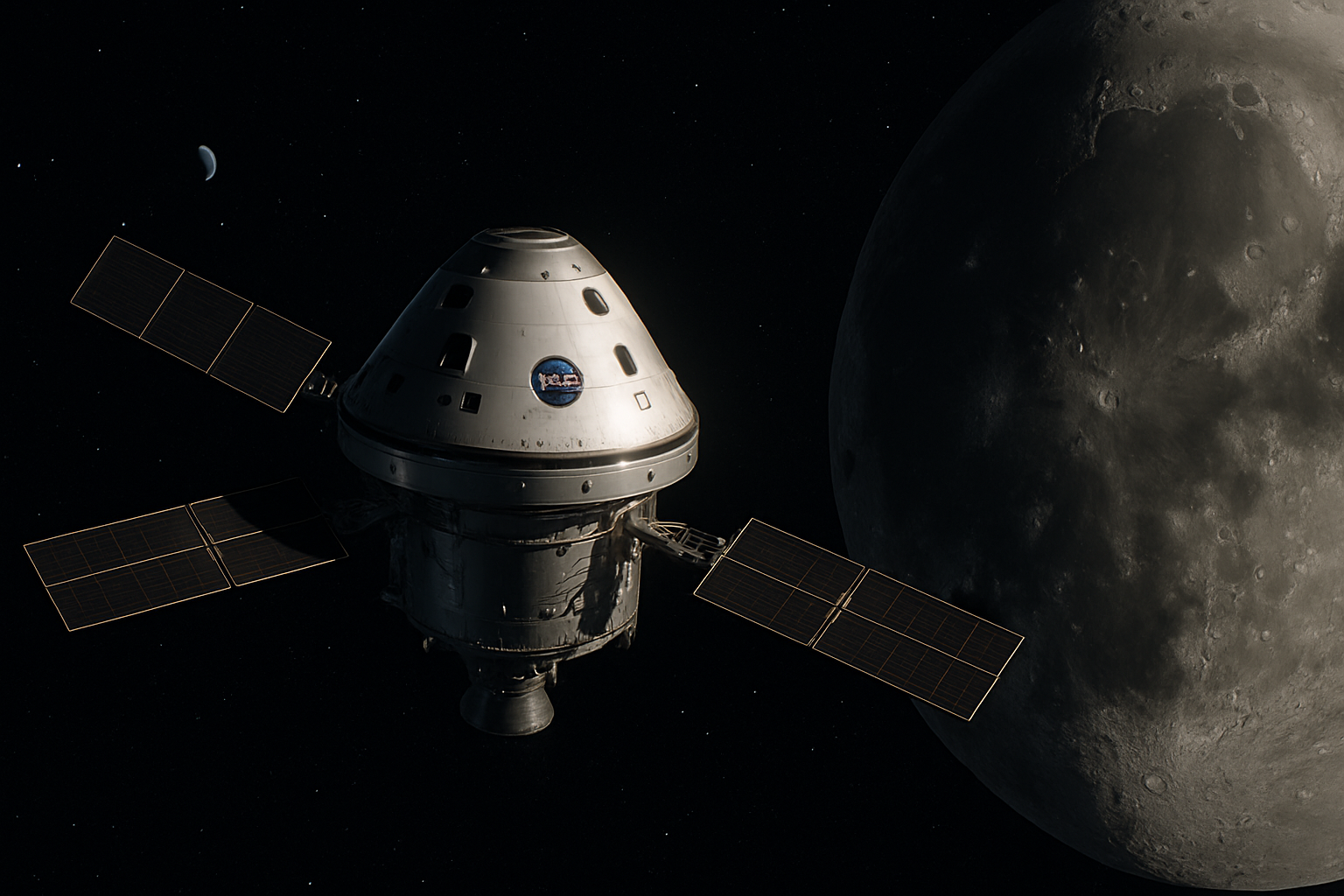
In a triumphant moment for human space exploration, NASA's Artemis II crew is returning to Earth after successfully completing humanity's first lunar flyby in over half a century, breaking Apollo-era distance records and marking a pivotal milestone in our return to deep space.
The four-astronaut international crew—Canadian Jeremy Hansen, NASA Commander Reid Wiseman, Christina Koch, and Victor Glover—achieved the remarkable feat of traveling approximately 406,777.8 kilometers from Earth, surpassing the previous record set by Apollo 13 in 1970 by more than 6,600 kilometers. Hansen became the first Canadian to venture beyond Earth orbit, while the entire crew became the humans who have traveled farthest from our home planet in history.
Historic Far Side Encounter and Communication Blackout
The mission's most dramatic moment occurred during a planned 40-minute communication blackout as the crew traveled 4,000 miles beyond the Moon's far side—completely isolated from Earth during humanity's deepest penetration into space. During this unprecedented period of silence, the astronauts were able to photograph and observe regions of the Moon that are permanently hidden from Earth, providing invaluable scientific data.
"We love you from the Moon," were Victor Glover's final words before the communication blackout began, with Mission Control responding, "See you on the other side."
— NASA Mission Control Communications
When communications were restored, the crew provided live video showing an unprecedented view: a small Earth rising behind the large Moon, both appearing as crescents from their deep space vantage point. The images represent the first photographs taken from a crewed spacecraft beyond Earth orbit since Apollo 17 in December 1972.
Technical Challenges Overcome
The mission was not without its challenges. The crew successfully resolved multiple technical issues during their journey, including toilet system malfunctions that became a viral social media moment, communication failures, and thermal sensor repairs. Christina Koch led the toilet repair efforts after frozen urine reportedly clogged the system, demonstrating significant advancement over Apollo predecessors in terms of crew comfort and mission adaptability.
These technical successes validated modern spacecraft capabilities for extended operations beyond Earth orbit, proving that contemporary astronaut training and backup systems are robust enough for sustained deep space missions where immediate Earth evacuation is impossible.
International Cooperation and Scientific Achievement
The mission showcased unprecedented international cooperation in deep space exploration. Jeremy Hansen's participation validated the Artemis Accords framework for peaceful lunar exploration, representing the most significant Canadian space contribution since the Space Shuttle era. The mission also carried scientific payloads from Argentina (the Atenea radiation device) and Czech Republic (ADVACAM radiation monitoring chips), demonstrating how space exploration has evolved into a truly international endeavor.
Italian researcher Andrea Longobardo from INAF explained that the Moon's far side is "rich with mountains while the near side mostly seas," offering significant advantages for astronomical observation and future resource extraction opportunities. The extensive photographic documentation provided by the Artemis II crew offers unprecedented human perspective of these mysterious regions.
Presidential Recognition and Strategic Context
President Donald Trump personally called the crew during their return journey, congratulating them as "truly extraordinary" and declaring they had "made history today." Trump noted that Artemis was "his baby," emphasizing the administration's commitment to lunar exploration during this pivotal moment in space history.
The mission occurs during what experts call the "space economy golden age," with NASA's historic $20 billion commitment to establishing a permanent lunar surface base by 2030—the largest space infrastructure investment in the agency's history. This comes as international competition intensifies, with China planning lunar crews by 2030 and SpaceX preparing for a potential trillion-dollar IPO in June 2026.
Validation of Deep Space Systems
The successful completion of this 10-day, 685,000-mile mission thoroughly validated critical systems needed for sustained human presence beyond Earth's magnetic field. The SLS rocket—at 322 feet tall, weighing 5.75 million pounds when fully fueled with over 700,000 gallons of liquid hydrogen and oxygen—proved itself as the most powerful NASA rocket for deep space missions.
Mission data will directly inform the design of Artemis III lunar landing operations scheduled for 2028 and establish the foundation for permanent lunar settlements that will serve as stepping stones to Mars exploration. The Space Reactor 1 Freedom nuclear spacecraft program, announced for Mars exploration, will provide the energy density needed for interplanetary missions where solar power is insufficient.
Space Medicine Breakthroughs
The mission builds upon crucial space medicine research, including Sophie Adenot's record-breaking eight-month ISS mission that focused on lung tissue cultivation and SANS (Space-Associated Neuro-Ocular Syndrome) studies. European research has revealed that microgravity disrupts human sperm navigation, making reproduction difficult in space environments—a critical concern for permanent settlements that will require artificial gravity solutions through rotating habitats.
These medical insights are essential for missions beyond Earth evacuation possibility, where astronauts may spend years without access to immediate medical care. The data collected during Artemis II will inform protocols for both lunar base operations and eventual Mars expeditions.
Looking Toward a Spacefaring Future
The successful completion of Artemis II marks the end of a 54-year gap in human deep space exploration—the longest period without such missions since the Apollo era. The mission represents humanity's renewed commitment to becoming a spacefaring civilization through the convergence of advanced technology, international cooperation, and decades of space medicine knowledge accumulated through ISS operations.
As the crew makes their way back to Earth for an expected Friday splashdown, their achievement validates the systems and capabilities essential for permanent extraterrestrial settlements and multi-planetary species development. The mission demonstrates that humanity has transitioned from brief visits to sustained cosmic expansion capabilities for the first time in human history.
Scientific and Cultural Impact
Beyond the technical achievements, the mission provided approximately two dozen scientists at Johnson Space Center with real-time observations of meteoroid impact flashes on the lunar surface and other phenomena never before witnessed by human eyes. The crew proposed naming two newly observed craters, adding to the scientific legacy of human lunar exploration.
The viral toilet repair incident, while highlighting practical challenges of space exploration, also demonstrated human adaptability and ingenuity in space environments. The unprecedented social media engagement around both the heroic achievements and mundane necessities of space travel has reinvigorated public interest in cosmic exploration on a scale not seen since the Apollo era.
As Artemis II continues its journey home, the mission stands as a testament to what humanity can achieve through international cooperation, technical excellence, and an unwavering commitment to pushing the boundaries of human exploration. The success of this historic flyby sets the stage for an exciting new chapter in space exploration, one that promises to establish permanent human presence beyond Earth and ultimately extend human civilization to the stars.