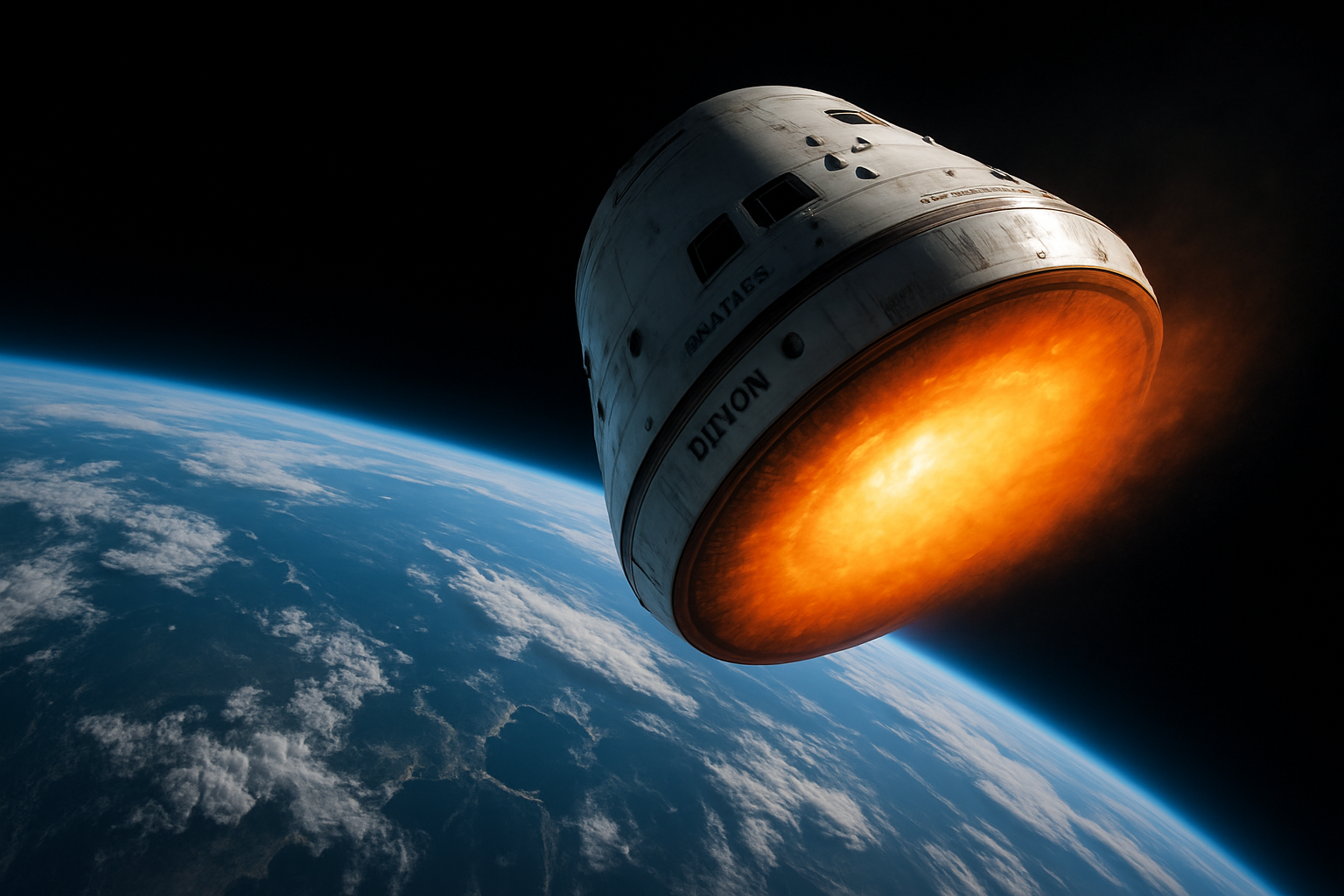
NASA's Artemis II crew has successfully completed humanity's first crewed lunar flyby in more than five decades, breaking Apollo 13's distance record by traveling 406,777.8 kilometers from Earth while capturing unprecedented photographs of our planet from deep space.
The four-astronaut international crew—Canadian Jeremy Hansen, who became the first Canadian to travel beyond Earth orbit, NASA Commander Reid Wiseman, Christina Koch, and Victor Glover—experienced a dramatic 40-minute communication blackout during their passage around the Moon's far side, marking humanity's deepest penetration into space since the Apollo era.
Historic Distance Record Shattered
During their closest lunar approach on Monday, the Artemis II crew traveled 4,000 miles beyond the Moon's far side, surpassing Apollo 13's 1970 distance record of 400,171 kilometers by an impressive 6,606.8 kilometers. This achievement represents the farthest humans have traveled from Earth in history, ending a 54-year gap since Apollo 17's mission in December 1972.
"We love you from the Moon," Victor Glover transmitted as the crew entered the communication blackout zone.
— Victor Glover, Artemis II Mission Specialist
The historic 40-minute radio silence occurred as the Moon blocked all Earth communications, leaving the four astronauts completely isolated during their farthest journey from home. Mission Control's response—"See you on the other side"—echoed the dramatic tension of humanity's boldest space exploration in decades.
Stunning "Earthset" Photography Milestone
Commander Reid Wiseman captured the first Earth photographs from a crewed spacecraft beyond Earth orbit since Apollo 17, producing stunning "Earthset" images showing our planet dipping below the lunar horizon. These historic photographs, described by the White House as showing "Humanity, from the other side," provide an unprecedented cosmic perspective reminiscent of Apollo 8's iconic "Earthrise" image from 1968.
The crew documented curved planetary slices, full globe views showing Africa and Europe, and aurora displays visible from their deep space vantage point, offering an emotional reminder of Earth's beauty and fragility from the cosmic perspective.
Technical Challenges Overcome
The mission faced several technical challenges that the crew resolved with remarkable proficiency, demonstrating significant advancement over Apollo-era capabilities. A Universal Waste Management System malfunction became a viral social media moment when Christina Koch led repair efforts after frozen urine reportedly clogged the spacecraft toilet system.
The crew also successfully addressed communication system failures, thermal sensor malfunctions, and other technical issues without affecting the mission timeline. These challenges and their resolution highlight both the practical realities of space exploration and the crew's exceptional training and adaptability.
Presidential Recognition and Global Impact
President Donald Trump personally called the crew during their return journey, congratulating them as "truly extraordinary" and declaring they had "made history today." Trump emphasized that Artemis was "his baby," highlighting the mission's importance to the current administration's space exploration priorities.
"Guys, you look great," Christina Koch observed while photographing Earth from deep space.
— Christina Koch, Artemis II Mission Specialist
The mission has generated unprecedented social media engagement since the Apollo era, with the toilet repair incident combining heroic achievement with the mundane necessities of space travel, demonstrating human ingenuity in overcoming space exploration challenges.
International Cooperation Validated
Jeremy Hansen's historic participation as the first Canadian beyond Earth orbit validates the Artemis Accords framework for peaceful lunar exploration. The mission represents the most significant Canadian space contribution since the Space Shuttle era, with Calgary-born astronaut Jenni Gibbons serving as Earth voice link backup.
Argentina's Atenea radiation device collected crucial deep space safety data throughout the mission, while Czech ADVACAM radiation monitoring chips measured astronaut safety, demonstrating successful international scientific cooperation in deep space.
Scientific Achievements and Discoveries
The crew provided direct visual observations of meteoroid impact flashes on the lunar surface and captured unprecedented photographic documentation of the Moon's permanently hidden far side—regions never before observed by human eyes. About two dozen scientists at Johnson Space Center recorded these phenomena in real-time, with the crew proposing names for two newly observed craters.
Italian researcher Andrea Longobardo from INAF explains that the Moon's far side is "rich with mountains while the near side is mostly seas," offering astronomical observation advantages and resource extraction opportunities for future lunar settlements.
Technical Validation of SLS Rocket
The mission successfully validated NASA's most powerful rocket ever built—the 322-foot, 5.75 million-pound Space Launch System (SLS) requiring over 700,000 gallons of liquid hydrogen and oxygen. Complete resolution of helium system failures and hydrogen leak problems that caused multiple 2026 delays vindicated NASA's safety-first institutional culture learned from the Challenger and Columbia tragedies.
Strategic Context and Future Implications
The mission occurs during what industry experts call the "space economy golden age," with projections exceeding $1 trillion by 2030. NASA's historic $20 billion commitment to establishing a permanent lunar surface base by 2030 represents the largest space infrastructure investment in agency history.
The successful mission serves as a critical stepping stone toward Artemis III's planned 2028 lunar landing, while China plans lunar crews by 2030 and SpaceX prepares for a trillion-dollar IPO in June 2026, intensifying international space competition.
Space Medicine Advances
The mission builds on French astronaut Sophie Adenot's record eight-month ISS research, including lung tissue cultivation and Space-Associated Neuro-Ocular Syndrome (SANS) studies essential for extended missions beyond Earth evacuation possibilities. European research reveals reproduction challenges in microgravity, requiring artificial gravity solutions through rotating habitats for permanent space settlements.
Looking Toward Friday's Return
The crew is expected to complete their historic 10-day, 685,000-mile mission with a Friday splashdown in the Pacific Ocean. The successful mission validates critical systems essential for permanent lunar settlements and Mars exploration, establishing the foundation for spacefaring species development and multi-planetary civilization advancement.
This achievement marks humanity's transition from brief space visits to sustained cosmic expansion capabilities for the first time in human history, determining the trajectory of human space exploration for generations to come as we establish permanent extraterrestrial settlements among the stars.