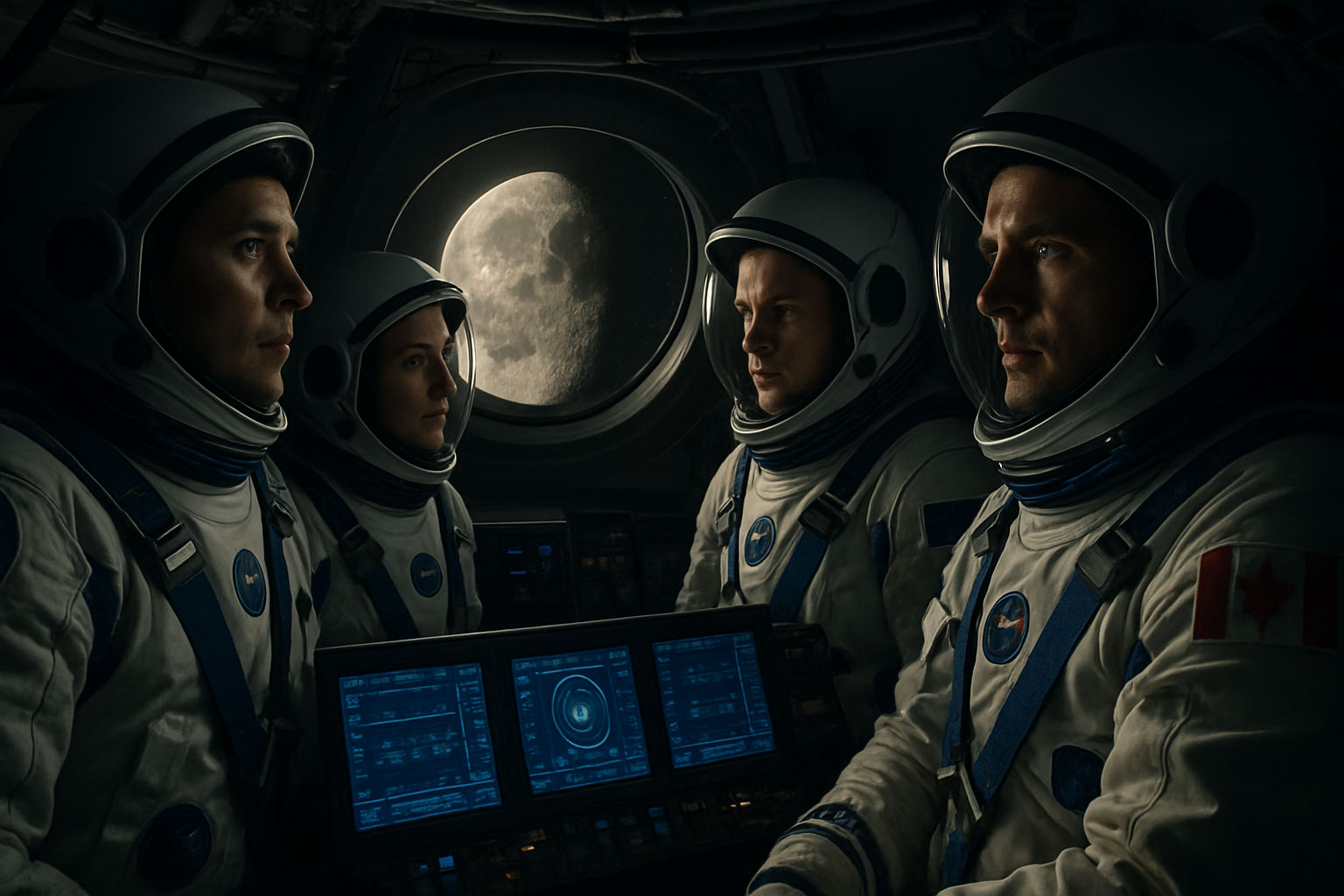
NASA's Artemis II crew has overcome significant technical challenges, including a malfunctioning toilet system, while capturing breathtaking images never before seen by human eyes as they make history on humanity's first lunar journey in over five decades.
The four-astronaut international crew—Canadian Jeremy Hansen (the first Canadian beyond Earth orbit), NASA Commander Reid Wiseman, Christina Koch, and Victor Glover—successfully passed the halfway point to the Moon on Sunday, positioning them closer to their lunar destination than Earth for the first time since Apollo 17 in December 1972.
Technical Challenges and Crew Adaptability
The mission faced multiple technical hurdles during its first days in space, testing the crew's training and backup systems. The spacecraft's toilet system, dubbed the "lunar loo," became inoperative shortly after the April 1 launch, with Norwegian sources indicating that frozen urine may have caused a system blockage.
Christina Koch led repair efforts with crew assistance, turning what could have been a mission-threatening problem into a viral social media moment that demonstrated the practical realities of space exploration. The crew used backup urine collection bags while working to restore the primary system, eventually measuring noise levels post-repair to ensure proper functionality.
"The toilet system was successfully fixed," NASA confirmed, representing a significant advancement over Apollo predecessors for extended mission comfort.
— NASA Mission Control
Beyond toilet issues, the crew resolved communication system failures and thermal sensor malfunctions during their first orbital days—all without affecting the mission timeline. This technical proficiency demonstrates remarkable advancement in crew training effectiveness and spacecraft system reliability compared to the Apollo era.
Historic Earth Photography from Deep Space
Commander Reid Wiseman captured the first photographs of Earth taken by astronauts from beyond Earth orbit since Apollo 17, showing both curved slices of the planet and full globe views with swirling white clouds over blue oceans. The images represent a historic milestone in space photography and human perspective.
The crew's emotional response to viewing Earth from deep space has captivated global audiences. Christina Koch exclaimed "Guys, you look great" when viewing Earth, while Wiseman noted the visibility of Africa, Europe, and aurora displays from their unique vantage point. Jeremy Hansen reflected on the achievement, stating that "humanity has demonstrated once again what it is capable of."
The astronauts reported being unable to "get away from the windows" during their historic journey, emphasizing the profound impact of seeing Earth from this unprecedented perspective after more than half a century.
Lunar Encounter and Record-Breaking Distance
As the crew travels toward their scheduled Monday lunar encounter, they will venture 4,000 miles beyond the Moon's far side—farther than any humans since the Apollo era, breaking Apollo 13's distance record. This 10-day mission covering 685,000 miles serves as crucial validation for deep space systems essential for future lunar settlements.
The successful translunar injection burn, described as "perfect" by NASA Flight Director Jeff Radigan, officially departed Earth orbit for the lunar trajectory. The flawless 5-minute 49-second engine burn occurred 25 hours post-launch, with Hansen describing the sensation as "falling out of the sky."
The Orion spacecraft has entered the lunar sphere of influence, where the Moon's gravity exerts stronger pull than Earth's. This milestone marks a critical phase as the crew prepares to photograph the mysterious lunar far side during their closest approach, providing valuable scientific documentation from an unprecedented human perspective.
International Cooperation and Scientific Research
Jeremy Hansen's participation as the first Canadian beyond Earth orbit validates the Artemis Accords framework for peaceful lunar exploration, representing the most significant Canadian human spaceflight contribution since the Space Shuttle era. Calgary-born astronaut Jenni Gibbons serves as Earth voice link and backup to Hansen.
Argentina contributed the Atenea radiation study device aboard the mission, collecting crucial deep space radiation effects data. Czech ADVACAM radiation monitoring chips from Prague are measuring astronaut safety parameters. These international partnerships demonstrate the global nature of humanity's return to deep space exploration.
Technical Validation and Future Missions
The mission occurs during what NASA calls the "space economy golden age," with the agency's historic $20 billion commitment to establishing a permanent lunar surface base by 2030—the largest space infrastructure investment in NASA history. The successful resolution of the SLS rocket's technical challenges, including helium system failures and hydrogen leak problems, validates the most powerful rocket NASA has ever built.
The mission builds on critical space medicine research, including French astronaut Sophie Adenot's record eight-month ISS mission focusing on lung tissue cultivation and Space-Associated Neuro-Ocular Syndrome (SANS) research essential for extended missions beyond Earth evacuation possibility.
"We are on our way to the Moon. The spacecraft is performing beautifully."
— Artemis II Crew Statement
Strategic Context and Competition
The mission unfolds amid intensifying international space competition, with China planning lunar crews by 2030 and SpaceX preparing a potential trillion-dollar IPO in June 2026. The space economy is projected to exceed $1 trillion by 2030, positioning space exploration as critical infrastructure rather than experimental endeavor.
NASA's safety-first approach, demonstrated through multiple delays prioritizing crew protection over schedules, reflects institutional learning from the Challenger and Columbia tragedies. Administrator Jared Isaacman's philosophy of "we will only launch when we believe we are ready" has been vindicated through the mission's current success.
Historical Significance and Future Implications
The 54-year gap since Apollo 17 represents the longest period without human deep space exploration. Artemis II marks humanity's renewed commitment to becoming a spacefaring civilization through advanced technology, international cooperation, and space medicine knowledge accumulated during decades of ISS operations.
Success determines the trajectory of human space exploration, establishing the foundation for permanent extraterrestrial settlements and multi-planetary species development. The mission serves as a stepping stone toward Artemis III's planned 2028 lunar landing and the eventual establishment of sustainable lunar settlements.
The toilet repair incident, while generating viral social media moments, symbolizes human ingenuity and adaptability in space environments. Such practical challenges highlight the evolution from brief Apollo visits to sustained human presence beyond Earth orbit—a transition essential for becoming a truly spacefaring species.
As the crew prepares for their historic lunar flyby, they carry not just the hopes of space agencies but of humanity itself, marking a pivotal moment in our cosmic expansion and the beginning of a new era in space exploration.