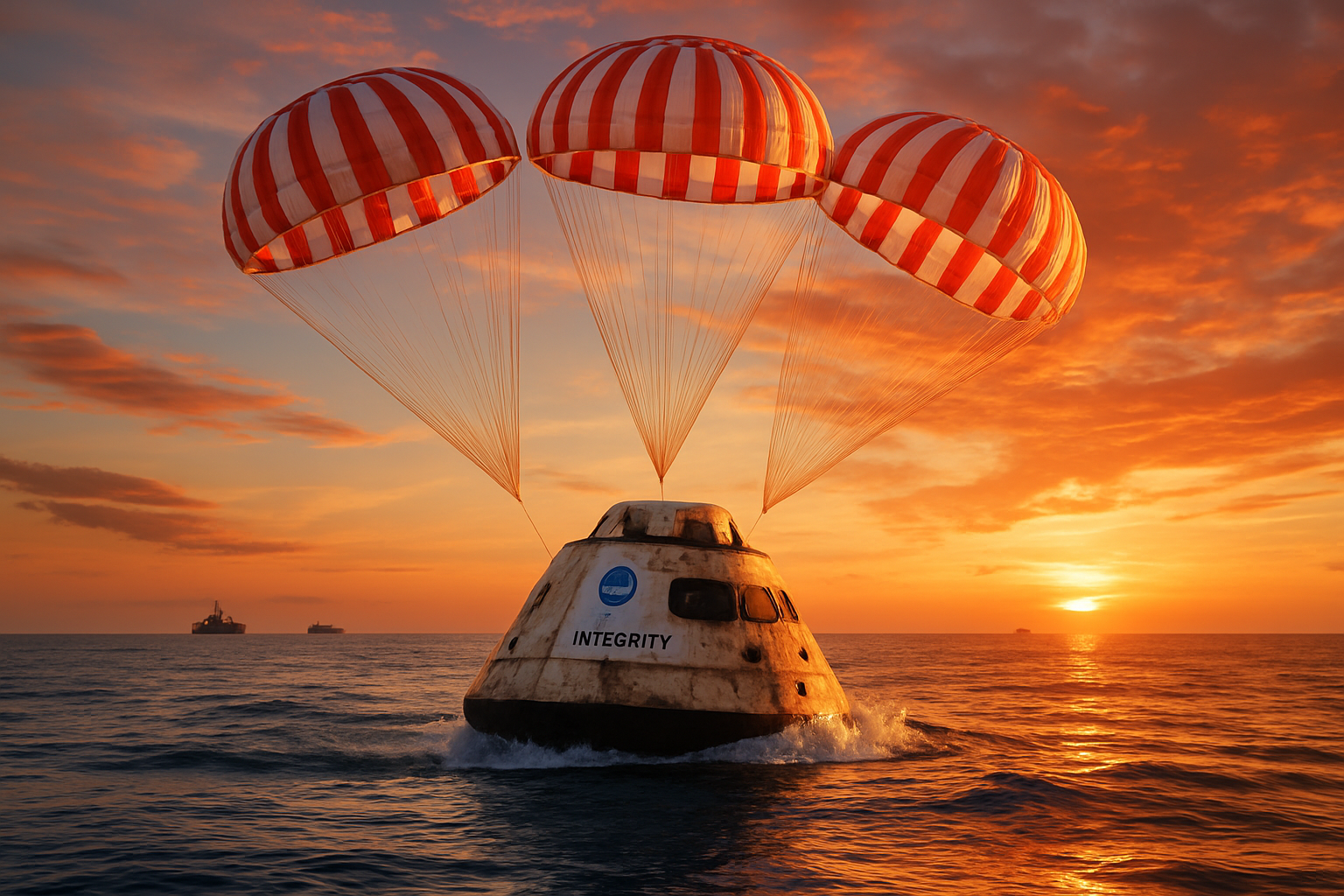
Four astronauts aboard NASA's Artemis II mission safely splashed down in the Pacific Ocean on Friday, April 11, 2026, completing humanity's first crewed journey around the Moon in more than half a century and marking a triumphant return to deep space exploration.
NASA's gumdrop-shaped Orion capsule, christened "Integrity," parachuted gently into calm seas off the Southern California coast at approximately 8:07 PM ET, concluding a historic 10-day mission that took the crew deeper into space than any humans had traveled before. The successful splashdown caps the first voyage by humans to the vicinity of the Moon since Apollo 17 in December 1972, ending a 54-year gap in deep space human exploration.
Record-Breaking Journey Into Deep Space
The four-astronaut international crew—Canadian Jeremy Hansen (the first Canadian to venture beyond Earth orbit), NASA Commander Reid Wiseman, Christina Koch, and Victor Glover—achieved a new human distance record of 406,777.8 kilometers from Earth during their lunar flyby. This surpassed the previous record held by Apollo 13 in 1970 by more than 6,600 kilometers, taking the crew approximately 4,000 miles beyond the Moon's far side.
The mission covered a total distance of 694,392 miles across two Earth orbits and a dramatic lunar flyby that saw the crew experience a 40-minute communication blackout while passing behind the Moon—completely isolated from Earth contact during humanity's deepest penetration into space since the Apollo era.
"The human mind isn't made to go through what we just went through," Commander Wiseman reflected during the mission. "Humanity has demonstrated once again what it is capable of."
— Reid Wiseman, Artemis II Mission Commander
Technical Challenges and Crew Adaptability
Throughout the mission, the crew demonstrated exceptional problem-solving skills and adaptability when faced with multiple technical challenges. The most publicized issue involved the spacecraft's Universal Waste Management System—commonly known as the "space toilet"—which malfunctioned shortly after launch, reportedly due to frozen urine clogging the system.
Mission Specialist Christina Koch led repair efforts with crew assistance, an incident that became a viral social media moment while highlighting both the practical realities of space exploration and the crew's technical proficiency. The team also successfully resolved communication system failures and thermal sensor malfunctions without affecting the mission timeline, demonstrating significant advancement over Apollo-era capabilities for extended mission comfort and sustainability.
Scientific Achievements and Lunar Photography
The mission yielded unprecedented scientific achievements, including the first Earth photographs taken from a crewed spacecraft beyond Earth orbit since Apollo 17. Commander Wiseman captured stunning "Earthset" images showing Earth dipping below the lunar horizon—a deliberate homage to Apollo 8's iconic Earthrise photograph from 1968.
During their closest approach to the Moon, the crew provided extensive photographic documentation of the lunar far side—mysterious regions permanently hidden from Earth that had never before been observed by human eyes. The astronauts also reported direct visual observations of meteoroid impact flashes on the lunar surface, with scientists at Johnson Space Center recording the phenomena in real-time and proposing names for two newly observed craters.
International Cooperation and Strategic Significance
Jeremy Hansen's achievement as the first Canadian to travel beyond Earth orbit validates the Artemis Accords framework for peaceful lunar exploration and represents the most significant Canadian contribution to human spaceflight since the Space Shuttle era. The mission also carried international scientific payloads, including Argentina's Atenea radiation detection device and Czech ADVACAM radiation monitoring chips, collecting crucial data on deep space radiation effects for future long-duration missions.
President Donald Trump personally called the crew during their return journey, congratulating them as "truly extraordinary" and declaring they had "made history today." The President emphasized Artemis as an administration priority, highlighting renewed American space leadership during a period of intensifying international competition.
Dangerous Reentry and Recovery
The mission's final phase presented the most dangerous challenge: atmospheric reentry at speeds exceeding 38,365 kph (23,839 mph), creating a "fireball effect" that tested the Orion heat shield's capabilities to their limits. NASA officials acknowledged there was essentially no backup plan if the thermal protection system had failed during the high-speed atmospheric entry, which subjected the spacecraft exterior to temperatures reaching 5,000°F (2,760°C).
A total exclusion zone was established around the Pacific Ocean splashdown site, coordinated with U.S. military forces due to potential debris risks. Recovery teams stood by to assist the crew's exit from the capsule and transport them to the recovery vessel USS John P. Murtha.
Foundation for Future Missions
The successful completion of Artemis II serves as a crucial stepping stone for NASA's ambitious lunar exploration program. The mission validated critical deep space systems including life support, radiation protection beyond Earth's magnetic field, and navigation capabilities essential for sustained human presence on the Moon.
NASA has committed $20 billion toward establishing a permanent lunar surface base by 2030—the largest space infrastructure investment in the agency's history. This mission directly supports preparations for Artemis III, scheduled for 2028, which will attempt the first crewed lunar landing since Apollo 17.
The mission also builds upon ongoing space medicine research, including French astronaut Sophie Adenot's record eight-month International Space Station mission focusing on lung tissue cultivation and Space-Associated Neuro-Ocular Syndrome (SANS) research. Such studies are essential for understanding human physiology during extended missions beyond the possibility of Earth evacuation.
Technical Validation and Future Exploration
The Space Launch System (SLS) rocket—standing 322 feet tall and weighing 5.75 million pounds when fully fueled—proved itself as the most powerful rocket NASA has ever built. The successful mission vindicates years of engineering work that resolved persistent helium system failures and hydrogen leak problems that had caused multiple delays throughout early 2026.
NASA has also announced the Space Reactor 1 Freedom nuclear spacecraft program for Mars exploration, which will provide the energy density necessary for interplanetary missions where solar power is insufficient. This nuclear propulsion technology will enable faster transit times, continuous power generation, and reduced radiation exposure for future deep space operations.
Economic and Strategic Context
The Artemis II mission occurs during what experts are calling a "space economy golden age," with the global space economy projected to exceed $1 trillion by 2030. SpaceX is preparing for a potentially trillion-dollar IPO in June 2026, while China has announced plans for crewed lunar missions by 2030, intensifying international competition in space exploration.
The successful completion of Artemis II represents more than a technological achievement—it marks humanity's transition from brief experimental forays into space to sustained cosmic expansion capabilities. This mission establishes the foundation for permanent extraterrestrial settlements and multi-planetary species development, positioning humanity as a truly spacefaring civilization for the first time in history.
Legacy and Historical Significance
As the Orion capsule bobbed safely in Pacific waters under its parachutes, the moment represented the culmination of decades of preparation and the beginning of a new era in human space exploration. Unlike the Apollo program's conclusion after six Moon landings, Artemis represents the beginning of sustained human presence beyond Earth orbit.
The mission's success validates the convergence of advanced technology, international cooperation, and space medicine knowledge accumulated through decades of International Space Station operations. It determines the trajectory of human space exploration for generations to come, establishing the foundation for permanent lunar settlements, Mars exploration, and ultimately, humanity's expansion among the stars.
With all four astronauts safely aboard the recovery vessel and the Orion capsule secured, Artemis II has not only achieved its primary objectives but has also reignited global enthusiasm for space exploration reminiscent of the Apollo era. The mission proves that humanity is ready to become a spacefaring species, with the Moon serving as our first permanent outpost in the cosmos.