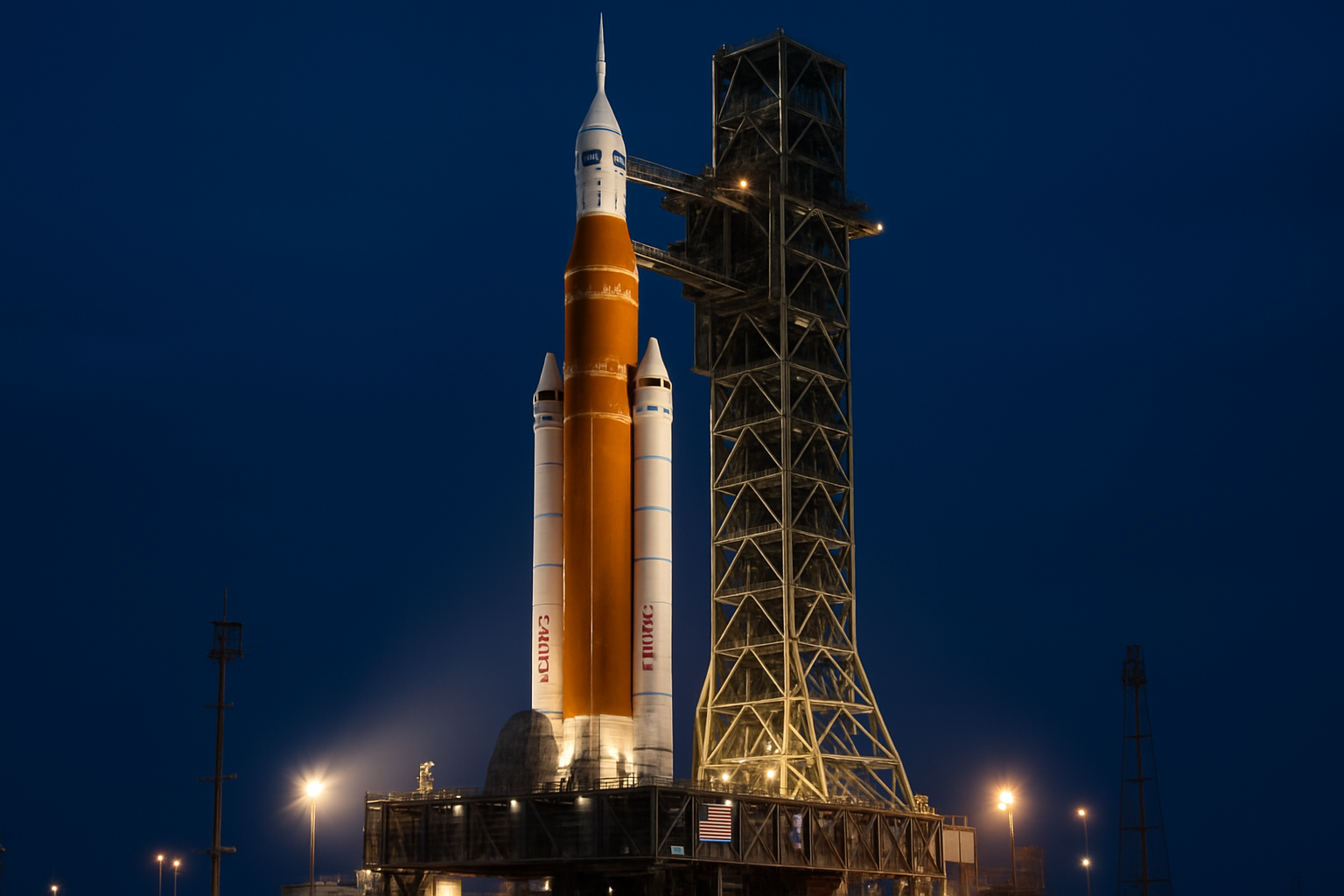
NASA's Artemis II mission reached a critical milestone on March 28, 2026, as the four-astronaut international crew officially arrived at Kennedy Space Center to begin final preparations for the historic April 1 launch, marking humanity's first journey beyond Earth orbit in over half a century.
The crew, consisting of Canadian Space Agency's Jeremy Hansen, NASA Commander Reid Wiseman, and Mission Specialists Christina Koch and Victor Glover, will embark on a 10-day lunar flyby mission covering 600,000 miles—the first crewed mission beyond Earth orbit since Apollo 17 in December 1972.
Technical Triumphs After Months of Delays
The mission's path to launch has been marked by significant technical challenges that NASA engineers have systematically resolved. Critical helium system failures affecting the Space Launch System (SLS) rocket's upper stage—essential for engine purging and fuel tank pressurization—were successfully addressed after causing multiple delays throughout early 2026.
Persistent hydrogen leak issues during wet dress rehearsal testing, which emerged consistently at T-minus 5 minutes during countdown simulations, have also been resolved through comprehensive engineering analysis and repairs. These technical problems had pushed the mission from its original February target through March before settling on the current April 1 launch date.
"We will only launch when we believe we are ready."
— Jared Isaacman, NASA Administrator
The SLS rocket represents NASA's most powerful launch vehicle ever constructed, standing 322 feet tall and weighing 5.75 million pounds when fully fueled with more than 700,000 gallons of liquid hydrogen and oxygen. This engineering marvel will propel the Orion spacecraft and its crew on humanity's return to deep space exploration.
International Cooperation and Historic Firsts
The mission carries profound significance for international space cooperation, particularly for Canada. Jeremy Hansen will become the first Canadian astronaut to travel beyond Earth orbit, representing a major milestone for the Canadian Space Agency since the Space Shuttle era. Calgary-born astronaut Jenni Gibbons serves as the Earth voice link and backup to Hansen, further cementing Canada's crucial role in the mission.
This international collaboration validates the Artemis Accords framework for peaceful lunar exploration, demonstrating how nations can work together on humanity's most ambitious space endeavors. The mission occurs during what experts term the "space economy golden age," with intensifying international competition as China plans lunar crews by 2030 and commercial space companies like SpaceX prepare for potential trillion-dollar IPOs.
The 54-Year Gap: From Apollo to Artemis
The significance of Artemis II extends far beyond its technical achievements. The 54-year gap since Apollo 17 represents the longest period in human history without deep space exploration. This mission marks humanity's renewed commitment to becoming a spacefaring civilization, utilizing advanced technology, international cooperation, and decades of space medicine knowledge accumulated during International Space Station operations.
Recent ISS research, including French astronaut Sophie Adenot's record-setting eight-month mission, has provided crucial data on long-duration spaceflight effects. Studies on Space-Associated Neuro-Ocular Syndrome (SANS) and lung tissue cultivation in microgravity directly inform the medical protocols that will keep Artemis II crew members healthy during their journey beyond Earth's protective magnetic field.
Strategic Context and Competition
The mission unfolds against a backdrop of unprecedented space industry transformation. NASA recently announced a historic $20 billion commitment toward establishing a permanent lunar surface base by 2030—the largest space infrastructure investment in the agency's history. This strategic pivot cancelled the Lunar Gateway project, redirecting resources toward surface operations in response to accelerated international competition.
China's advancing Shenlong reusable spacecraft program and plans for crewed lunar missions by 2030 have intensified the new space race. Meanwhile, Pakistan's selection of astronaut candidates for China's Tiangong station and European nations' drive for space independence through programs like Germany's €10 billion satellite investments demonstrate the democratization of space capabilities.
Safety-First Philosophy
NASA's approach to Artemis II reflects hard-learned lessons from the space program's history. The classification of Boeing's Starliner mission as a Type A mishap—the same severity level as the Challenger and Columbia disasters—reinforced the agency's comprehensive safety assessment protocols. Multiple delays demonstrate NASA's institutional maturity in prioritizing crew protection over schedule adherence.
This methodical problem-solving approach builds long-term confidence in deep space transportation systems essential for sustained lunar presence and eventual Mars exploration. The technical challenges resolved during Artemis II's development validate systems for radiation protection, life support, and navigation that will be crucial for permanent lunar settlements.
Mission Objectives and Scientific Goals
Artemis II serves as a critical stepping stone toward the Artemis III lunar landing planned for 2028. The mission will validate deep space life support systems, test radiation protection capabilities beyond Earth's magnetic field, and demonstrate navigation technologies required for sustained lunar operations.
The crew will conduct experiments to understand human adaptation to the deep space environment, including radiation exposure effects and long-duration spaceflight challenges. This data will directly inform protocols for future lunar bases and Mars expeditions, where astronauts may spend years without the possibility of Earth evacuation.
Space Economy Golden Age
The mission occurs during what analysts call the transition from the "AI revolution" to the "space economy golden age." The space economy is projected to exceed $1 trillion by 2030, with commercial enterprises increasingly driving innovation beyond traditional government programs.
SpaceX's preparation for a potential June 2026 IPO with valuations exceeding $1 trillion demonstrates the maturation of commercial space capabilities. The company's strategic pivot from Mars colonization to lunar settlements within the next decade aligns with NASA's accelerated lunar timeline, creating substantial opportunities for public-private partnerships.
Looking Beyond Earth's Orbit
The success of Artemis II will be critical for humanity's expansion into the cosmos. The mission tests systems essential for permanent lunar settlements that will serve as stepping stones to Mars exploration. Technologies validated during this 10-day journey will inform the design of habitats, life support systems, and transportation networks that could sustain human presence throughout the solar system.
As the crew arrived at Kennedy Space Center, they carried with them the aspirations of billions of people worldwide who have never witnessed human deep space exploration. Their mission represents not just a return to the Moon's vicinity, but the first steps toward becoming a truly spacefaring species.
With launch just days away, Artemis II stands poised to mark a new chapter in human space exploration—one that could define the trajectory of our species for generations to come. The convergence of international cooperation, advanced technology, and unwavering commitment to safety provides a robust foundation for humanity's greatest adventure: the expansion of human civilization beyond Earth.