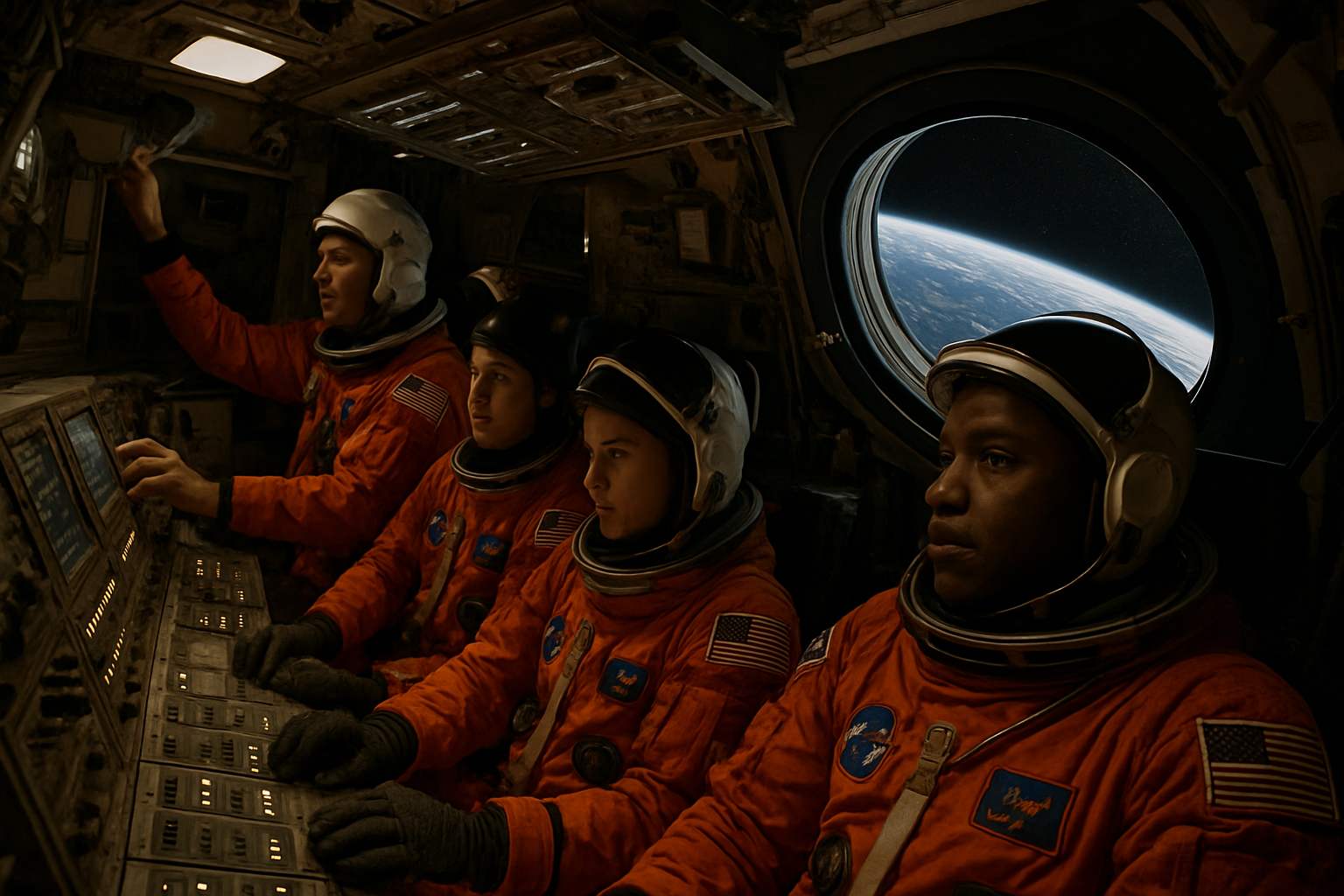
As NASA's Artemis II crew successfully completed humanity's first journey beyond Earth orbit in over half a century, their historic achievement has cast new light on mounting threats to future space exploration from an increasingly congested orbital environment.
The four-astronaut international crew—Canadian Jeremy Hansen, NASA Commander Reid Wiseman, Christina Koch, and Victor Glover—traveled 685,000 miles on their 10-day lunar flyby mission, breaking Apollo 13's distance record by venturing 4,000 miles beyond the Moon's far side. Their successful April 1-6, 2026 mission ended a 54-year gap since Apollo 17, marking a triumphant return to deep space exploration.
Technical Excellence Amid Growing Orbital Challenges
The mission showcased remarkable technical advancement over Apollo-era capabilities. When the spacecraft's Universal Waste Management System malfunctioned—becoming a viral social media moment as Christina Koch led repair efforts—the crew's rapid problem-solving demonstrated sophisticated training and backup systems that far exceed their 1970s predecessors.
"Humanity has demonstrated once again what it is capable of," Hansen declared as the crew captured the first Earth photographs from crewed spacecraft beyond Earth orbit since 1972. Reid Wiseman's images showing Africa, Europe, and aurora displays provided a cosmic perspective that has captivated global audiences.
"The crew's ability to resolve multiple technical challenges including communication failures, thermal sensor malfunctions, and waste management repairs without affecting mission timeline represents a quantum leap in space operations capability."
— NASA Flight Director Jeff Radigan
Space Debris: The Hidden Threat to Cosmic Expansion
However, the mission's success comes against a backdrop of mounting concern about orbital debris threatening future space access. Current data reveals over 30,000 tracked objects orbiting Earth, with numbers increasing daily as space activity intensifies.
Romanian space experts warn of a potential cascade effect where collisions could generate millions of tiny fragments traveling at 17,500 mph, making space launches so dangerous that humanity could become effectively trapped on Earth. This "Kessler Syndrome" scenario represents an existential threat to our emerging spacefaring civilization.
Austrian scientists have documented atmospheric pollution from rocket debris, including tenfold elevated lithium concentrations from Falcon-9 reentries. With the space economy projected to exceed $1 trillion by 2030 and multiple nations planning massive satellite constellations, sustainable orbital practices have become critical for maintaining long-term space access.
International Competition and Cooperation
The Artemis II success occurs during what experts call the "space economy golden age," marked by intensifying international competition. China plans crewed lunar missions by 2030, while SpaceX prepares a trillion-dollar IPO for June 2026. Pakistan has selected astronaut candidates for China's Tiangong station, demonstrating the democratization of space capabilities.
NASA's strategic response includes a historic $20 billion commitment to establish a permanent lunar surface base by 2030—the largest space infrastructure investment in agency history. The decision to cancel the Lunar Gateway orbiting station and redirect funds to surface operations reflects urgency in establishing tangible lunar presence amid growing competition.
Jeremy Hansen's participation as the first Canadian beyond Earth orbit validates the Artemis Accords framework for peaceful lunar exploration, while Argentina's Atenea radiation device collected valuable deep space data throughout the mission.
The Dark Side of the Moon: Scientific Revelations
Italian astronomer Andrea Longobardo emphasizes the scientific importance of the Moon's far side: "We call it dark, but it's not. It's rich with mountains, while we see mostly seas on the near side." The Artemis II crew's six-hour photographic mission during their closest approach provided unprecedented documentation of these mysterious regions permanently hidden from Earth.
This scientific data proves invaluable as multiple nations prepare for lunar settlements. The far side's unique characteristics—including reduced radio interference and different geological composition—offer distinct advantages for astronomical observation and resource extraction.
Space Medicine and Long-Duration Challenges
The mission builds on crucial space medicine research, including French astronaut Sophie Adenot's record eight-month ISS mission focusing on lung tissue cultivation and Space-Associated Neuro-Ocular Syndrome (SANS) research. European studies reveal reproduction challenges in microgravity environments, necessitating artificial gravity solutions for permanent settlements.
The toilet repair incident, while humorous, highlighted practical challenges of extended space habitation. These seemingly mundane issues become critical for missions lasting months or years, where crew comfort and system reliability directly impact mission success and psychological well-being.
Nuclear Propulsion and Mars Preparation
NASA's Space Reactor 1 Freedom nuclear spacecraft program represents another crucial advancement. Nuclear propulsion provides energy density essential for interplanetary missions where solar power proves insufficient, enabling faster transit times and reduced radiation exposure for Mars-bound crews.
The Artemis II mission validated deep space life support systems, radiation protection beyond Earth's magnetic field, and navigation capabilities essential for sustained lunar presence. These technologies serve as stepping stones toward Mars exploration and the establishment of permanent extraterrestrial settlements.
A Sustainable Path Forward
As humanity stands on the threshold of becoming a truly spacefaring civilization, the success of Artemis II provides both inspiration and sobering context. While we've proven our ability to return to deep space with advanced technology and international cooperation, the growing debris crisis demands immediate attention.
China's Hukeda-2 mission, featuring flexible "octopus tentacle" robotic arms for orbital servicing and debris disposal, represents one promising approach. Such technologies could extend satellite lifespans and prevent the cascade effects that threaten our cosmic future.
The convergence of triumph and challenge in April 2026 reflects humanity's complex relationship with space exploration. We possess unprecedented capabilities for cosmic expansion, yet face threats that could curtail these ambitions if left unchecked.
"This mission represents a generational achievement combining advanced technology, international cooperation, and space medicine expertise. Success determines the trajectory of human space exploration for generations to come."
— NASA Administrator Jared Isaacman
As the Artemis II crew returned safely to Earth, their images of our pale blue dot floating in the cosmic dark serve as both celebration and warning. We have the technology to expand beyond Earth, but we must act responsibly to preserve space access for future generations. The window for establishing sustainable space practices narrows with each passing launch, making the decisions of the next few years critical for humanity's cosmic destiny.