In a mission that has already broken humanity's 54-year gap in deep space exploration, NASA's Artemis II crew has turned what could have been an embarrassing technical setback into a celebrated demonstration of human adaptability and engineering excellence.
The four-astronaut international crew—Canadian Jeremy Hansen, NASA Commander Reid Wiseman, Christina Koch, and Victor Glover—successfully resolved multiple technical challenges during their first day in space, including communication system failures, thermal sensor malfunctions, and a spacecraft toilet system repair that unexpectedly captured global attention.
The Viral Moment That Defined Mission Resilience
What began as a routine technical issue aboard NASA's Orion spacecraft quickly transformed into one of the most talked-about moments of the historic flight. Astronaut Christina Koch's assistance in fixing the toilet malfunction prompted lighthearted exchanges with mission control and generated widespread online discussion about the realities of space exploration.
The incident, while seemingly minor, represents a significant advancement over Apollo-era capabilities. Unlike their predecessors from the 1970s, the Artemis II crew can now handle waste management "much more comfortably than Apollo predecessors," according to NASA officials—a crucial improvement for the mission's 10-day, 685,000-mile lunar flyby.
"The crew has successfully resolved the issue and can now manage waste systems with significantly greater comfort and efficiency than previous deep space missions."
— NASA Mission Control
Technical Excellence Under Pressure
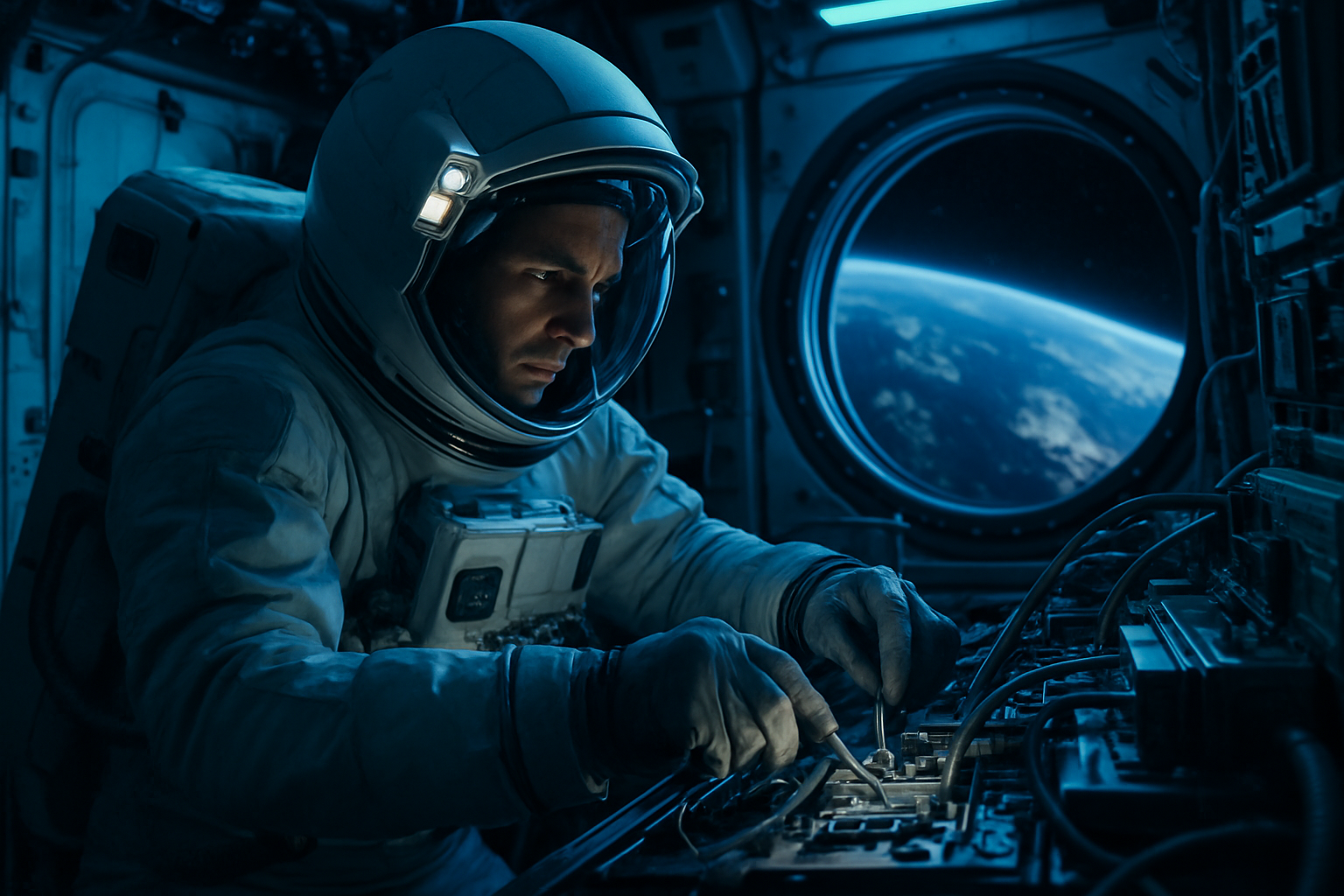
The toilet repair was just one of several technical challenges the crew faced and overcame during their first orbital day. Communication system failures were restored, thermal sensors were repaired, and all issues were resolved without affecting the mission timeline—a testament to both crew training effectiveness and backup system reliability.
These rapid resolutions demonstrate the technological evolution from the Apollo era. The Artemis II mission, utilizing the most powerful NASA rocket ever built—the 322-foot SLS system weighing 5.75 million pounds when fully fueled with 700,000+ gallons of liquid hydrogen and oxygen—represents decades of advancement in spacecraft design and crew preparedness.
International Cooperation Validates Deep Space Ambitions
The mission's success carries profound significance beyond technical achievements. Jeremy Hansen's participation marks the first time a Canadian has traveled beyond Earth orbit, validating the Artemis Accords framework for peaceful lunar exploration and representing the most significant Canadian human spaceflight contribution since the Space Shuttle era.
The international collaboration extends to scientific payloads, with Argentina's Atenea radiation study device aboard the mission, collecting crucial data on deep space radiation effects that will inform future lunar base planning and Mars exploration protocols.
Strategic Context: The New Space Economy
Artemis II's launch occurs during what industry experts term the "space economy golden age," with the sector projected to exceed $1 trillion by 2030. NASA's historic $20 billion commitment to establishing a permanent lunar surface base by 2030 represents the largest space infrastructure investment in agency history, positioning the United States for leadership in an increasingly competitive international arena.
This strategic pivot reflects global dynamics, with China planning crewed lunar missions by 2030 and SpaceX preparing for a potentially trillion-dollar IPO in June 2026. The mission validates critical deep space systems at a time when space exploration has evolved from experimental endeavor to essential infrastructure.
Building on Decades of Space Medicine Research
The crew's technical proficiency builds on extensive International Space Station research, including French astronaut Sophie Adenot's record eight-month mission conducting lung tissue cultivation and Space-Associated Neuro-Ocular Syndrome (SANS) studies. This research directly informs medical protocols for future lunar bases and Mars expeditions, where astronauts may spend years without the possibility of Earth medical evacuation.
The successful resolution of the toilet system and other technical issues demonstrates that human spaceflight has matured to handle the complex challenges of extended deep space operations, a critical requirement for the permanent extraterrestrial settlements that NASA envisions.
Historical Significance and Future Implications
The 54-year gap since Apollo 17 in December 1972 represents the longest period without human deep space exploration. Artemis II's success marks humanity's renewed commitment to becoming a spacefaring civilization through advanced technology, international cooperation, and accumulated space medicine knowledge.
The mission serves as a stepping stone toward Artemis III's planned lunar landing in 2028 and validates systems essential for permanent lunar settlements and Mars exploration. Success in handling routine technical challenges like waste management systems, while seemingly mundane, proves crucial for missions where astronauts will operate far from Earth's support systems.
As the crew prepares for their lunar trajectory insertion, having successfully demonstrated their ability to handle complex technical challenges, they carry forward not just human ambitions for cosmic exploration, but proof that human ingenuity and training can overcome the unexpected obstacles that space inevitably presents.
The toilet repair that captured global attention serves as a powerful metaphor: in space exploration, no challenge is too small or too complex for human determination and engineering excellence to resolve.