After a groundbreaking 10-day journey that saw them travel farther from Earth than any humans since the Apollo era, NASA's Artemis II crew is preparing for their return to Earth with a critical Pacific Ocean splashdown off the Southern California coast on Friday evening.
The four-astronaut international crew—Canadian Jeremy Hansen, the first Canadian to venture beyond Earth orbit, NASA Commander Reid Wiseman, Christina Koch, and Victor Glover—have completed humanity's first crewed lunar flyby mission in 54 years, ending the longest gap in human deep space exploration since Apollo 17 in December 1972.
Record-Breaking Journey to the Moon's Far Side
The historic mission achieved a new human distance record of 406,777.8 kilometers from Earth, surpassing Apollo 13's 1970 record of 400,171 kilometers by an impressive 6,606.8 kilometers. During their closest lunar approach, the crew traveled 4,000 miles beyond the Moon's far side, providing unprecedented observations of regions permanently hidden from Earth's view.
The mission's most dramatic moment came during a 40-minute communication blackout as the spacecraft passed behind the lunar far side, leaving the crew completely isolated from Earth contact—the deepest space penetration by humans in over five decades. Upon communication restoration, the crew shared stunning images of Earth rising above the lunar horizon, marking the first Earth photography from a crewed spacecraft beyond Earth orbit since Apollo 17.
"The human mind isn't made to go through what we just went through," Commander Wiseman reflected during their first press conference from space, describing the profound psychological impact of their deep space journey.
— Reid Wiseman, Artemis II Mission Commander
The Critical Re-Entry Challenge
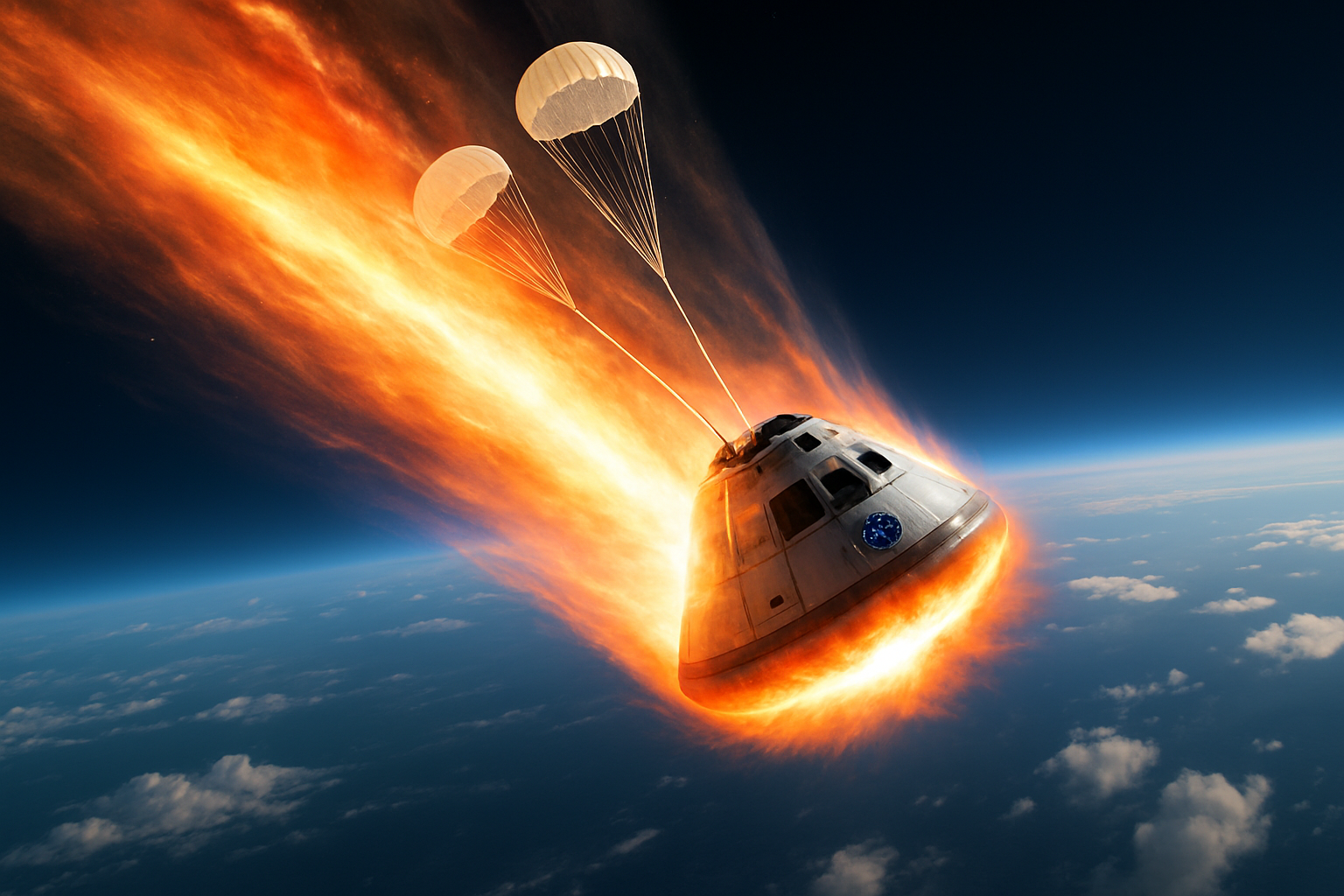
As the crew approaches Earth, they face what NASA officials acknowledge is the mission's most dangerous phase: atmospheric re-entry at speeds reaching 23,839 mph (38,365 kph). The Orion spacecraft's heat shield will be subjected to intense atmospheric friction, creating what crew members describe as "riding a fireball" through Earth's atmosphere.
NASA engineers stress that there is essentially no backup plan if the thermal protection system fails during this high-speed atmospheric entry. The heat shield technology, designed to withstand temperatures exceeding 2,500°C, represents a crucial test for future deep space missions where such extreme re-entry velocities will be commonplace.
The re-entry sequence will begin with the separation of Orion's crew capsule from its service module, followed by the fiery plunge through Earth's atmosphere and a six-minute radio blackout before the capsule deploys its parachutes for the final descent into the Pacific Ocean.
Technical Triumphs and Viral Moments
Throughout their journey, the crew demonstrated exceptional adaptability in overcoming technical challenges that arose during the mission. The most notable incident involved a malfunction of the Universal Waste Management System—the spacecraft's toilet—which became a viral social media moment when Christina Koch led the repair efforts.
The crew also successfully resolved communication system failures and thermal sensor malfunctions without affecting the mission timeline, showcasing significant advancement over Apollo-era capabilities for extended mission sustainability. These improvements in crew comfort and system reliability prove crucial for future lunar base operations and Mars expeditions.
International Cooperation in Deep Space
Jeremy Hansen's participation as the first Canadian to travel beyond Earth orbit validates the Artemis Accords' framework for peaceful lunar exploration. The mission also carried international scientific payloads, including Argentina's Atenea radiation device, which collected valuable deep space effects data, and Czech ADVACAM radiation monitoring chips that measured astronaut safety throughout the journey.
President Donald Trump personally congratulated the crew during their return journey, calling them "truly extraordinary" and declaring they had "made history today." The call emphasized the mission's role in maintaining American space leadership during an era of intensifying international competition.
Scientific Achievements and Documentation
The mission provided numerous scientific breakthroughs, including direct visual observations of meteoroid impact flashes on the lunar surface and unprecedented photographic documentation of the Moon's far side regions never before observed by human eyes. The crew captured historic "Earthset" images showing Earth dipping below the lunar horizon, providing a cosmic perspective on planetary beauty and fragility.
About two dozen scientists at Johnson Space Center recorded phenomena in real time, with the crew proposing to name two newly observed lunar craters based on their observations. These scientific achievements represent just the beginning of what sustained human presence in deep space can accomplish.
Strategic Context and Future Implications
The mission occurs during what experts call a "space economy golden age," with NASA's historic $20 billion commitment to establishing a permanent lunar surface base by 2030—the largest space infrastructure investment in the agency's history. This ambitious timeline positions the United States competitively as China plans its own crewed lunar missions by 2030 and SpaceX prepares for a potentially trillion-dollar IPO in June 2026.
The successful validation of the Space Launch System (SLS) rocket—a 322-foot, 5.75 million-pound behemoth requiring over 700,000 gallons of liquid hydrogen and oxygen—establishes it as the most powerful NASA rocket ever built, capable of supporting sustained deep space operations.
Space Medicine and Human Adaptation
The mission builds upon crucial space medicine research, including Sophie Adenot's record eight-month ISS mission focusing on lung tissue cultivation and Space-Associated Neuro-Ocular Syndrome (SANS) studies. This research proves essential for extended missions beyond Earth evacuation possibility, directly informing protocols for lunar base design and Mars expedition planning.
European research has revealed reproduction challenges in microgravity environments, necessitating artificial gravity solutions for permanent settlements—knowledge that will prove crucial as humanity establishes its first extraterrestrial communities.
A New Era of Human Space Exploration
The completion of Artemis II marks humanity's transition from brief space visits to sustained cosmic expansion capabilities. This mission validates the deep space life support, radiation protection, and navigation systems essential for permanent lunar settlements and Mars exploration, establishing the foundation for humanity's development as a truly spacefaring species.
As the crew prepares for their Friday Pacific splashdown, they carry with them not just the data and experiences from their historic journey, but the hopes of a species taking its first confident steps toward becoming a multi-planetary civilization. The successful completion of this mission will determine the trajectory of human space exploration for generations to come, potentially establishing permanent human presence among the stars for the first time in our species' history.
"I felt like I was walking on the surface... Humanity has demonstrated once again what it is capable of."
— Jeremy Hansen, First Canadian Beyond Earth Orbit
The mission represents more than a technological achievement—it embodies the convergence of advanced technology, international cooperation, and decades of space medicine knowledge into a single, transformative moment that could define humanity's cosmic future.