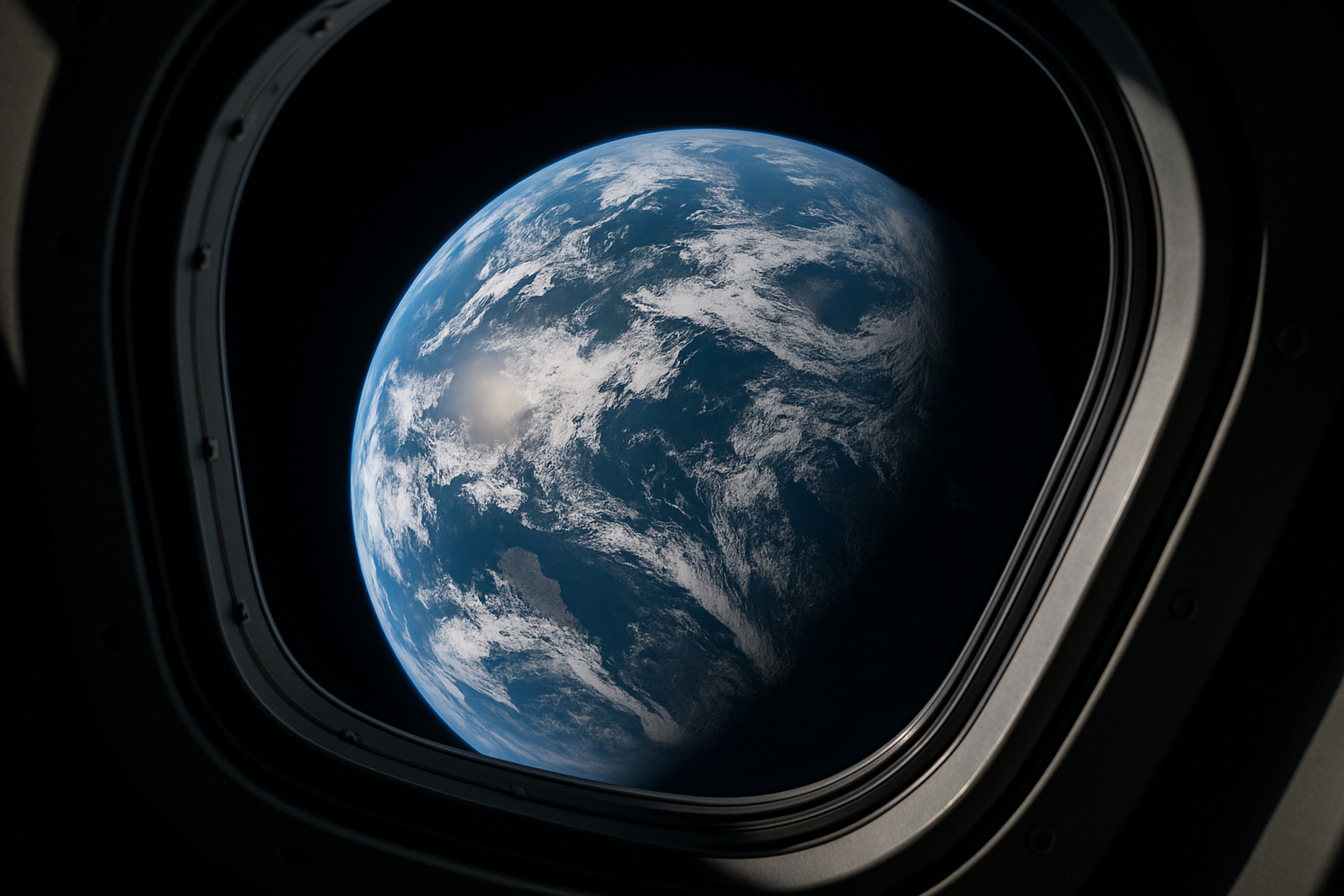
NASA's Artemis II crew has shared the first stunning images of Earth captured during their historic journey toward the Moon, marking humanity's return to deep space exploration after a 54-year gap since Apollo 17.
The breathtaking photographs, released Friday approximately 1½ days into the mission, show our planet in all its brilliant blue beauty as the four-astronaut crew zooms ever closer to their lunar destination. The images represent the first Earth views from a crewed spacecraft traveling beyond Earth's orbit since December 1972.
First Images Capture Earth's Brilliant Beauty
The first photograph, taken by mission commander Reid Wiseman, captures a curved slice of Earth visible through one of the Orion spacecraft's windows. The second image shows the entire globe, with the oceans topped by swirling white tendrils of clouds that create a stunning celestial portrait of our home planet.
"You can see Africa, Europe, and if you look really closely, you can see the aurora. It was a spectacular moment."
— Reid Wiseman, Artemis II Mission Commander
The crew's emotional reaction to these views has been profound. Mission specialist Christina Koch described the experience simply: "Guys, you look great," as she marveled at the impressive vistas of Earth that the four crew members are witnessing on their journey.
Historic Mission Achievements
The Artemis II mission launched successfully on April 1, 2026, at 6:24 PM EDT from Kennedy Space Center, ending the longest gap in human deep space exploration in history. The international crew consists of:
- Jeremy Hansen - Canadian Space Agency (first Canadian beyond Earth orbit)
- Reid Wiseman - NASA Mission Commander
- Christina Koch - NASA Mission Specialist
- Victor Glover - NASA Mission Specialist
Following the successful launch, the crew completed a critical translunar injection burn approximately 25 hours into the mission, officially departing Earth's orbit for their 10-day, 685,000-mile lunar flyby. NASA Flight Director Jeff Radigan described the 5-minute 49-second engine burn as "perfect," with all crew members performing excellently.
Technical Challenges Overcome
The mission has already demonstrated the crew's remarkable technical proficiency and problem-solving capabilities. During their first day in orbit, the astronauts successfully resolved multiple technical challenges without affecting the mission timeline:
- Communication system failures were quickly restored
- Thermal sensor malfunctions were repaired
- Spacecraft toilet system issues were resolved
According to NASA announcements, the Orion toilet system was "successfully fixed," representing a significant advancement over Apollo-era spacecraft in terms of crew comfort and mission sustainability for extended deep space operations.
"We can't seem to get away from the windows. We are on our way to the Moon."
— Artemis II Crew Statement
International Cooperation Milestone
Jeremy Hansen's participation marks a historic milestone as the first Canadian to travel beyond Earth's orbit, validating the Artemis Accords framework for peaceful lunar exploration. This represents the most significant Canadian human spaceflight contribution since the Space Shuttle era.
The mission also carries Argentina's Atenea radiation study device, which is collecting valuable data on deep space radiation effects - crucial information for future lunar bases and Mars expeditions. Jenni Gibbons, a Calgary-born astronaut, serves as the Earth voice link and backup communications specialist for the mission.
Scientific and Strategic Significance
As of midday Friday, the Artemis II spacecraft was approximately halfway to its lunar destination, with the crew scheduled to arrive near the Moon on Monday. The mission will take the astronauts approximately 4,000 miles beyond the Moon's far side - farther from Earth than any humans have traveled since the Apollo era.
This historic journey serves multiple critical purposes:
- Deep Space Systems Validation - Testing life support, radiation protection, and navigation systems beyond Earth's magnetic field
- Crew Training - Providing invaluable experience for future lunar landing missions
- International Partnership Demonstration - Proving the effectiveness of global cooperation in space exploration
- Technology Advancement - Validating systems essential for permanent lunar settlements and Mars exploration
Looking Toward the Future
The Artemis II mission represents a crucial stepping stone toward NASA's ambitious goals, including the planned Artemis III lunar landing in 2028 and the establishment of a permanent lunar surface base by 2030 - a $20 billion commitment representing the largest space infrastructure investment in NASA history.
The mission occurs during what experts are calling a "space economy golden age," with the global space economy projected to exceed $1 trillion by 2030. This includes intensifying international competition, with China planning crewed lunar missions by 2030 and commercial space companies like SpaceX preparing for massive expansion.
The success of Artemis II validates critical technologies for humanity's transition to a truly spacefaring civilization. The mission tests systems essential for permanent lunar settlements and Mars exploration, building on space medicine research including French astronaut Sophie Adenot's record eight-month ISS mission, which provided crucial data on lung tissue cultivation and Space-Associated Neuro-Ocular Syndrome (SANS) research.
A New Chapter in Human Space Exploration
As the Artemis II crew continues their historic journey, their stunning images of Earth serve as a powerful reminder of both our planet's beauty and humanity's remarkable capability to explore beyond our home world. The mission marks not just a return to lunar exploration, but the beginning of a new era of sustained human presence in deep space.
The technological achievements, international cooperation, and scientific discoveries of Artemis II are laying the foundation for permanent extraterrestrial settlements and establishing humanity as a multi-planetary species. After more than half a century, we are once again reaching for the Moon - and this time, we're planning to stay.