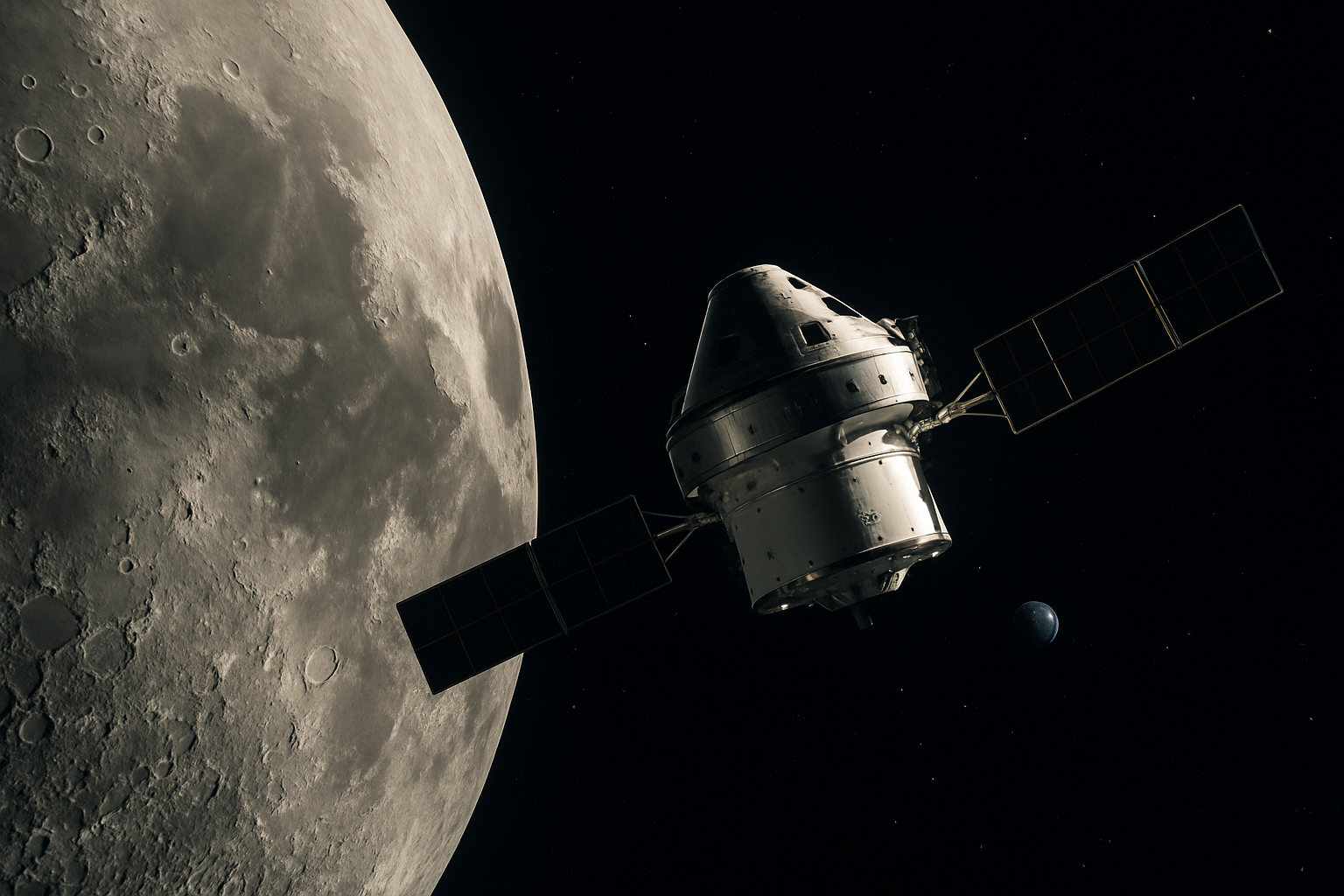
NASA's Artemis II mission has successfully completed humanity's first crewed lunar flyby in over five decades, setting new distance records while intensifying the global race to establish permanent lunar presence as China advances its ambitious 2030 crewed landing timeline.
The historic mission, which concluded with a Pacific splashdown in April 2026, saw four astronauts—Canadian Jeremy Hansen, NASA Commander Reid Wiseman, Christina Koch, and Victor Glover—travel 406,777.8 kilometers from Earth, breaking Apollo 13's 1970 distance record by over 6,600 kilometers. This achievement marks the end of a 54-year gap in human deep space exploration since Apollo 17.
Record-Breaking Achievements and Technical Triumphs
The mission's success represents a watershed moment for space exploration, with the crew experiencing unprecedented achievements including a 40-minute communication blackout during their passage behind the Moon's far side—the deepest human penetration into space since the Apollo era. During this historic blackout, the astronauts were completely isolated from Earth, traveling 4,000 miles beyond the Moon's far side.
"We love you from the Moon,"
— Victor Glover, before the communication blackout
The mission captured the first Earth photographs from a crewed spacecraft beyond Earth orbit since Apollo 17 in December 1972. Commander Reid Wiseman documented stunning "Earthset" images showing Earth dipping below the lunar horizon, providing a cosmic perspective that reinvigorated global public interest in space exploration.
Perhaps most memorably, the mission featured a viral moment when Mission Specialist Christina Koch led repairs of the spacecraft's toilet system after frozen urine clogged the Universal Waste Management System. The incident, which became a social media sensation, demonstrated both the practical realities of space exploration and significant advancement over Apollo-era spacecraft in terms of crew comfort and mission sustainability.
China's Accelerating Lunar Ambitions
While NASA celebrated its Artemis II success, China has been steadily advancing its own lunar program with remarkable achievements. Chinese scientists from the Shanghai Institute of Technical Physics achieved a historic breakthrough using artificial intelligence to determine the Moon's far side chemical composition through Chang'e-6 samples—the first detailed mapping of permanently hidden lunar regions representing nearly half the Moon's surface.
China's systematic approach includes the successful launch of its fourth Shenlong reusable spacecraft and concrete plans for crewed lunar missions by 2030. Unlike the commercial-government hybrid approach of NASA's Artemis program, China's government-led strategy enables long-term strategic planning without market pressures, positioning it as a formidable competitor in the new space race.
Strategic Transformation of Space Exploration
NASA's response to intensifying competition includes a historic $20 billion commitment to establish a permanent lunar surface base by 2030—the largest space infrastructure investment in the agency's history. This strategic pivot involved canceling the Lunar Gateway orbiting project to redirect funds toward surface operations, following a December presidential directive for accelerated lunar presence.
The success of the Space Launch System (SLS) rocket—a 322-foot, 5.75 million-pound behemoth requiring over 700,000 gallons of liquid hydrogen and oxygen—validated NASA's most powerful rocket ever built after resolving persistent technical challenges including helium system failures and hydrogen leaks that caused multiple delays throughout 2026.
"Humanity has demonstrated once again what it is capable of,"
— Jeremy Hansen, first Canadian beyond Earth orbit
International Cooperation and Competition
The Artemis II mission exemplified successful international cooperation, with Jeremy Hansen becoming the first Canadian beyond Earth orbit, validating the Artemis Accords framework for peaceful lunar exploration. Argentina contributed the Atenea radiation study device, while Czech Republic provided ADVACAM radiation monitoring chips, demonstrating the mission's scientific value beyond national boundaries.
However, the space landscape is increasingly multipolar. Pakistan has selected astronaut candidates for China's Tiangong space station missions in October-November 2026, exemplifying space capability democratization. European nations are advancing independent launch capabilities through initiatives like Germany's €10 billion satellite investment and Sweden's Isar Aerospace facilities.
Space Economy Golden Age
The mission occurs during what experts term a "space economy golden age," with the global space economy projected to exceed $1 trillion by 2030. SpaceX is preparing for a potential trillion-dollar IPO in June 2026, representing the commercial space sector's maturation from experimental venture to essential infrastructure.
Commercial space capabilities are advancing alongside government programs, creating an integrated Earth-space technological ecosystem. Space-based data centers are emerging as solutions to Earth's memory crisis, with companies like Blue Origin filing applications for 51,600-satellite constellations supporting orbital computing with continuous solar power and unlimited expansion potential.
Space Medicine and Human Adaptation
The mission builds on crucial space medicine research, including French astronaut Sophie Adenot's record eight-month ISS mission conducting lung tissue cultivation and Space-Associated Neuro-Ocular Syndrome (SANS) research. European research has revealed significant reproduction challenges in microgravity environments, necessitating artificial gravity solutions through rotating habitats for permanent settlements.
These medical advances are critical for sustainable human presence beyond Earth orbit, where traditional Earth-based medical evacuation is impossible. The research directly informs protocols for lunar bases and Mars expeditions, where astronauts may spend years without rescue possibilities.
Nuclear Propulsion and Deep Space Capabilities
NASA has announced the Space Reactor 1 Freedom nuclear spacecraft program for Mars exploration, providing the energy density necessary for interplanetary missions where solar power is insufficient. Nuclear propulsion enables faster transit times, continuous power generation, and reduced radiation exposure—capabilities essential for missions beyond the Moon-Earth system.
This technology positions humanity for sustained deep space operations and multi-planetary expansion, representing a fundamental shift from chemical propulsion limitations to nuclear-powered cosmic civilization infrastructure.
Safety-First Culture and Institutional Learning
The multiple delays that preceded Artemis II's successful launch demonstrated NASA's institutional learning from historical tragedies. The agency's methodical problem-solving approach, prioritizing crew protection over schedule adherence, reflects a mature safety-first culture developed through decades of experience with human spaceflight risks.
This approach, while sometimes criticized for causing delays, proved vindicated through the mission's flawless execution despite complex technical challenges and adverse space weather conditions.
Future Implications for Humanity
The success of Artemis II validates systems essential for permanent lunar settlements and Mars exploration, marking humanity's transition from brief space visits to sustained cosmic expansion capabilities. The mission serves as a stepping stone toward Artemis III's planned 2028 lunar landing and establishes the foundation for permanent extraterrestrial settlements.
As President Donald Trump congratulated the crew, calling them "truly extraordinary," the mission represents more than technological achievement—it symbolizes humanity's renewed commitment to becoming a spacefaring civilization through advanced technology, international cooperation, and comprehensive space medicine knowledge.
The convergence of commercial innovation, international competition, AI integration, and breakthrough technologies positions space exploration as critical infrastructure rather than experimental endeavor. Success in this new space race will determine humanity's trajectory toward permanent settlements among the stars, with both the United States and China investing billions in the infrastructure necessary for multi-planetary civilization development.
As the crew returned to Earth after their historic 685,000-mile journey, they brought back more than scientific data and stunning photographs—they carried proof that humanity's cosmic future is no longer a distant dream, but an achievable reality demanding immediate action and sustained commitment from spacefaring nations worldwide.