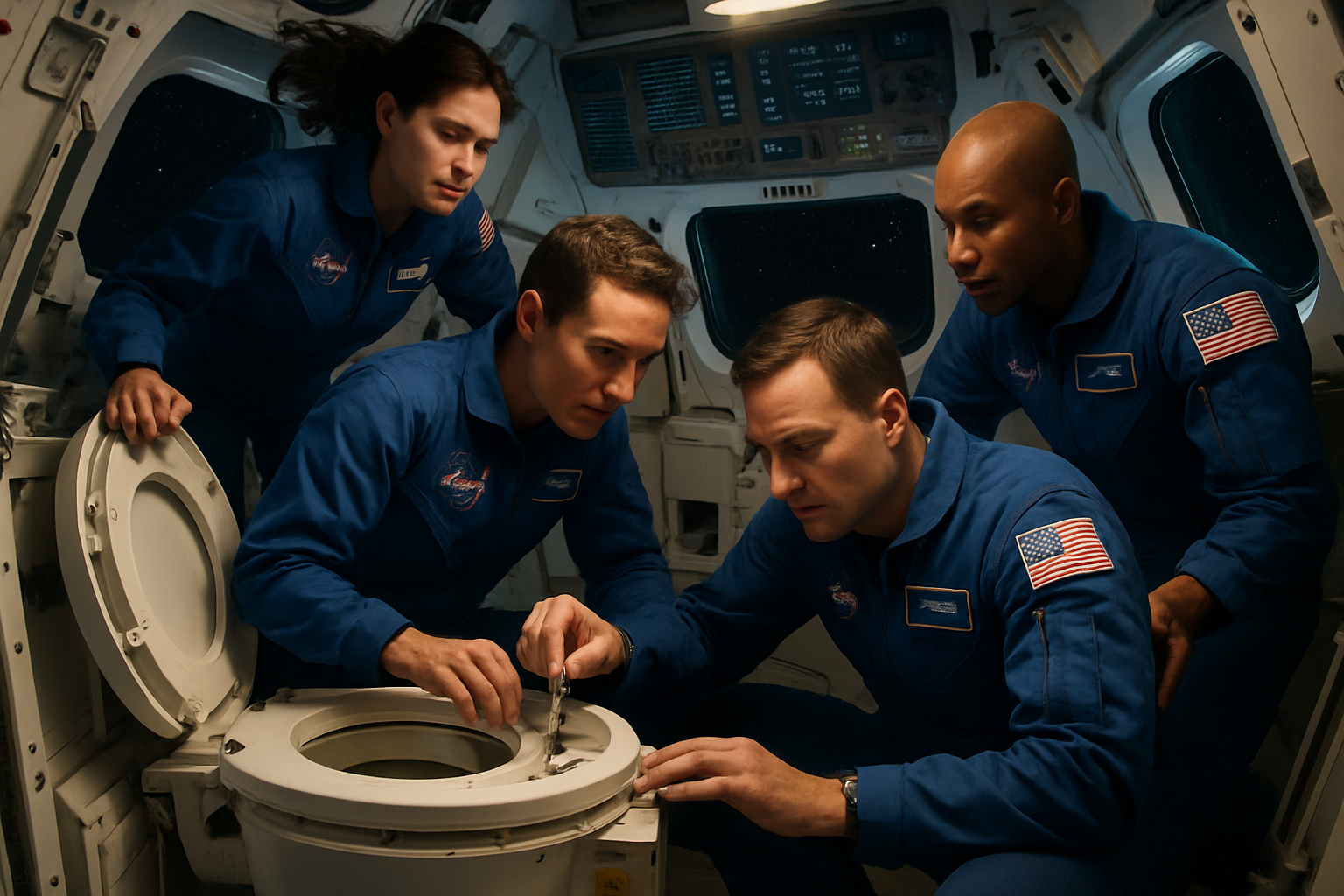
NASA's Artemis II crew has successfully resolved toilet system malfunctions aboard the Orion spacecraft during their historic journey to the Moon, demonstrating remarkable technical proficiency and crew adaptability during humanity's first deep space mission in over five decades.
The toilet malfunction, dubbed the "lunar loo" by mission controllers, occurred shortly after the spacecraft's successful departure from Earth orbit on April 1, 2026. The four-astronaut international crew—Canadian Jeremy Hansen, NASA Commander Reid Wiseman, Christina Koch, and Victor Glover—worked together to repair the critical waste management system without affecting the mission timeline.
Swift Resolution of Technical Challenges
According to NASA reports, the toilet system became inoperative following Wednesday's launch and has been experiencing intermittent issues since the crew began their 10-day, 685,000-mile lunar flyby mission. Mission control instructed astronauts to use backup urine collection bags until the primary system could be restored.
Christina Koch took the lead in assisting with the toilet repair, with the incident quickly becoming a viral social media moment that symbolized human ingenuity and adaptability in space exploration. The crew was observed measuring noise levels post-repair to ensure the system was functioning within acceptable parameters.
"The crew demonstrated exceptional problem-solving capabilities during the first orbital day, resolving communication system failures, thermal sensor malfunctions, and spacecraft toilet system repairs without affecting the mission timeline."
— NASA Mission Control
Technical Challenges Overcome
The Artemis II mission has faced multiple technical hurdles since launch, all of which the crew has successfully navigated. Beyond the toilet malfunction, astronauts also addressed communication system failures and thermal sensor malfunctions during their first day in space. Norwegian media reports suggest that frozen urine may have clogged the system, requiring careful troubleshooting in the microgravity environment.
The successful resolution of these issues represents a significant advancement over Apollo-era missions in terms of crew comfort and mission sustainability. The modern toilet system aboard Orion is designed to handle waste management "much more comfortably than Apollo predecessors," according to NASA documentation, making it crucial for extended deep space operations.
Mission Progress and International Cooperation
Despite the technical challenges, the Artemis II mission continues to achieve its primary objectives. The crew successfully completed a perfect translunar injection burn, officially departing Earth's orbit for their lunar trajectory approximately 25 hours after launch. NASA Flight Director Jeff Radigan described the 5-minute 49-second engine burn as "flawless."
Jeremy Hansen's participation as the first Canadian astronaut beyond Earth orbit validates the Artemis Accords framework for peaceful lunar exploration, representing the most significant Canadian human spaceflight contribution since the Space Shuttle era. The mission also carries Argentina's Atenea radiation study device, collecting valuable data on deep space radiation effects.
Advancing Space Technology
The toilet repair incident highlights the evolution of space technology since the Apollo era. Modern spacecraft systems are designed with crew comfort and mission sustainability in mind, recognizing that extended missions beyond Earth's orbit require reliable life support systems, including waste management.
The Orion spacecraft represents a significant technological advancement, incorporating lessons learned from decades of International Space Station operations. The successful resolution of multiple technical challenges during the mission's first day demonstrates the effectiveness of NASA's safety-first approach and comprehensive crew training programs.
Historic Context and Future Implications
The Artemis II mission marks the end of a 54-year gap since Apollo 17's December 1972 lunar mission, representing the longest period without human deep space exploration in history. The crew is positioned to break Apollo 13's distance record, traveling 4,000 miles beyond the Moon's far side during their Monday lunar encounter.
This mission serves as a critical stepping stone toward Artemis III's planned 2028 lunar landing and NASA's ambitious $20 billion commitment to establish a permanent lunar base by 2030. The successful resolution of technical challenges validates the systems essential for sustained human presence beyond Earth's magnetic field protection.
Broader Mission Success
The mission occurs during what experts call a "space economy golden age," with the global space economy projected to exceed $1 trillion by 2030. SpaceX is preparing for a potentially trillion-dollar IPO in June 2026, while China plans crewed lunar missions by 2030, intensifying international space competition.
The crew's rapid resolution of technical issues without timeline impact showcases advancement in human space operations capabilities. Their ability to handle multiple simultaneous challenges—from toilet repairs to communication failures—demonstrates the maturation of space exploration from experimental endeavor to operational capability.
As the Artemis II crew continues their historic journey, their successful management of technical challenges reinforces confidence in humanity's capacity to establish permanent extraterrestrial settlements and develop into a truly spacefaring civilization. The mission represents not just a return to deep space exploration, but a foundation for sustained human cosmic expansion.