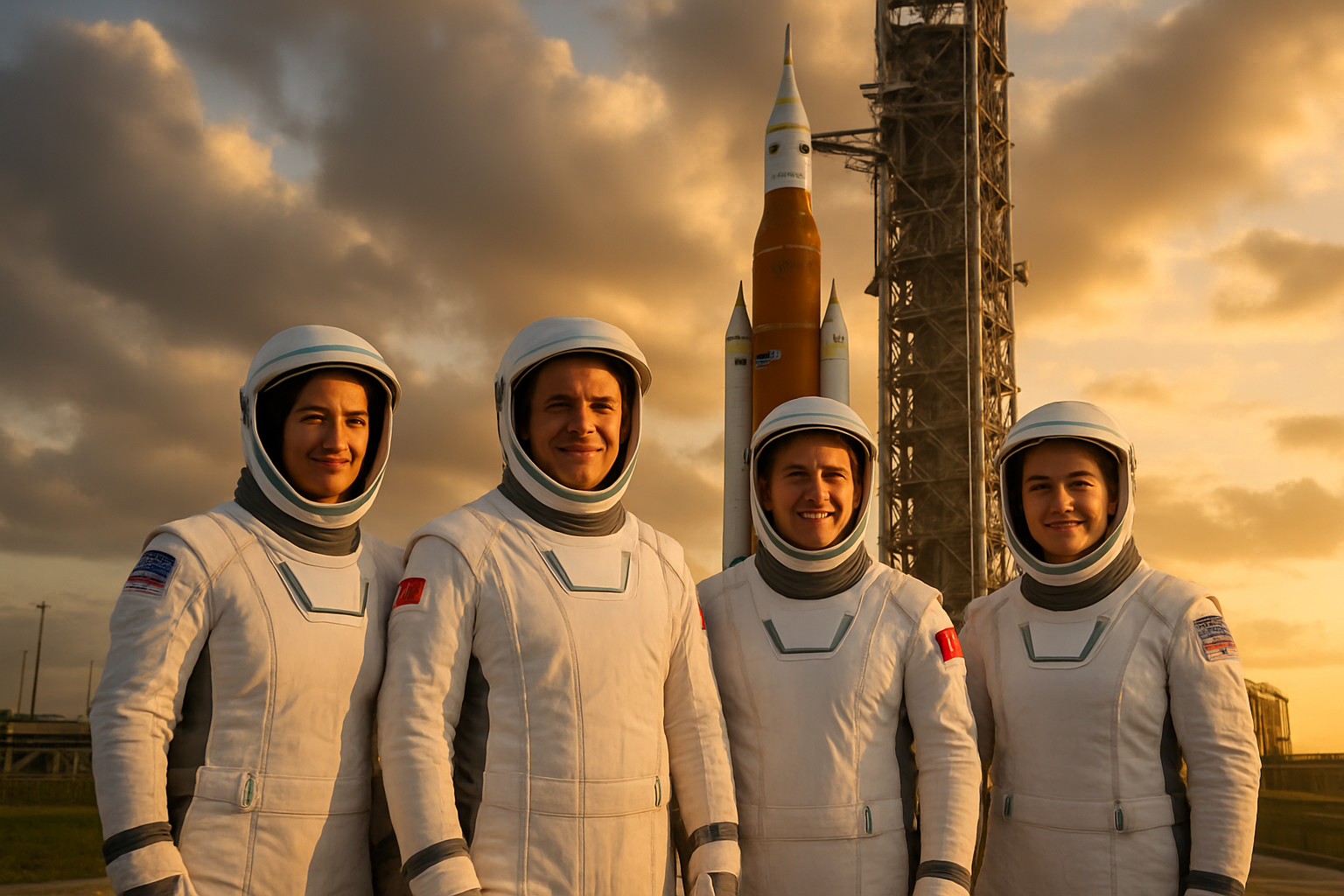
After months of technical delays and engineering challenges, NASA Administrator Jared Isaacman has confirmed that the historic Artemis II mission is targeting April 1, 2026, for launch, marking humanity's first return to deep space in over five decades while international competition for lunar dominance reaches unprecedented levels.
The four-astronaut international crew—Canadian Space Agency's Jeremy Hansen, NASA Commander Reid Wiseman, Mission Specialists Christina Koch, and Victor Glover—arrived at Kennedy Space Center on March 28 to begin final preparations for their 10-day lunar flyby mission. Hansen will become the first Canadian to travel beyond Earth orbit, representing a milestone in international space cooperation that spans 54 years since Apollo 17's final lunar journey in December 1972.
Technical Triumph After Setbacks
NASA engineers have successfully resolved the critical technical issues that plagued the Artemis program throughout early 2026. Persistent hydrogen leak problems during wet dress rehearsal testing and helium system failures affecting the Space Launch System (SLS) rocket's upper stage had pushed the mission through multiple delays from its original February launch window.
The helium system, essential for engine purging and fuel tank pressurization, experienced critical failures during testing phases at T-minus 5 minutes in countdown simulations. Engineers worked methodically to address these challenges while maintaining NASA's institutional commitment to crew safety over schedule adherence.
"We will only launch when we believe we are ready," emphasized Administrator Isaacman, reflecting the agency's safety-first culture developed through institutional learning from historical tragedies.
— Jared Isaacman, NASA Administrator
The SLS rocket represents NASA's most powerful launch vehicle ever built, standing 322 feet tall and weighing 5.75 million pounds when fully fueled with over 700,000 gallons of liquid hydrogen and oxygen. The successful resolution of technical challenges demonstrates the sophisticated engineering required for deep space transportation systems operating beyond Earth's protective magnetic field.
Strategic Pivot in Lunar Exploration
The Artemis II mission occurs amid NASA's most significant strategic restructuring in decades. The agency announced a historic $20 billion commitment to establish a permanent lunar surface base by 2030, canceling the Lunar Gateway orbiting space station project following December presidential directives for accelerated lunar presence.
This strategic pivot redirects resources from orbital operations to surface infrastructure, positioning the United States for sustained lunar habitation rather than temporary visits. Components originally intended for the Gateway station, manufactured by Northrop Grumman and Vantor, will be repurposed for permanent lunar base construction.
The decision reflects mounting international competition, particularly from China's advancing lunar program. Chinese scientists at the Shanghai Institute of Technical Physics recently achieved a breakthrough using artificial intelligence to determine the Moon's far side chemical composition through Chang'e-6 samples—the first detailed mapping of permanently hidden lunar regions representing nearly half the Moon's surface.
International Competition Escalates
The global space race has intensified dramatically during what analysts describe as the transition from an "AI revolution" to a "space economy golden age." China plans crewed lunar missions by 2030, while its fourth Shenlong reusable spacecraft mission demonstrates growing confidence in cost-effective orbital access capabilities.
SpaceX President Gwynne Shotwell declared that humans could return to the Moon before 2030 through the company's strategic shift from Mars colonization to lunar settlement development. This pivot leverages the Moon's advantages: monthly launch windows versus Mars's 26-month cycles, three-day travel times enabling rapid resupply, and real-time communication capabilities.
Pakistan's selection of astronaut candidates for China's Tiangong space station missions in October-November 2026 exemplifies the democratization of space capabilities beyond traditional spacefaring nations. European nations are advancing independent launch capabilities through Germany's €10 billion satellite investments and Sweden's Isar Aerospace facilities testing 30 engines monthly.
Space Medicine and Human Adaptation
Critical research aboard the International Space Station continues informing future lunar missions. French astronaut Sophie Adenot's record eight-month mission has provided invaluable data on long-duration spaceflight effects, including lung tissue cultivation research and Space-Associated Neuro-Ocular Syndrome (SANS) studies affecting astronaut vision during extended missions.
European research published in Communications Biology reveals concerning challenges for permanent space settlements: microgravity seriously disrupts human sperm navigation, making reproduction extremely difficult in space environments. This research highlights the complex biological adaptations required for sustainable human presence beyond Earth.
Romanian and Austrian scientists documented that weightlessness disorients sperm cells, preventing successful navigation toward fertilization targets—a critical concern for permanent lunar colonies. Solutions may require artificial gravity systems through rotating habitats, directly influencing lunar base design requirements and Mars mission planning.
Economic and Strategic Implications
The space economy is projected to exceed $1 trillion by 2030, with SpaceX preparing for a potential June 2026 IPO that could value the company at over $1 trillion. This economic transformation reflects space infrastructure's evolution from experimental technology to essential global capability.
NASA's $20 billion lunar base commitment represents the largest space infrastructure investment in agency history. The permanent lunar presence will enable resource extraction, technology demonstration, scientific research, and Mars exploration training while positioning American leadership in the emerging cosmic economy.
Space-based data centers are emerging as solutions to Earth's memory crisis, with semiconductor prices increasing sixfold. Companies like Blue Origin have filed applications for 51,600-satellite constellations supporting orbital computing facilities that offer unlimited expansion, continuous solar power, and elimination of cooling requirements consuming billions of gallons of water annually in terrestrial facilities.
Nuclear Propulsion and Mars Preparation
NASA's Space Reactor 1 Freedom nuclear spacecraft program represents the next phase of deep space exploration. Nuclear propulsion provides energy density essential for interplanetary missions where solar power is insufficient, enabling faster transit times, continuous power generation, and reduced radiation exposure during extended journeys to Mars.
The lunar base will serve as a crucial testing ground for technologies and procedures required for Mars missions. Research conducted on the Moon's surface will inform life support systems, radiation protection, and in-situ resource utilization techniques essential for sustainable human presence on the Red Planet.
Governance and International Cooperation
Permanent lunar settlement requires new international agreements addressing resource utilization, environmental protection, and peaceful space use. The Artemis Accords provide a framework, but detailed governance protocols are needed for data sharing, emergency response, and sustainable development practices.
Canadian industry faces uncertainty with the Gateway cancellation affecting the Canadarm3 robotic arm developed by MDA Systems in Brampton, Ontario. However, Jeremy Hansen's prominent role in Artemis II demonstrates continued Canadian leadership in international space cooperation, validating the nation's technological capabilities and partnership value.
Historical Significance
The 54-year gap since Apollo 17 represents the longest period without human deep space exploration in the space age. Artemis II marks humanity's renewed commitment to becoming a spacefaring civilization, integrating advanced technology, international cooperation, and space medicine knowledge accumulated during decades of ISS operations.
The mission will test systems essential for permanent lunar settlements and Mars exploration, establishing the foundation for multi-planetary human presence. Success could define the next era of human spaceflight, transforming space exploration from brief visits to sustained expansion beyond Earth.
"This mission represents generational achievement combining the best of our technological capabilities with the power of international cooperation."
— Reid Wiseman, Artemis II Mission Commander
As the Artemis II crew completes final preparations at Kennedy Space Center, their mission carries the hopes and ambitions of a species ready to reclaim its cosmic destiny. The successful launch and completion of this lunar flyby will determine whether humanity can overcome the technical and cooperative challenges required to become a truly spacefaring civilization, setting the stage for permanent settlement of other worlds and the expansion of human presence throughout the solar system.