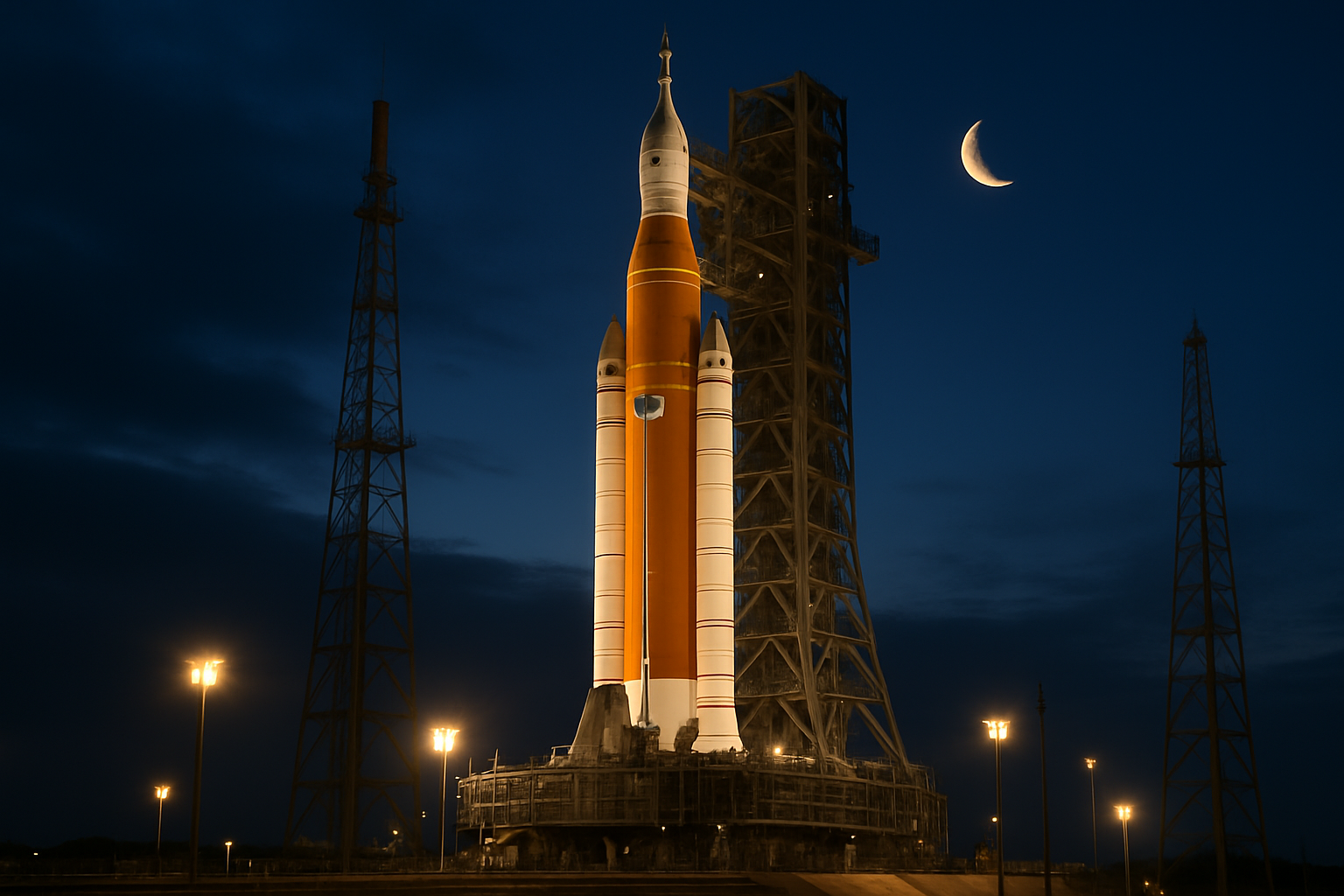
NASA Administrator Jared Isaacman has confirmed the historic Artemis II mission will launch April 1, 2026, sending four astronauts on humanity's first crewed journey beyond Earth orbit since Apollo 17 in December 1972, ending a 54-year gap in deep space exploration.
The mission represents a pivotal moment in space exploration history, as Canadian astronaut Jeremy Hansen, NASA Commander Reid Wiseman, Christina Koch, and Victor Glover prepare for a 10-day lunar flyby covering 600,000 miles aboard the most powerful rocket NASA has ever built.
Technical Breakthrough After Persistent Challenges
The confirmation comes after engineers successfully resolved critical technical issues that caused multiple delays throughout early 2026. The Space Launch System (SLS) rocket experienced persistent hydrogen leak problems and helium system failures affecting the upper stage components essential for engine purging and fuel tank pressurization.
"We will only launch when we believe we are ready," Administrator Isaacman emphasized, reflecting NASA's safety-first approach that prioritizes crew protection over schedule adherence. This methodology demonstrates institutional learning from historical tragedies including Challenger and Columbia disasters.
The SLS rocket stands 322 feet tall, weighs 5.75 million pounds when fully fueled, and requires over 700,000 gallons of liquid hydrogen and oxygen. Technical problems consistently emerged at T-minus 5 minutes during countdown simulations, requiring comprehensive engineering analysis and repairs.
International Cooperation in the Space Economy Golden Age
Jeremy Hansen's participation marks a historic milestone as the first Canadian to venture beyond Earth orbit, validating the Artemis Accords framework for international lunar exploration. His selection represents the culmination of decades of Canadian space expertise, from the original Canadarm through International Space Station robotics systems.
"This mission represents humanity's renewed commitment to becoming a spacefaring civilization through advanced technology and international cooperation."
— NASA Administrator Jared Isaacman
The mission occurs during what analysts describe as a "space economy golden age" transition, with intensifying international competition driving unprecedented innovation. China plans crewed lunar missions by 2030, while Pakistan has selected astronaut candidates for the Chinese Tiangong station missions scheduled for October-November 2026.
Strategic Foundation for Lunar Settlement
Artemis II serves as a crucial stepping stone toward Artemis III's planned 2028 lunar landing, validating deep space life support systems, radiation protection capabilities, and navigation technologies beyond Earth's magnetic field protection. The mission will test systems essential for permanent lunar settlements and Mars exploration foundation.
NASA recently announced a historic $20 billion commitment toward establishing a permanent lunar surface base by 2030, representing the largest space infrastructure investment in the agency's history. This strategic pivot cancels the previously planned Lunar Gateway orbiting station, redirecting resources toward surface operations amid competitive pressure from China's advancing space capabilities.
Commercial Space Revolution Context
The mission unfolds as SpaceX prepares for a potential June 2026 initial public offering with valuations exceeding $1 trillion, reflecting the maturation of commercial space enterprise from experimental ventures to essential infrastructure. The space economy is projected to exceed $1 trillion by 2030, with satellite infrastructure, space-based data centers, and resource extraction creating new economic opportunities.
European nations are advancing space independence through Germany's €10 billion satellite investment and Sweden's Isar Aerospace facilities testing 30 engines monthly. This democratization of space capabilities challenges traditional assumptions about space exploration leadership while fostering innovation through international competition.
Space Medicine Breakthroughs Support Deep Space Missions
Critical research aboard the International Space Station continues informing long-duration spaceflight protocols. French astronaut Sophie Adenot's record eight-month mission has provided invaluable data on lung tissue cultivation in microgravity and Space-Associated Neuro-Ocular Syndrome (SANS), which affects astronaut vision during extended missions.
This medical research directly informs protocols for future lunar bases and Mars expeditions, where astronauts may spend years without the possibility of Earth medical evacuation. The convergence of cryogenic research, space medicine, and international cooperation creates a comprehensive framework for sustainable human presence beyond Earth orbit.
Nuclear-Powered Mars Exploration Initiative
Beyond lunar objectives, NASA has announced the Space Reactor 1 Freedom nuclear spacecraft program for Mars exploration, providing energy density for interplanetary missions where solar power proves insufficient. Nuclear propulsion enables faster transit times, continuous power generation, and reduced radiation exposure during long-duration deep space missions.
These technological advances position the United States as a leader in the emerging space economy while addressing immediate challenges of extended human spaceflight. The integration of nuclear power with advanced life support systems represents a fundamental evolution in space exploration methodology.
Governance and Environmental Considerations
The establishment of permanent lunar settlements requires new international agreements addressing resource utilization, environmental protection, and peaceful space use. While the Artemis Accords provide a framework, permanent settlement necessitates detailed governance protocols for data sharing, emergency response, and sustainable development.
Environmental considerations are emerging as Austrian research has documented atmospheric pollution from rocket debris, including tenfold lithium elevation, emphasizing the need for sustainable space development practices. Space-based data centers could potentially reduce terrestrial environmental impact while providing cleaner computing alternatives.
Historical Significance and Future Trajectory
The 54-year gap since Apollo 17 represents the longest period without human deep space exploration, making Artemis II a generational achievement combining advanced technology, international cooperation, and space medicine knowledge accumulated through decades of ISS operations.
Success will be critical for resource access, scientific discovery, and technological development defining spacefaring capabilities. The mission validates systems for permanent lunar settlements serving as stepping stones to Mars exploration, establishing infrastructure for humanity's expansion beyond Earth.
As the space industry transitions from government-led programs to commercial collaboration models, Artemis II represents a watershed moment determining whether methodical safety approaches can overcome technical hurdles while maintaining the innovation momentum driving the space economy's golden age.
The coming months will prove crucial in determining the trajectory of humanity's cosmic future, as nations invest billions in space infrastructure and prepare for unprecedented expansion of human presence beyond Earth orbit.